Lumen Vietnam Fund

Blog

Vietnam's manufacturing recovery gaining traction: S&P

Vietnam's manufacturing recovery gaining traction: S&P

The S&P Global Vietnam Manufacturing Purchasing Managers' Index posted 51.8 in June, down from 52.8 in May but still above the 50.0 no-change mark, reflecting an improvement in the health of the sector.

Business conditions have now strengthened on a monthly basis throughout the past year, S&P Global stated in a release on July 1.

Andrew Harker, economics director at S&P Global Market Intelligence wrote: "The Vietnamese manufacturing sector ended the first half of 2026 on a positive note, with sustained expansions of new orders and output recorded."

"Encouragingly, anecdotal evidence from the latest PMI survey suggested that growth was more driven by improving customer demand than the efforts to build safety stocks which supported growth in May. Reduced stockpiling efforts potentially reflected a marked easing of inflationary pressures during the month," he added.
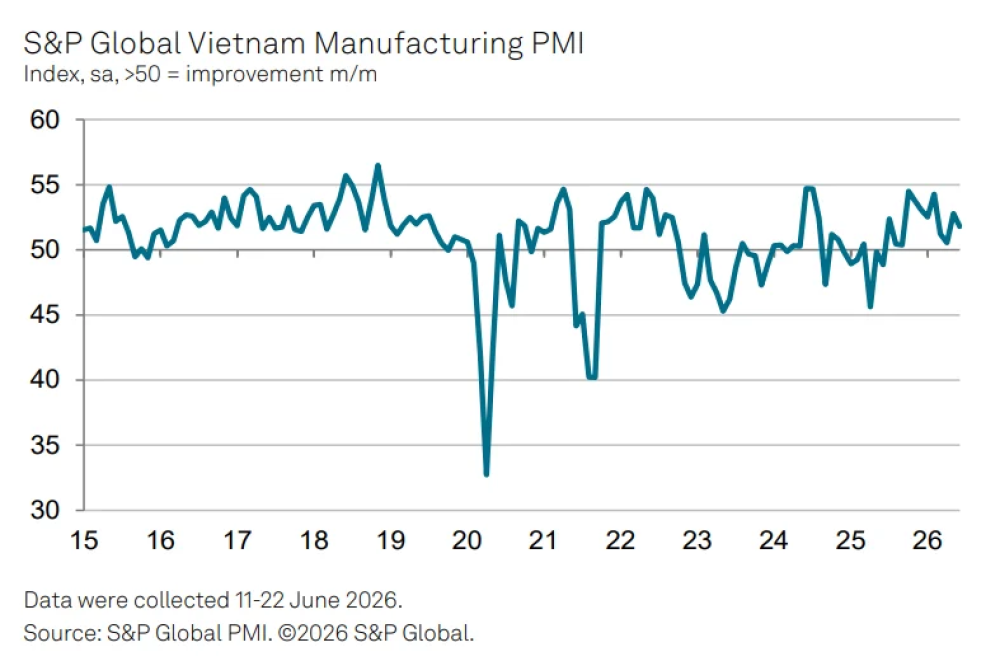
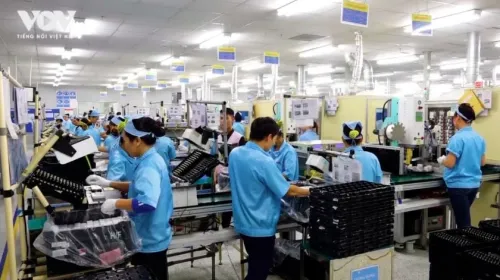
Output rose for the 14th successive month, and at a marked pace that was the fastest since February. Higher new orders and rising output requirements encouraged manufacturers to expand their purchasing activity for the second month running in June.

But continued supply-chain delays meant that stocks of inputs fell sharply. Staffing levels were also down amid ongoing evidence of spare capacity in the sector.

In fact, the fall in stocks of inputs was the most marked for a year. In some cases, inputs had been used to support production growth rather than being held in stock, while challenges importing goods were also mentioned.

Indeed, sourcing inputs in general again proved difficult for firms as suppliers' delivery times lengthened further. The latest deterioration in vendor performance was only modest and the least marked in four months, however.

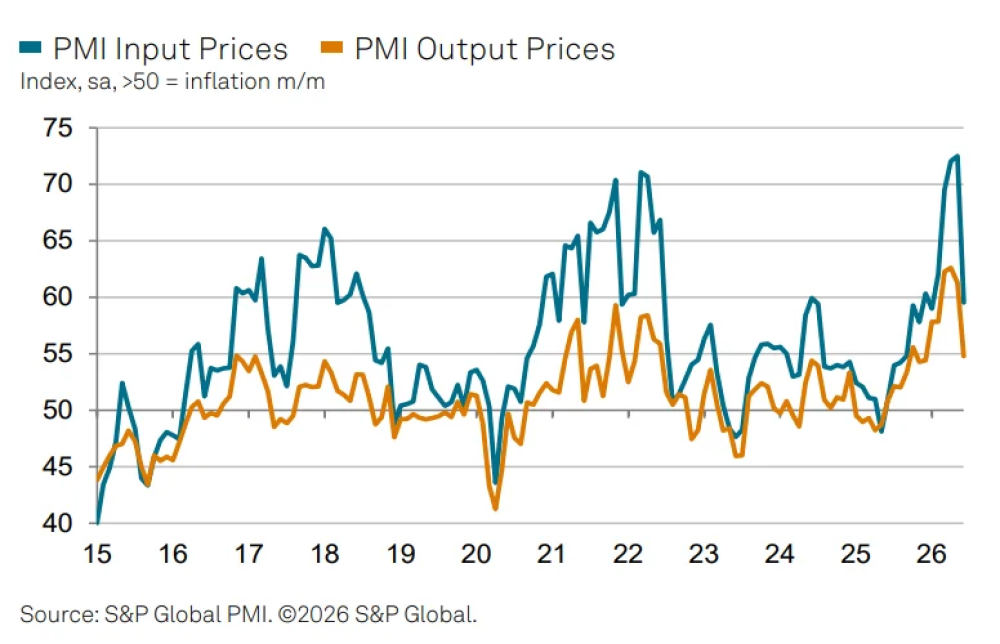
Input costs continued to rise sharply in June, but the rate of inflation was much softer than that seen in May and the lowest since the start of the year. Where input prices increased, panellists linked this to material supply shortages and higher transportation costs. Similarly, the rate of output price inflation also eased in June and was at a six-month low.

Contrasting with the generally positive picture in June, employment continued to decrease, the fourth month running in which this has been the case. Although modest, the latest fall was sharper than that seen in May as a number of firms reported employee resignations.

Despite lower workforce numbers, outstanding business decreased again, and at a solid pace. Manufacturers remained optimistic that output will rise over the coming year, and confidence ticked up to the highest in four months.
Hopes for further increases in new orders, new product development and efforts to expand operations were among the factors supporting optimism. That said, sentiment remained below the level seen prior to the outbreak of war in the Middle East.

"Overall, the sector goes into the second half of the yearon a positive footing, and firms should be well placed toremain in growth territory should we see a more stableinternational environment during the remainder of 2026," said Andrew Harker.

Vietnam's government has set a target of 11.9% economic growth in the second half of 2026 to achieve its goal of expanding GDP by at least 10% for the full year, according to a government resolution issued on June 27.

The target was outlined in Resolution 168, which updates the country's growth scenario and sets out key policy measures for the remainder of the year while maintaining macroeconomic stability.

On April 24, the National Assembly - the country's legislature - set a 2026-2030 agenda targeting at least 10% average annual GDP growth.

Source: Thai Ha
Latest Posts

Vietnam's economy grows 8.39% in Q2, first-half expansion tops 8%

Vietnam's economy grows 8.39% in Q2, first-half expansion tops 8%

VOV.VN - Vietnam's gross domestic product (GDP) expanded an estimated 8.39% year on year in the second quarter of 2026, lifting economic growth in the first half of the year to 8.18%, according to the National Statistics Office (NSO) under the Ministry of Finance on July 2.

The strong performance was driven mainly by industry and construction, which grew 10.51% in the second quarter and accounted for just over half of overall GDP growth. The services sector expanded 7.87%, while agriculture, forestry and fisheries posted growth of 4.06%.

During the first six months of the year, industry and construction grew 9.81%, contributing 47.2% to overall economic growth, while services expanded 8.09%, accounting for 47.14%. Agriculture, forestry and fisheries increased 3.87%, contributing the remaining 5.66%.

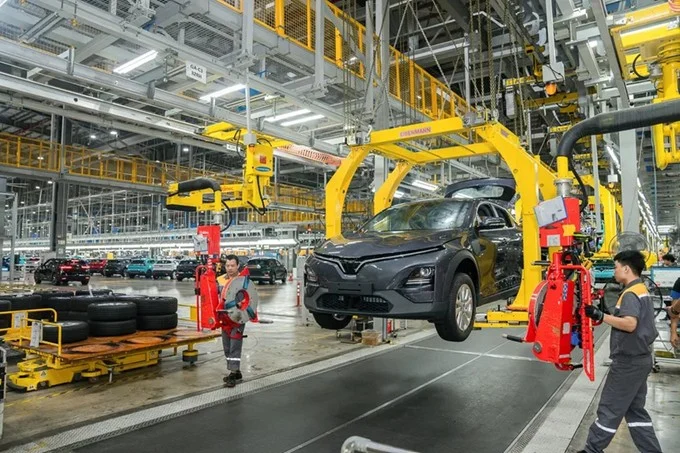
Manufacturing was the economy's main growth engine, with manufacturing and processing rising 10.23% and contributing 33.07% to overall GDP growth.

Industrial output maintained solid momentum, supported by strengthening growth drivers, a recovery in export orders and the spillover effects of public investment. Value added in the industrial sector rose 9.86% year on year in the first six months of 2026, generating 40.35% of the economy's overall value-added growth.

The agriculture, forestry and fisheries sector also recorded steady growth, supported by resilient domestic demand and continued expansion of agricultural export markets. Value added in agriculture increased 3.57% in the first half, contributing 3.83% to overall growth. Forestry expanded 3.98%, making up 0.27%, while fisheries rose 4.88%, accounting for 1.56%.

The services sector also posted robust growth as stronger consumer demand boosted trade, transportation and tourism activity.

According to the NSO, value added in services increased 8.09% year on year in the first half of 2026. Several major service industries continued to post solid gains and remained important contributors to economic growth. Transportation and warehousing expanded 10.18%, or 7.73% of overall growth, while wholesale and retail trade grew 9.67%, representing 13.51%. Accommodation and food services rose 8.05%, contributing 2.73%, and finance, banking and insurance activities increased 7.97%, making up 4.71%.

In terms of GDP composition during the first half of 2026, agriculture, forestry and fisheries accounted for 10.61% of the economy, industry and construction 37.66%, services 43.52%, and taxes less subsidies on products 8.21%.

On the expenditure side, final consumption increased 8.15%, gross capital formation rose 15.20%, exports of goods and services climbed 20.18%, while imports increased 26.44% compared with the same period last year.


Vietnam's agro-forestry-fishery exports reach $35.9 billion in 1H

Vietnam's agro-forestry-fishery exports reach $35.9 billion in 1H

China remained Vietnam's largest individual export market for the products, representing 21.3% of total agro-forestry-fishery exports.

Vietnam's agro-forestry-fishery exports maintained steady growth in the first half of 2026, with total export turnover reaching an estimated $35.88 billion, up 6% from the same period last year, according to the Ministry of Agriculture and Environment.

The sector's export value in June alone was estimated at $6.34 billion, representing a 3% increase from May and a 10.1% rise year-on-year.

Agricultural products remained the largest export category, generating $18.59 billion in the first six months of the year, up 0.2% from a year earlier. Seafood exports reached $5.7 billion, increasing 11.4%, while forestry products earned $9.2 billion, up 4.6%.

Asia continued to be Vietnam's largest export market for agro-forestry-fishery products, accounting for 44.4% of total export value during the period. The Americas ranked second with a 21.4% share, followed by Europe at 14.4%. Africa and Oceania accounted for 2.4% and 1.5%, respectively.

China remained Vietnam's largest individual export market for the products, representing 21.3% of total agro-forestry-fishery exports. The US ranked second with a 19% share, followed by Japan at 6.8%.


Ho Chi Minh City launches eight key projects worth US$9.6 bln

Ho Chi Minh City launches eight key projects worth US$9.6 bln

Ho Chi Minh City on July 1 simultaneously broke ground on eight major infrastructure projects worth more than VND253 trillion (US$9.6 billion) to mark the 50th anniversary of Saigon-Gia Dinh officially being named after President Ho Chi Minh (July 2, 1976–2026).

The projects are the Nha Rong Wharf–Khanh Hoi Cultural Park and Bach Dang Riverside Green Space; the Ho Tram–Long Thanh International Airport Urban Expressway; the Can Gio–Vung Tau Sea-Crossing Route; the Cai Mep Ha General and Container Port (Phase 1); the Binh Tien Bridge and Road project, the Ho Chi Minh City–Moc Bai Expressway (Phase 1), the interchange of the Ben Luc–Long Thanh Expressway and Rung Sac Road; and the interchange of the Ben Luc–Long Thanh Expressway and National Highway 50.

Speaking at the ground-breaking ceremony, Vice Chairman of the municipal People's Committee Hoang Nguyen Dinh described the event as more than the start of major construction works.

It is a pledge in action, demonstrating the city's determination to enter a new stage of development and meet the expectations of the nation, he said.

According to Dinh, the projects will improve regional connectivity, expand urban development space and strengthen the city's competitiveness.

Among them, the Nha Rong Wharf–Khanh Hoi Cultural Park and Bach Dang Riverside Green Space project holds particular historical significance. Covering more than 73 hectares, the site is where President Ho Chi Minh departed in 1911 to seek a path for national salvation.

The area is expected to become a major cultural, historical and tourism destination while improving traffic along the Saigon River.

Dinh urged relevant agencies to accelerate administrative procedures, site clearance and construction material supplies, while calling on investors and contractors to apply modern technologies, ensure construction quality and safety, and prevent losses throughout project implementation.

Dang Minh Truong, chairman of Sun Group, said developing the Nha Rong Wharf–Khanh Hoi project is both an honour and a historic responsibility.

He noted that the company aims to preserve and promote the area's heritage rather than replace it with new landmarks.

Meanwhile, Vingroup Deputy General Director Tran Van Anh, representing the consortium that is developing the Can Gio–Vung Tau Sea-Crossing Route, stressed the company would mobilise its financial, technological and human resources for the project.

She added that the route would significantly shorten travel time between Can Gio and Vung Tau, promoting trade, tourism and the region's marine economy.

According to the municipal People's Committee, the projects are financed through a combination of public investment, public-private partnerships (PPP) and private capital, reflecting the Government's policy of promoting private sector development.

The city expects the projects to unlock new development opportunities following its expanded administrative boundaries, strengthen regional connectivity, boost the marine economy, logistics, tourism and services, and reinforce Ho Chi Minh City's role as Vietnam's leading economic centre.

See all blog