Lumen Vietnam Fund

Blog

Samsung Display ultra-thin glass supplier breaks ground on second plant in northern Vietnam

Samsung Display ultra-thin glass supplier breaks ground on second plant in northern Vietnam

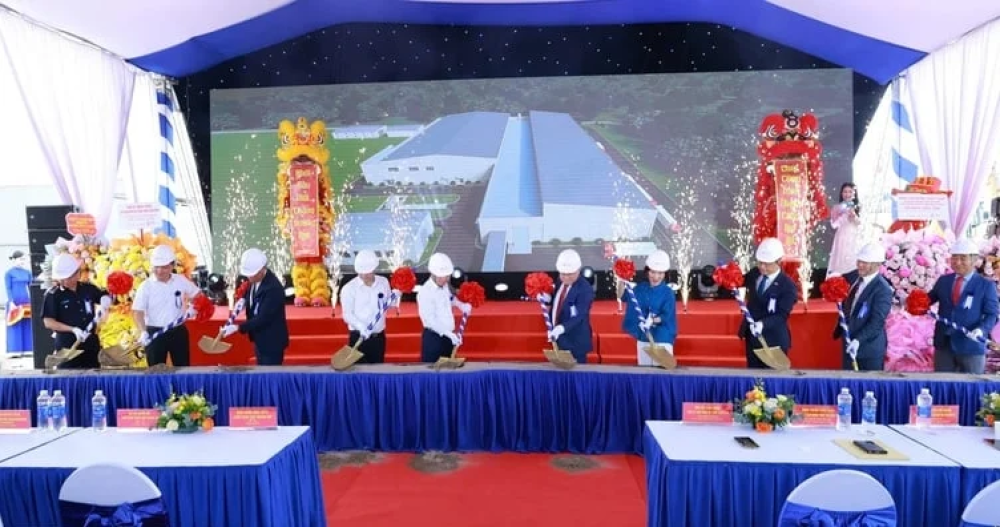
South Korea's Dowooinsys Vina, a subsidiary of NP Group, has begun construction of its second manufacturing plant in Thai Nguyen province, expanding production capacity for ultra-thin glass (UTG) used in Samsung Display's foldable smartphone panels.

The new facility, located in Song Cong II Industrial Park, represents an investment of $130 million and is expected to increase the company's total production capacity in Vietnam to a maximum 3 million UTG units per month once fully equipped.

The groundbreaking ceremony was held on Wednesday, following the commissioning of Dowooinsys Vina's first plant. According to Thai Nguyen authorities, the company's initial investment phase was $120 million, bringing the combined investment for the two phases to $250 million.

Tran Van Hau, Vice Chairman of the Thai Nguyen People's Committee, said the company had disbursed about $90 million by the time construction of the second plant began.

Dowooinsys Vina to boost ultra-thin glass capacity to 3 million units a month

UTG is a key protective material used in foldable display panels. Thai Nguyen authorities said the company currently supplies 100% of its UTG output to Samsung Display, making it part of the South Korean electronics giant's global supply chain.

According to Dowooinsys, the second factory is designed to add production capacity of up to 2 million UTG units per month. Combined with the existing plant's capacity of 1 million units, the company's total monthly output in Thai Nguyen could reach 3 million units after all production equipment is installed.

The new facility will be built on a site covering approximately 25,300 square meters, with nearly 17,600 sqm of floor space. During the first construction phase, the company plans to complete the factory building, clean rooms, utility systems, electrical infrastructure and fire protection systems by January 2027.

Construction costs for the initial phase are estimated at 26 billion won (about $17.3 million). Dowooinsys said the construction will be financed through the Vietnamese subsidiary's existing funds without financial support from its parent company or external borrowing, while production equipment will be installed in line with market demand.

CEO Ok Kyung-seok said the second plant represents a strategic investment to prepare for continued growth in the global UTG market. He said the company would continue expanding into new markets while strengthening research and development to reinforce its leadership position in the industry.

South Korean supplier plays key role in foldable display supply chain

Dowooinsys was established in South Korea on March 25, 2010, and specializes in the research, manufacturing and sale of ultra-thin glass.

According to the company's listing prospectus filed with the Korea Exchange, New Power Plasma was Dowooinsys's largest shareholder, holding approximately 27% before its initial public offering. Following the company's public listing in July 2025, the stake declined to 23.1%. A disclosure dated April 3, 2026 showed New Power Plasma's ownership had increased to 27.1%.

On its website, Dowooinsys said it began mass production of UTG in 2019. The technology was first commercialized in Samsung's Galaxy Z Flip, the foldable smartphone launched in February 2020.

UTG remains the company's flagship product for foldable smartphones, while development is underway for larger information technology devices, including tablets and laptops.

Dowooinsys Vina's investment project in Vietnam was originally licensed in 2022 with registered capital of $30 million, covering about 45,000 sqm and designed to produce 900,000 units annually.

Thai Nguyen authorities now state that the first investment phase totals $120 million, although publicly available information does not specify when or how the registered capital was revised from the initial amount.

In 2025, Dowooinsys Vina generated revenue of more than $62 million and employed 672 workers, including 650 Vietnamese employees.

At the groundbreaking ceremony, Thai Nguyen's Vice Chairman Tran Van Hau called on the company to expand recruitment and training of local workers and strengthen cooperation with businesses in the province to gradually increase the localization rate.

Source: Quang Minh, Nguyen Quang

Photo: Photo courtesy of Dien May Xanh
Latest Posts

UOB raises Vietnam's 2026 GDP Growth forecast to 8.5%

UOB raises Vietnam's 2026 GDP Growth forecast to 8.5%

The country's first-half GDP growth reaching 8.18%.

Vietnam's economy accelerated in the second quarter of 2026, prompting Singapore-based UOB Bank to upgrade its full-year GDP growth forecast to 8.5% from 7.0%, citing stronger-than-expected economic performance and robust demand for artificial intelligence (AI).

According to UOB's latest report on Vietnam's economic growth in the first half of 2026, the country's GDP expanded 8.39% year-on-year in the second quarter, up from 7.94% in the first quarter. This lifted first-half GDP growth to 8.18%.

The result significantly exceeded UOB's previous expectations despite prolonged geopolitical tensions in the Middle East and elevated energy prices, reflecting broad-based expansion across the industrial, construction, services and agricultural sectors.

Manufacturing remained the primary driver of growth in the second quarter, supported by surging global demand for AI-related products. Citing data from Vietnam's National Statistics Office, UOB said industrial production rose 10.8% in the first six months of the year, compared with 8.7% in the same period of 2025. Manufacturing and processing output increased 11.4%, making the largest contribution to overall industrial growth.

The bank also noted that global supply chain diversification continued despite geopolitical uncertainty and rising energy costs. Registered foreign direct investment (FDI) reached nearly $34.7 billion in the first half of 2026, up 61% from $21.5 billion a year earlier.

According to UOB, the strong growth in registered FDI points to a healthy pipeline of future disbursements and reinforces expectations that 2026 could become Vietnam's record year for attracting foreign investment.

UOB said Vietnam remains the fastest-growing economy in ASEAN, with regional peers posting growth of between 2.8% and 6.0% in the first quarter and likely recording slower expansion in the second quarter. Supported by stronger-than-expected first-half growth, sustained AI momentum and easing energy prices, the bank raised its 2026 GDP forecast to 8.5%.


Beyond FDI, Vietnam leverages foreign resources to build up domestic capacity

Beyond FDI, Vietnam leverages foreign resources to build up domestic capacity

Nearly 40 years after opening its economy to tap international resources for national development, Vietnam is shifting its focus from simply attracting more foreign investment to using it more effectively to strengthen domestic capacity, the central message of the Politburo’s Resolution No. 10-NQ/TW.

The adoption of the Foreign Investment Law in 1987 ushered in a new development vision for Vietnam. Moving away from a largely closed economy, the country embraced integration into the world as part of the Doi Moi (Renewal) process. The immediate priorities were to break the blockade and embargo, and attract capital, technology and management expertise to gradually revive the economy and put it on a path toward dynamic growth.

The past four decades have validated that decision. Vietnam has transformed from a capital-starved economy dependent on external assistance into one of the world’s most open economies, deeply connected to regional and global markets. Foreign trade turnover now exceeds 180% of GDP, and the foreign-invested sector contributes around 75% of the total. Tens of thousands of investment projects have fuelled growth, accelerated industrialisation, generated employment, expanded export markets, and brought in advanced technology and modern management practices.

At the same time, those achievements have highlighted a new challenge: how to turn external resources into stronger domestic capacity, greater technological capability, improved competitiveness and a more self-reliant economy.

This shift reflects not only demands in reality but also an evolution in Vietnam’s development thinking. As national objectives change, development policies must change with them.

With that in mind, the Politburo issued Resolution No. 10-NQ/TW on developing the foreign-invested economic sector. Instead of concentrating mainly on attracting foreign capital, the resolution emphasises building a foreign-invested sector that is closely integrated with the domestic sector to create new growth drivers for the country.

While foreign investment was once regarded primarily as a supplementary source of capital, the foreign-invested sector is now recognised as an organic component of the Vietnamese economy, developing alongside the state, private and cooperative sectors in support of national development. This marks not only a broader policy framework but also a fundamental change in how the FDI sector is viewed in the country’s new stage of development.

That thinking is embodied in six major shifts set out in Resolution No. 10-NQ/TW: from attracting foreign investment to developing the foreign-invested sector; from prioritising capital volume to prioritising quality, efficiency and value added; from input-based incentives to performance-based incentives; from developing isolated FDI projects to forming a comprehensive ecosystem for international capital flows; from managing investment to creating a favourable environment for investment and development; and from competition in investment attraction among localities to nationally coordinated development.

Together, these six shifts pursue a single goal: transforming the foreign-invested sector into a force that strengthens national capacity and competitiveness rather than merely adding more capital to the economy.

The resolution sets targets for 2030 and a vision for 2045, placing less emphasis on the sheer scale of FDI inflows.

Vietnam aims to attract US$200–300 billion in registered FDI by 2030, including US$150–200 billion in disbursed capital. More significantly, 75% of newly registered capital is expected to come from developed economies with strengths in advanced technology and modern governance. Localisation rates in key industries are targeted at 45–50% while around 10,000 Vietnamese firms are expected to join the supply chains of foreign-invested enterprises. The country also aims to upgrade its stock market to emerging-market status before 2030.

These targets indicate that success will no longer be measured simply by the number of projects or the amount of capital attracted. Instead, it will be assessed by the extent of technology transfer, the rise of Vietnamese businesses within global value chains, and the share of value added retained in the domestic economy.

Experience has shown that chasing project numbers alone can trigger competition based on incentives, land and low costs while placing pressure on the environment. Domestic firms have often remained outside higher-value segments, technology transfer has been limited, and localisation rates have stayed below the level needed for sustainable development.

That is why Party General Secretary and State President To Lam emphasised that the spirit of Resolution No. 10-NQ/TW is clear: foreign investment is intended not to replace domestic strength, but to reinforce it and enhance self-reliance; not merely to deliver fast growth, but to achieve sustainable, inclusive and high-quality development.

As Vietnam enters a new stage of development with a renewed mindset, it is determined not to pursue investment at all costs. Instead, the country will proactively select and work closely with high-quality investors that are committed to long-term operations, comply with the law, respect the legitimate interests of workers, communities and the nation, share technology, develop human resources, support Vietnamese enterprises and help elevate Vietnam’s position in global value chains.


ADB keeps Vietnam’s growth forecast unchanged, highest in Southeast Asia

ADB keeps Vietnam’s growth forecast unchanged, highest in Southeast Asia

Vietnam's GDP growth projection remains unchanged at 7.2 percent in 2026 amid global energy crisis.

The Asian Development Bank (ADB) has maintained its growth forecast for Vietnam, projecting that the country will remain the fastest-growing economy in Southeast Asia, with GDP growth of 7.2 percent in 2026 and 7.0 percent in 2027, the Government News quoted the bank’s Asian Development Outlook (ADO) July 2026 report as reporting on July 9.

Vietnam's positive outlook is underpinned by sustained growth in the manufacturing sector, resilient exports and investment, and steady domestic demand.

Vietnam's growth projections are among the highest in developing Asia and the Pacific, where economic growth is forecast at 4.9 percent in 2026, down from the ADB's 5.1 percent forecast in April due to the downside risks stem primarily from prolonged disruptions in energy market caused by the conflict in the Middle East.

For 2027, ADB raised its regional growth forecast to 5.1 percent, up from 4.8 percent in its late-April update and matching its April projection.

The ADB warned of significant downside risks to the regional growth outlook, including a renewed escalation of geopolitical conflicts, prolonged uncertainty in energy markets, tighter global financial conditions, a re-pricing of AI-related stocks, and a deeper property market downturn in China.

Regional inflation is projected to accelerate to 4.6 percent in 2026, compared with the ADB's 3.6 percent forecast in April, though lower than the 5.2 percent projection in the late-April update. Inflation is expected to ease to 3.4 percent in 2027.


See all blog