Lumen Vietnam Fund

Blog

Manufacturing remains key driver of Vietnam’s economic growth in H1: NSO

Manufacturing remains key driver of Vietnam’s economic growth in H1: NSO

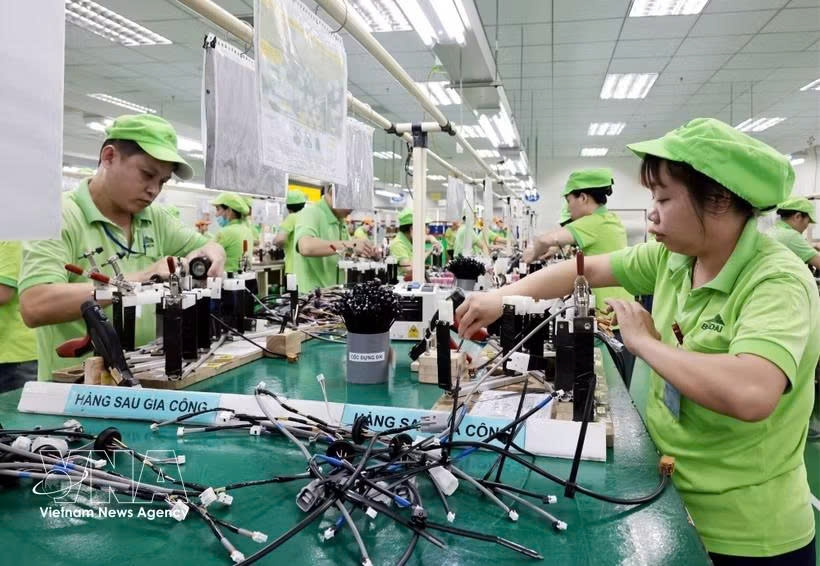
Vietnam's industrial production maintained strong momentum in the second quarter and the first six months of 2026, with the Index of Industrial Production (IIP) posting its fastest first-half growth since 2019, according to the National Statistics Office (GSO) under the Ministry of Finance.

The robust performance reflects the manufacturing sector’s steady recovery and reaffirms its role as the economy’s main growth engine.

The NSO reported that the IIP in the second quarter rose an estimated 11.2% year-on-year, driven by manufacturing (up 11.3%), electricity production and distribution (12.4%), water supply and waste management (10.3%), and mining (7%).

For the first six months, the index increased 10.8% from a year earlier, surpassing the 8.7% growth recorded in the same period of 2025 and marking the highest first-half expansion since 2019.

This indicates that industrial production is recovering broadly, supported by stronger domestic consumption, exports and investment, said NSO Director Nguyen Thi Huong.

Manufacturing remained the largest contributor, expanding 11.4% and contributing 8.9 percentage points to the overall industrial growth.

Electricity production and distribution rose 9.6%, while mining increased 5.8%, reversing its decline in the same period last year.

Many manufacturing subsectors posted outstanding growth, including basic metals (21.5%), motor vehicles (17.7%), beverages (15.4%), other transport equipment (15%), non-metallic mineral products (14.9%), chemicals (14.8%), and fabricated metal products (13.9%).

Some others recorded weaker growth or contraction, however. Leather and related products rose only 4%, while hard coal and lignite mining fell 5.7%, highlighting uneven performance across industries despite the broader recovery.

Industrial production increased across all 34 provinces and cities, with strong growth in manufacturing and electricity generation driving local performance. Manufacturing output surged in Quang Ninh (37.8%), Ha Tinh (30.7%), Ninh Binh (27.7%), Phu Tho (25.8%), and Nghe An (25%).

Electricity production recorded notable increases in Ha Tinh (48.3%), Phu Tho (18.3%), and Dien Bien (15.6%), reflecting the broadening momentum of industrial growth nationwide.

Output of major industrial products also recorded strong growth, including motorcycles (32.9%), automobiles (26.9%), rolled steel (23.3%), processed seafood (21.6%), refined sugar (16.8%), beer (14.4%), chemical paints (14%), and crude oil (13.1%). Production of NPK fertiliser, monosodium glutamate, clean coal and leather footwear declined.

Meanwhile, market demand also continued to improve. The manufacturing consumption index rose 10.8% in the first half, exceeding the growth recorded a year earlier, while the average inventory ratio fell to 82.2%, down from 85.7% in the same period last year, indicating stronger sales and faster production turnover.

The labour market also showed positive signs, with employment at industrial enterprises increasing 3.1% year-on-year, including a 3.2% rise in manufacturing, reflecting business confidence in further production expansion.

The strongest first-half industrial growth since 2019 not only underscores the sector's solid recovery but also provides a firm foundation for Vietnam to sustain robust economic growth throughout 2026. With manufacturing continuing to lead, supported by improving demand, employment and production capacity, industry is expected to remain a key pillar of economic expansion.


Source: VNA

Photo: VNA
Latest Posts

Việt Nam's H1 foreign investment inflows jump 61%, led by Asian investors

Việt Nam's H1 foreign investment inflows jump 61%, led by Asian investors

Realised foreign investment, a measure of capital actually disbursed into the economy, rose 11.2 per cent from a year earlier to an estimated $13.03 billion, the highest level for the first half of a year in the past five years, according to the NSO.

HÀ NỘI — Foreign investment commitments to Việt Nam reached US$34.65 billion in the first half of 2026, up 61 per cent from a year earlier, driven by strong inflows into manufacturing and continued investment from Asian economies, official data shows.

Data released by the National Statistics Office (NSO) shows newly registered investment hit $17.39 billion across 2,013 projects from January to June, up 1.3 per cent in the number of projects and 87.2 per cent in registered capital from a year earlier.

Singapore was the largest source of fresh investment with more than $7.3 billion, followed by South Korea, Japan and mainland China. Together, the four Asian economies accounted for the majority of foreign investment commitments in the first six months of the year.

At the same time, foreign investors added $11.04 billion to 541 existing projects, representing a 24 per cent rise year-on-year.

They also contributed $6.22 billion through capital contributions and share acquisitions, an increase of nearly 90 per cent from a year earlier, reflecting continued expansion by existing investors alongside new investment.

Manufacturing and processing remained the biggest recipient of foreign capital, attracting $17.91 billion or 63 per cent of total newly registered and additional investment, reinforcing Việt Nam's position as a regional manufacturing and export hub. It was followed by real estate with $5.1 billion, or 17.9 per cent.

Realised foreign investment, a measure of capital actually disbursed into the economy, rose 11.2 per cent from a year earlier to an estimated $13.03 billion, the highest level for the first half of any year in the past five years, according to the NSO.

Manufacturing accounted for $10.76 billion, or 82.6 per cent, of disbursed investment. Real estate attracted $965.2 million, representing 7.4 per cent of the total, while electricity, gas, hot water, steam and air conditioning supply projects received $479.2 million, or 3.7 per cent.

The figures point to continued momentum in foreign investment, with both new commitments and project implementation strengthening as multinational companies expand manufacturing operations in Việt Nam.

Under its five-year strategy, Việt Nam aims to draw in up to $300 billion in registered foreign investment, equivalent to more than $50 billion annually, while disbursed capital is expected to reach up to $200 billion, or $40 billion each year.

These goals were set out in the Politburo's Resolution 10-NQ/TW on developing the foreign-invested sector by 2030.

Experts said the targets are closely linked to Việt Nam's broader economic ambitions, with sustained double-digit growth expected to require significant investment. They said foreign investment would remain an increasingly important source of capital to support the country's expansion plans.

Nguyễn Anh Tuấn, chairman of the Việt Nam's Association of Foreign-Invested Enterprises, said the goals were ambitious and would require Việt Nam to consistently attract record levels of both registered investment commitments and realised capital.


HCM City seeks on-time public spending to boost economic growth

HCM City seeks on-time public spending to boost economic growth

HCM City has instructed all agencies and investors to speed up public investment, describing it as a key task to achieve economic growth targets and deliver its 2026 investment plan.

HCM CITY — HCM City has instructed all agencies and investors to speed up public investment, describing it as a key task to achieve economic growth targets and deliver its 2026 investment plan.

Under a directive signed on June 29 by Vice Chairman of its People's Committee, Hoàng Nguyên Dinh, Party secretaries and chairpersons of people's committees at the ward, commune and special zone levels must directly oversee the review of all payment documents and ensure they are promptly submitted for disbursement.

Local authorities have been instructed to resolve issues within their remit rather than pass responsibility elsewhere or delay decisions, with their leaders to be held personally accountable to the city Party Committee and People's Committee for disbursement.

The directive also calls for faster resolution of bottlenecks involving compensation, resettlement, land acquisition, site clearance, investment and construction procedures, tendering, payments and project settlement so that eligible projects can move ahead.

Project investors have been instructed to prepare monthly disbursement schedules for every package, setting out workloads, deadlines and individual responsibilities.

They must also submit payment claims promptly, avoid backlogs, accelerate construction and acceptance procedures and immediately report issues beyond their authority.

The Department of Finance has been tasked with tracking the progress of every agency, unit, and project owner.

Every week, it will identify slow-disbursing units and delayed projects and recommend corrective measures to the city government.

It will also propose transferring capital from projects unlikely to spend their allocated funds to those capable of faster disbursement.

A public infrastructure project in HCM City. — Photo courtesy of laodong.vn

State Treasury Region II has been instructed to deploy additional staff and extend working hours where necessary to process all eligible payment applications without delay.

The Departments of Construction, Agriculture and Environment, Planning and Architecture and Justice are required to expedite administrative procedures to keep projects on schedule.

The Department of Home Affairs will use disbursement performance as one of the criteria for assessing the annual performance of heads of departments, agencies, and local administrations.

The directive comes as disbursement remains well behind schedule.

As of June 22, HCM City had disbursed VNĐ32.8 trillion (US$1.25 billion), or a mere 22.2 per cent of the VNĐ147.6 trillion allocated for 2026.

It still falls far short of the city's second-quarter target of 40-45 per cent and below the national average of 24.2 per cent.

Officials blame this slow progress on the restructuring of the city's project management system and administrative delays during the transition, which have left many works awaiting payment despite completion.

Progress has also been constrained because 2026 is the first year of the 2026-30 medium-term public investment plan, meaning many projects are in the preparatory stage and not ready for payment.

Other factors slowing implementation include delays in site clearance, relocation of infrastructure, lengthy legal procedures, contractual disputes, fluctuating construction material prices and the lack of official pricing for night-time construction.

Of the 46 projects allocated more than VNĐ500 billion each, with a combined investment in excess of VNĐ77.8 trillion, most have recorded low disbursement rates because the bulk of construction work will begin in the second half of the year after investment procedures are completed.

Speaking at a meeting on the city's socio-economic performance earlier last month, the chairman of the city People's Committee, Nguyễn Văn Được, said public investment would be one of the main drivers of the goal of achieving double-digit economic growth in 2026.

He exhorted officials to remove obstacles to site clearance and investment procedures and reallocate capital from slow-moving projects to those capable of making faster progress.

The city is targeting disbursement of 40-45 per cent of its public investment plan by the end of the first half of the year, around 70 per cent by the end of the third quarter, and 100 per cent by year-end.

Performance will also be tied to officials' annual assessments, emulation rankings, and future budget allocations to increase accountability in the public sector.

34 airlines set to operate at Long Thanh International Airport

34 airlines set to operate at Long Thanh International Airport

According to the Airports Corporation of Vietnam, representatives from 34 carriers have already conducted site surveys and held working sessions to prepare for operations at the airport which is expected to open in December 2026.

The Airports Corporation of Vietnam (ACV) has submitted a report to the Goregarding ơn the progress of component project 3 of the Long Thanh International Airport (LTIA) Phase 1, along with the proposed operational strategy for the airport's opening.

According to ACV, instead of relocating all operations from Tan Son Nhat International Airport to Long Thanh, the former will continue to handle the entire domestic flight network and short-to-medium-haul international routes. Meanwhile, Long Thanh will gradually take over suitable international routes to maximize its capacity from the very first stage of operation.

ACV stated that it has proactively collaborated with domestic and international carriers to develop an operational framework for Long Thanh. To date, the majority of airlines have expressed a strong interest in operating at the new hub.

Among domestic carriers, Vietnam Airlines has officially registered to transfer four international routes from Ho Chi Minh City to Long Thanh, including Beijing (Daxing Airport), Hong Kong, Guangzhou (Baiyun Airport), and Manila. Vietjet Air has committed to maintaining at least two international routes at Long Thanh, while Vietravel Airlines plans to begin commercial operations by late 2026 and increase flight frequency starting from the Summer 2027 schedule.

Regarding international airlines, ACV noted that representatives from 34 carriers have already conducted site surveys and held working sessions to prepare for operations at the airport which is expected to open in December 2026.

Parallel to relocating existing routes, ACV collaborated with partners in early June 2026 to promote the opening of 21 new international routes that currently lack direct links to Ho Chi Minh City for the 2025-2030 period. These routes focus on markets including mainland China, Taiwan (China), India, Sri Lanka, Malaysia, Indonesia, Bangladesh, the United States, Thailand, and Europe.

ACV expects these new routes to contribute approximately 2 million passengers annually to Long Thanh by 2030, in addition to the traffic redirected from Tan Son Nhat. The highest growth potential is anticipated from routes connecting North America, Europe, the Middle East, South Asia, Central Asia, and Oceania.


See all blog