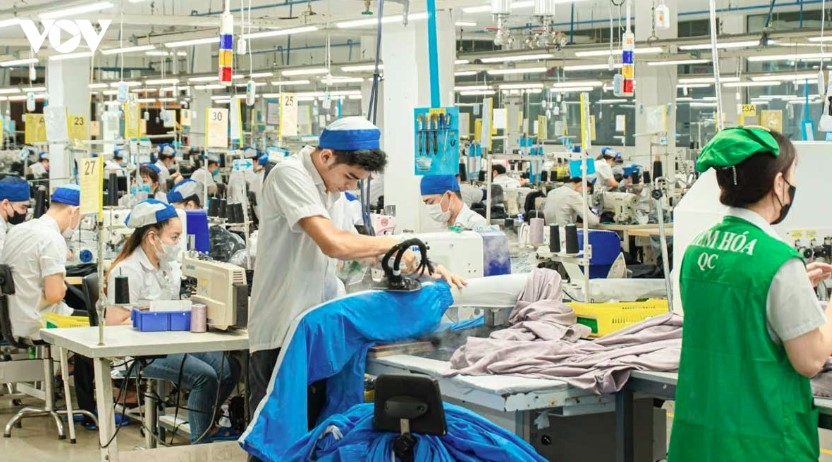
Textile and garment sector targets US$47-47.5 billion export revenue for 2026
Vietnam’s textile and garment industry is targeting full-year export revenues between US$47 billion and US$47.5 billion in 2026 thanks to steady growth momentum and sufficient order volumes through the end of the year.
During the first eight months of the year, the sector generated US$32 billion in export revenue, marking a 3% year-on-year increase, according to the Vietnam Textile and Apparel Association (Vitas).
Preliminary data through September 15 showed total turnover of US$33.66 billion, comprising US$28.4 billion from garments, US$3.37 billion from yarns, and US$1.85 billion from raw materials and accessories.
Vitas Chairman Vu Duc Giang attributed the milestone to the sector's resilience amid global market fluctuations, boosted by three strategic pillars.
First, the industry has comprehensively diversified markets and products, with Vietnamese goods now reaching 137 countries and territories.
The US remains the primary export destination, accounting for roughly 40% of market share, followed by the EU, the Republic of Korea (RoK), Japan, China, ASEAN, and emerging markets in the Middle East and Africa.
Second, companies have accelerated the adoption of technology, automation, and AI in management and production to optimize operational efficiency. Third, enhanced supply chain integration has stepped up stronger cooperation across domestic enterprises.
Apart from diversification and technology, flexibility is seen as a core advantage, with Vitas affirming that domestic producers are fully prepared to handle short-lead, small-batch orders with high quality standards.
With enterprises actively negotiating agreements for early 2027 alongside their current production schedules, the path toward the yearly target is well-supported.
However, Vitas noted that the sector faces numerous challenges, including shifting trade policies and increasingly stringent environmental, labor, and sustainability requirements in major importing markets, thus requiring domestic producers to actively adapt to sustain growth in the time to come.
Source: VOV