Lumen Vietnam Fund

Blog

Vietnamese firms see limited impact from new US tariff

Vietnamese firms see limited impact from new US tariff

The United States' decision to impose a new tariff of 12.5 percent on certain imports from Vietnam is unlikely to have a major immediate impact, largely because many exporters have already reduced their dependence on the U.S. market, according to Vietnamese businesses.

However, industry leaders and analysts caution that the cumulative impact of tariffs and other trade measures should be closely monitored.

Effective July 24, Vietnamese exports to the United States are subject to a new 12.5-percent tariff under Section 301 of the U.S. Trade Act of 1974, representing an increase of 2.5 percentage points from the previous temporary rate.

Tran Thi Khanh Hien, director of research at MB Securities, told Tuoi Tre (Youth) online newspaper that the tariff does not apply to all Vietnamese exports.

A broad range of products, including electronics, machinery, and components, remain exempt.

These categories account for roughly 55 percent of Vietnam's exports to the United States during the first half of 2026, making them the country's largest export segment.

However, several key export industries, including textiles and garments, seafood, wood products, and furniture, are subject to the new tariff.

Hien noted that Vietnamese exporters could face stronger competition as rival manufacturing countries such as Malaysia or Bangladesh receive lower tariff rates.

Even so, she believes the overall outlook for Vietnam's exports remains largely intact.

Vietnam has built a substantial presence in the U.S. market, particularly in the mid-range textile and footwear segments.

Hien said replacing Vietnamese suppliers would not be feasible in the near term.

Should tariffs raise costs, the burden is likely to be shared across the supply chain, including manufacturers, retailers, and American consumers, rather than falling entirely on Vietnamese producers.

Meanwhile, industries that are more easily replaced, such as stone products, steel, and certain furniture items, account for a relatively small share of exports and are therefore unlikely to significantly affect Vietnam's overall export performance.

Manufacturers diversify beyond US

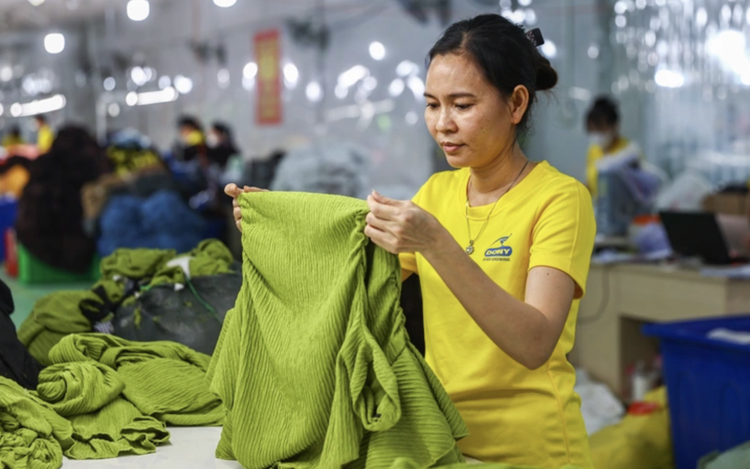
Pham Quang Anh, director of Dony Garment Production Company, said the U.S. market accounted for 60 - 70 percent of the company's production in 2025.

While the large volume of American orders supported stable operations, it also exposed the company to sudden policy shifts involving tariffs, rules of origin, and import requirements.

Rather than continuing to concentrate on expanding sales in the U.S., garment manufacturer Dony began restructuring its market strategy.

Domestic orders, which represented just over 10 percent of revenue in 2025, have increased to more than 25 percent during the first half of this year.

The company has also expanded into Cambodia, Laos, and other Southeast Asian markets.

Following several rounds of restructuring, exports to the United States now account for less than 40 percent of Dony's business.

Anh emphasized that entering new markets involves far more than selling existing products elsewhere.

The company has established new customer relationships while adapting product designs, materials, quality standards, and delivery methods.

"We cannot wait for policies to stabilize before taking action," he said.

The company has maintained stable production by focusing on uniforms, customized products, and higher-value orders.

It has also accelerated automation, increased operational specialization, and renegotiated input costs.

Its revenue rose by some six percent during the first half of the year.

Although profit margins have yet to improve significantly, the company's more diversified customer base has strengthened its resilience.
Steel industry sees limited direct effect

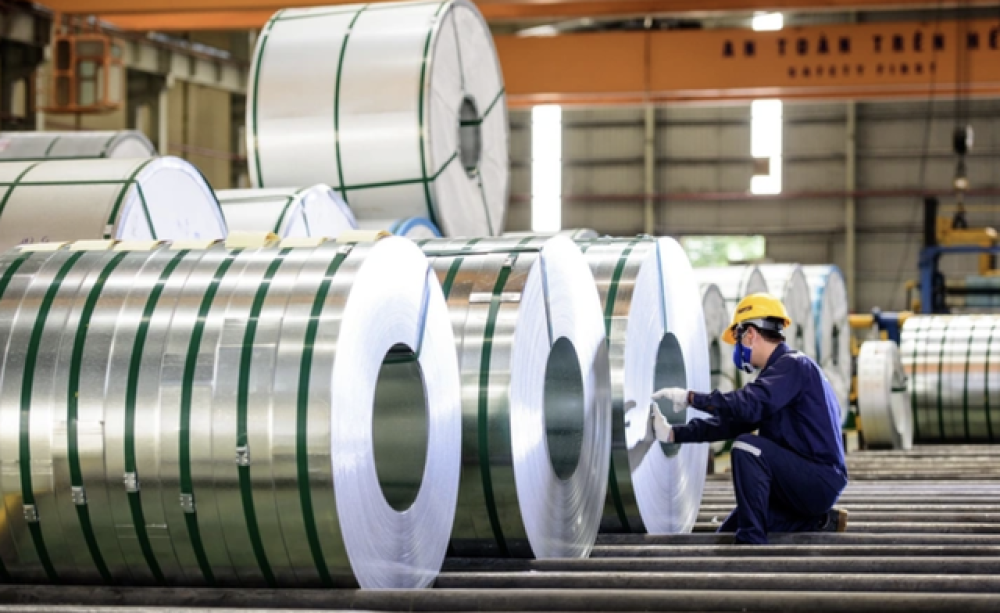
Executives in Vietnam's steel industry expressed little concern over the new U.S. tariff.

“The steel sector is not significantly affected,” a senior executive at one of Vietnam's largest steel companies said, noting that many producers sharply reduced exports to the U.S. roughly two years ago.

Vietnamese steel has long faced multiple trade barriers in the American market, including import tariffs, anti-dumping investigations, countervailing duty cases, and anti-circumvention measures.

The United States had previously imposed a 25-percent tariff on imported steel under Section 232 before later raising it to 50 percent.

Hoa Sen Group stopped exporting coated steel products to the United States in September 2024 and has since expanded sales to more than 90 countries and territories while strengthening its domestic business.

The industry executive warned against assuming that the additional 2.5 percentage-point increase marks the end of U.S. trade restrictions.

Washington could tighten rules of origin, initiate product-specific investigations, or scrutinize raw material sourcing more aggressively.

The steel industry may also experience indirect effects.

If export-oriented sectors such as textiles and wood products receive fewer orders, demand for factories, transportation services, machinery, and industrial materials could weaken.

Meanwhile, exports from countries facing barriers in the U.S. market may be redirected to Southeast Asia, intensifying price competition in Vietnam.

Industries with heavy reliance on the U.S. market including wood products, electronics, textiles, and footwear are expected to face the greatest adjustment challenges.

Despite the challenges, many businesses see the evolving trade environment as an opportunity to diversify export markets and reduce dependence on a single destination.

Vietnamese companies continue to regard the United States as a critical market, but its recent policy uncertainty has prompted them to broaden revenue sources and strengthen long-term growth.

Hien said exporters will also face increasing pressure from overseas buyers to comply with stricter international standards.

Over time, these requirements are expected to improve labor conditions, employee welfare, corporate governance, and Vietnam's overall business environment.

She said that the tariff policy pursued by Washington should be viewed primarily as a negotiating tool aimed at increasing government revenue and reducing the U.S. trade deficit.

High tariff rates are intended to create leverage during trade negotiations rather than represent permanent policy outcomes.

As a result, bilateral negotiations are likely to continue as countries seek more favorable tariff arrangements and trade conditions.

Although the direct impact on exports appears manageable, Hien said that the most significant short-term risk stems from investor sentiment in the stock market.

In periods when financial markets lack supportive information or remain particularly sensitive, tariff-related news can trigger disproportionately negative reactions.

From a longer-term perspective, experts believe increasingly stringent requirements on trade, labor standards, and intellectual property from the United States and other developed economies will encourage Vietnamese companies to strengthen corporate governance, improve product quality, and align operations with international best practices.

Such changes are expected to enhance Vietnam's competitiveness and support deeper integration into global value chains.

Last week, the United States imposed new tariffs of 10 and 12.5 percent on goods from 60 trading partners, including the EU and China, alleging those countries failed to curb imports made by forced labor, just as a temporary 10 percent global tariff expired, Reuters reported.

The move is the White House's first step in efforts to rebuild President Donald Trump's near-global tariff wall after the U.S. Supreme Court in February struck down his ‘reciprocal’ duties of 10 to 50 percent imposed last year under a national emergencies law to try to shrink the U.S. ‌trade deficit.

Source: Tuoi Tre News

Photo: Cong Trieu / Tuoi Tre
Latest Posts

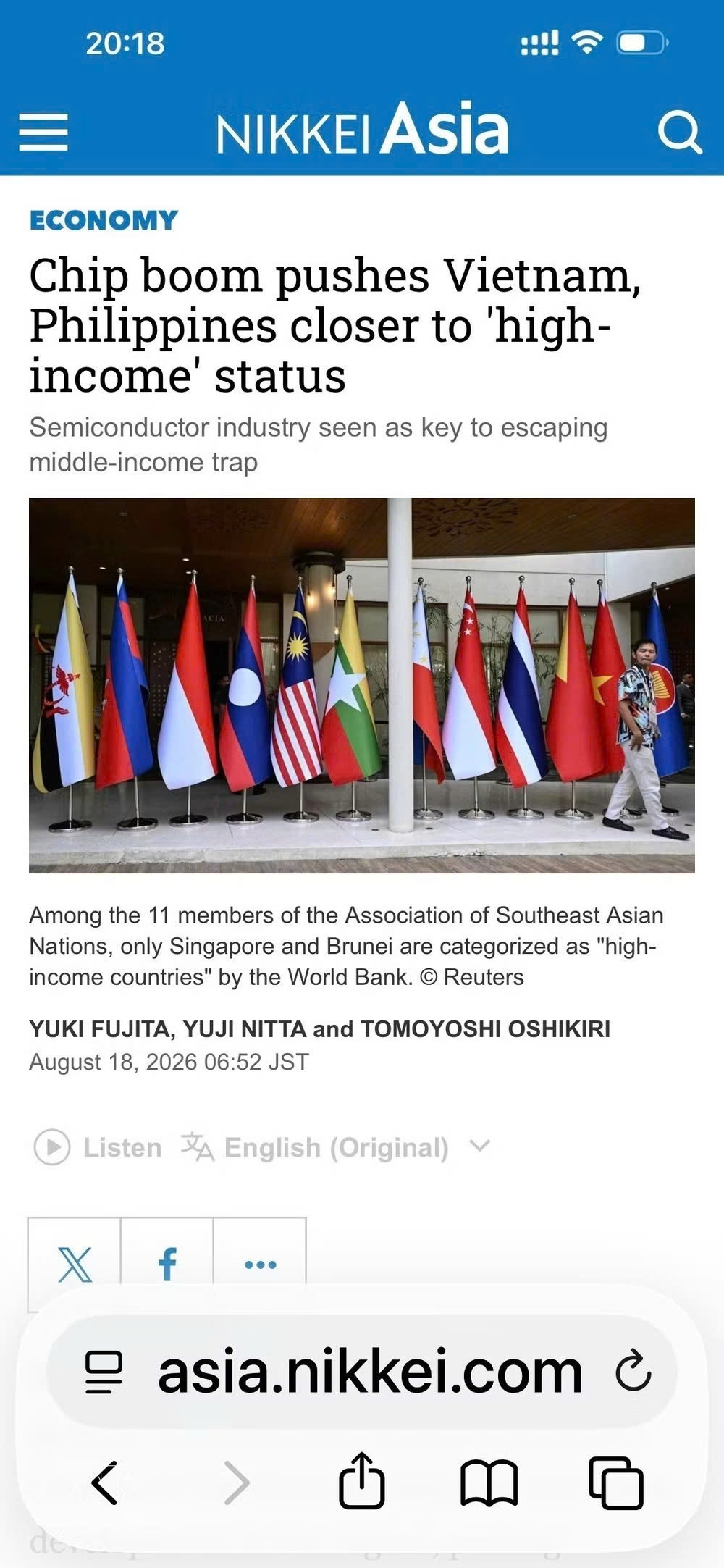
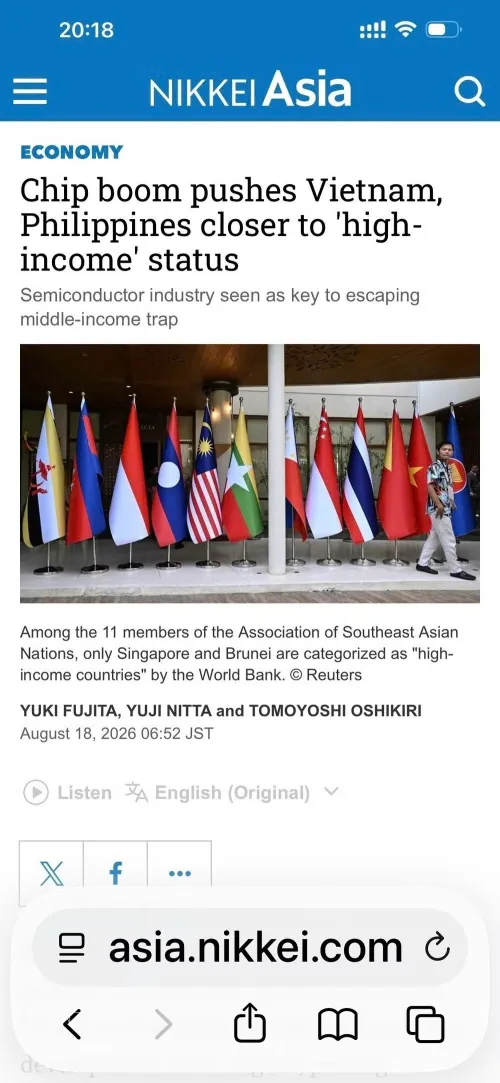
Chip boom pushes Vietnam closer to “high-income” status: Nikkei Asia

Chip boom pushes Vietnam closer to “high-income” status: Nikkei Asia

The rapid development of the semiconductor industry is reshaping Southeast Asia’s economic trajectory, creating opportunities for Vietnam and the Philippines to move closer to the ranks of high-income economies, according to Nikkei Asia.

Vietnam’s semiconductor industry offers the country an opportunity to shift from a growth model heavily reliant on low-cost labour and manufacturing toward more technology-intensive, higher value-added sectors, the paper said.

In the World Bank’s income classification updated in July, Vietnam was placed in the upper-middle-income group. Nikkei Asia said that to further raise income levels, the country needs to gradually reduce its reliance on low-cost labour and develop high-tech industries capable of generating greater added value.

Vietnam has raised incomes through an export-driven growth model. Its network of free trade agreements with countries and regions worldwide has helped attract foreign investment and establish manufacturing hubs for electronic components and electrical equipment.

In June, LG Innotek from the Republic of Korea announced plans to build a semiconductor substrate manufacturing plant in Vietnam with an estimated investment of around US$1 billion.

Vietnam is also seeking to expand its participation in the semiconductor value chain, moving beyond downstream activities such as assembly, packaging and testing into more technology-intensive areas, including chip design and the fabrication of integrated circuits on semiconductor wafers.

Under the country’s semiconductor industry development strategy, Vietnam aims to train more than 50,000 engineers and graduates for the sector by 2030.​

Nikkei Asia said the development of the semiconductor and electronics industries could provide an additional impetus for Vietnam’s economic growth amid rising global demand for products supporting artificial intelligence (AI).

To capitalise on the opportunity, Vietnam needs to continue improving the quality of its workforce and strengthening research and development capacity, while enhancing its ability to participate in higher value-added stages of global supply chains.

Meanwhile, the Philippines is also seeking to expand its semiconductor industry, which remains concentrated mainly in assembly, packaging and testing. Semiconductors and electronic products currently account for more than half of the country’s total merchandise exports. The Philippines is likewise seeking to upgrade its semiconductor industry as global demand for AI-related chips continues to grow.


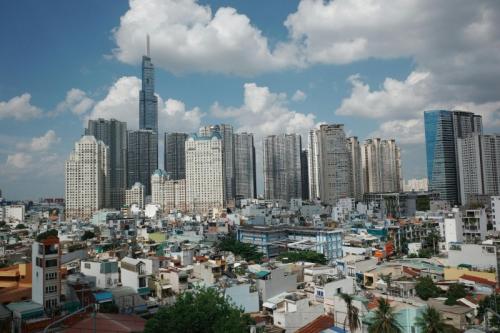
Capital inflow drives expansion of HCMC’s hospitality and entertainment ecosystem

Capital inflow drives expansion of HCMC’s hospitality and entertainment ecosystem

BIG Investment Group Joint Stock Company (BIG) has announced a $5 million equity investment commitment from Brookland Group & Partners Limited, a global strategic private equity firm.

BIG Investment Group Joint Stock Company (BIG) has announced a $5 million equity investment commitment from Brookland Group & Partners Limited, a global strategic private equity firm.

Brookland Group & Partners Limited, headquartered in Dubai and Singapore, has deployed over $12 billion across 24 jurisdictions. The two parties officially signed their strategic cooperation agreement on August 7.

This marks BIG’s first successful international capital raise, occurring as the company prepares to transition from the UPCoM to the Ho Chi Minh City Stock Exchange (HOSE) by September 2026. This move to Vietnam’s main board will require BIG to adhere to more stringent standards regarding information disclosure, corporate governance, and free-float ratios.

The $5 million investment is structured as equity, meaning it will not incur debt on BIG’s balance sheet or dilute the ownership of existing shareholders. The investment is equivalent to approximately 38% of the group’s charter capital and is more than triple its projected 2025 after-tax profit of VND36.6 billion ($1.4 million).

This capital will serve as the primary funding source for BIG’s expansion into the hotel, F&B, and entertainment sectors in central HCM City. Individual acquisitions and deals will be supported by separate funding arrangements upon completion.

In 2025, the country welcomed 21.2 million international visitors. The Government has set a target of 25 million international arrivals this year and 35 million by 2030, following a steady average growth rate of 10% per year since 2011.

The hospitality market is reflecting this momentum. Real estate consultancy JLL forecasts a sharp increase in hotel transactions this year, primarily within the 4- and 5-star segments in Hanoi and HCM City. According to JLL, foreign investors are seeking yields of 7–9% in Vietnam’s hotel assets—significantly higher than the 3–4% yields found in developed markets such as Japan and Australia.

HCM City, with a population of over 14 million, is striving to become one of Asia’s leading hubs for MICE (Meetings, Incentives, Conferences, and Exhibitions) tourism and the "night economy," with the Saigon River serving as the central axis for nightlife development.

Local tourism authorities acknowledge that the city currently faces a shortage of high-quality venues operating after 10 pm, and lacks large-scale entertainment complexes comparable to those in Singapore and Bangkok.


Dai Quang Minh proposes $5 bln HCMC-Long Thanh railway, targets 2030 completion

Dai Quang Minh proposes $5 bln HCMC-Long Thanh railway, targets 2030 completion

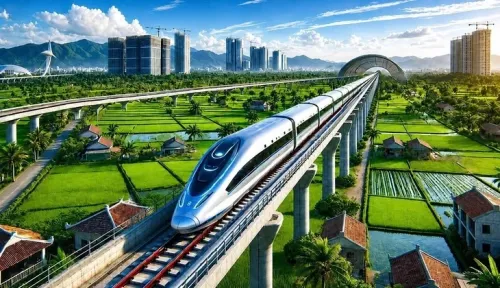
Dai Quang Minh Real Estate Investment JSC has proposed a 46.4-kilometer rail line linking downtown Ho Chi Minh City with Long Thanh International Airport, with an estimated cost of VND134.17 trillion ($5.14 billion) for the first phase, according to a feasibility study currently under review.

The Thu Thiem-Long Thanh railway project is among key infrastructure projects that HCMC plans to break ground on Vietnam’s National Day, or September 2.

The updated study puts the line's length at about 46.44 km, running from the eastern end of Thu Thiem station on the Ben Thanh-Thu Thiem route in HCMC to Cam Duong depot in neighboring Dong Nai city.

About 11 km of the line would run underground, while 34.5 km would be elevated, with the remainder at ground level or on transition sections.

The line would have 18 stations, excluding Thu Thiem station, including 16 elevated and two underground stations. The first phase would build 14 stations to improve investment efficiency.

Six stations would be located in HCMC and eight in Dong Nai, providing connections to residential areas, industrial zones, and Long Thanh airport.

Connecting with wider rail network

The route would follow major transport corridors, including expressways and Ring Road 3, while connecting with six other rail lines to create a mass-transit network serving Long Thanh airport.

It would link with the Ben Thanh-Thu Thiem metro at Thu Thiem station, Metro Line 6 at Ring Road 2 and Phu Huu stations, and Metro Line 10 at Long Truong station.

The project would also connect with the Vung Tau-Ba Ria-Phu My railway at Xom Goc station, as well as an extension of the Ben Thanh-Suoi Tien metro line and the North-South high-speed railway at a station inside Long Thanh airport.

The line is designed to handle nearly 47,000 passengers per hour, with an average capacity of more than 23,400 passengers per hour in each direction.

Trains would have a maximum design speed of 120 kilometers per hour and operate at between 80 km/h and 110 km/h depending on the section.

The project would use GoA4 automated operation, the highest level of automation under European standards, to align with the planned Tham Luong-Ben Thanh-Thu Thiem metro corridor.

BT model proposed

The first phase is expected to have a preliminary investment cost of VND134.17 trillion ($5.14 billion), excluding land clearance expenses. The estimate is lower than an earlier proposal.

The project is expected to be developed under a build-transfer (BT) contract, with the investor responsible for raising capital and receiving payment through a combination of land funds and state budget resources.

Construction is targeted for completion in 2030, creating a direct mass-transit connection between HCMC and Long Thanh International Airport.

HCMC has a long-term plan for more than 1,000 km of urban railway, but currently operates only about 20 km of the Ben Thanh-Suoi Tien metro line.

The city has also begun work on the Ben Thanh-Tham Luong, Ben Thanh-Thu Thiem and Ben Thanh-Can Gio routes.

By 2030, the city aims to expand its urban railway network to 255 km. Other projects under preparation include the New Binh Duong-Suoi Tien line, the first phase of Metro Line 6 from Tan Son Nhat airport to Phu Huu, Thu Dau Mot-Tao Dan, and the Tham Luong-An Ha-Tay Bac urban area section of Metro Line 2.


See all blog