Lumen Vietnam Fund

Blog

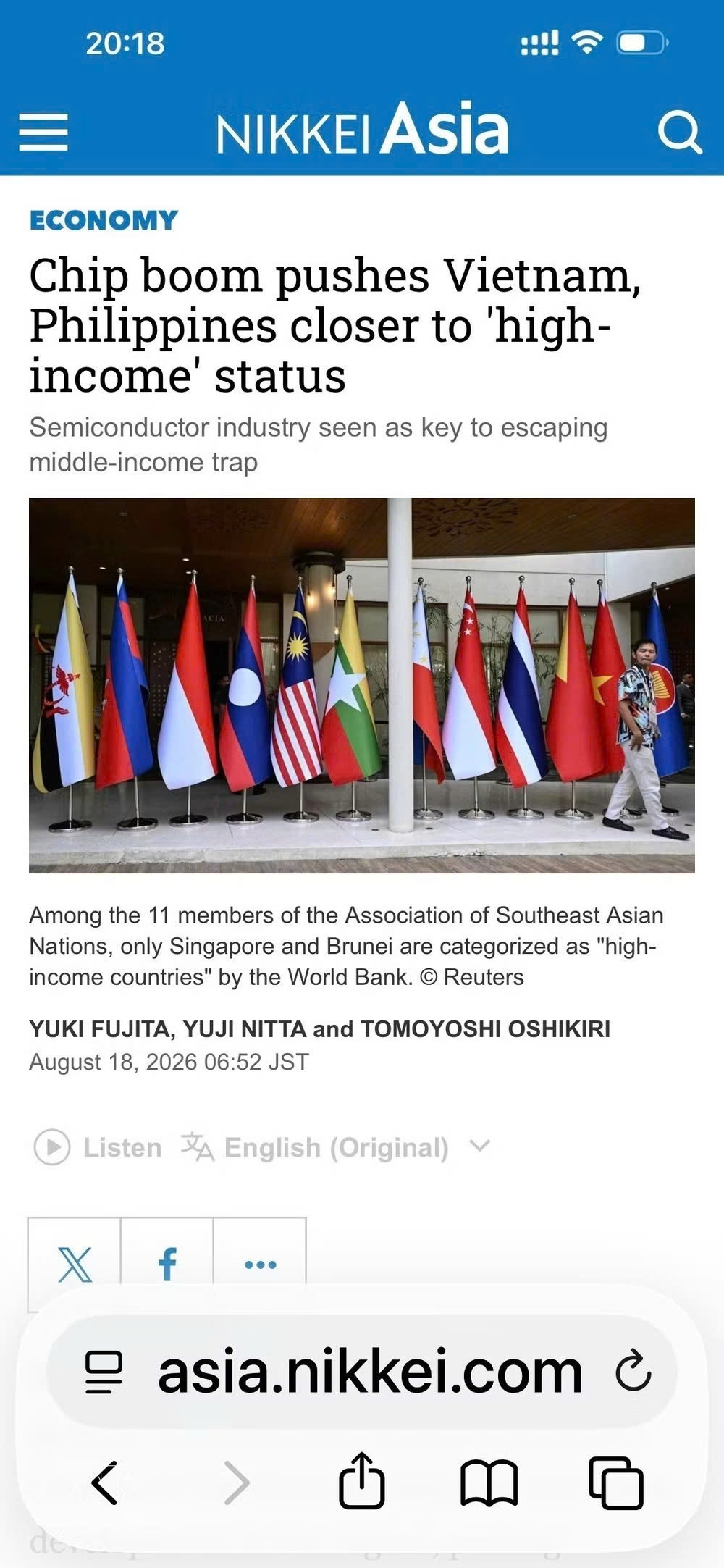
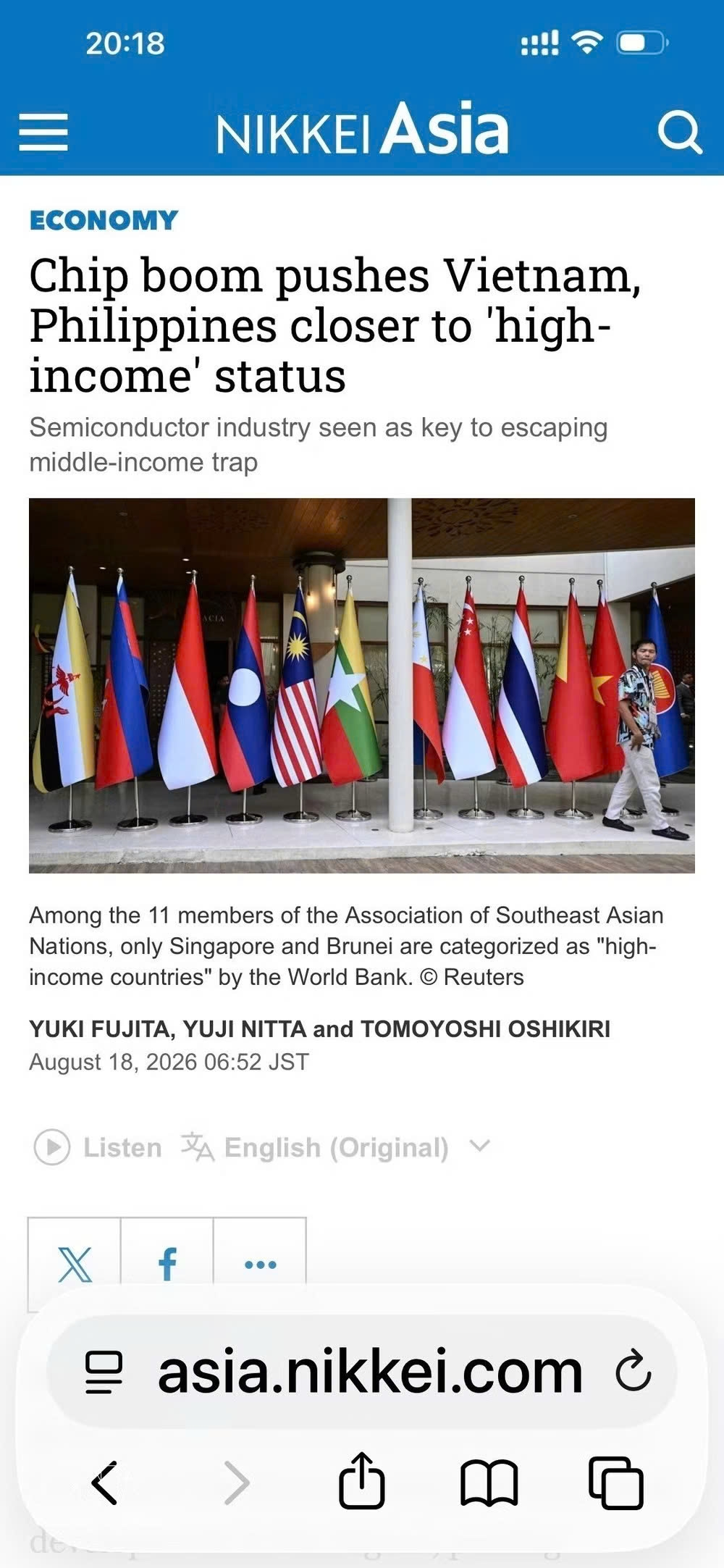
Chip boom pushes Vietnam closer to “high-income” status: Nikkei Asia

Chip boom pushes Vietnam closer to “high-income” status: Nikkei Asia

The rapid development of the semiconductor industry is reshaping Southeast Asia’s economic trajectory, creating opportunities for Vietnam and the Philippines to move closer to the ranks of high-income economies, according to Nikkei Asia.

Vietnam’s semiconductor industry offers the country an opportunity to shift from a growth model heavily reliant on low-cost labour and manufacturing toward more technology-intensive, higher value-added sectors, the paper said.

In the World Bank’s income classification updated in July, Vietnam was placed in the upper-middle-income group. Nikkei Asia said that to further raise income levels, the country needs to gradually reduce its reliance on low-cost labour and develop high-tech industries capable of generating greater added value.

Vietnam has raised incomes through an export-driven growth model. Its network of free trade agreements with countries and regions worldwide has helped attract foreign investment and establish manufacturing hubs for electronic components and electrical equipment.

In June, LG Innotek from the Republic of Korea announced plans to build a semiconductor substrate manufacturing plant in Vietnam with an estimated investment of around US$1 billion.

Vietnam is also seeking to expand its participation in the semiconductor value chain, moving beyond downstream activities such as assembly, packaging and testing into more technology-intensive areas, including chip design and the fabrication of integrated circuits on semiconductor wafers.

Under the country’s semiconductor industry development strategy, Vietnam aims to train more than 50,000 engineers and graduates for the sector by 2030.​

Nikkei Asia said the development of the semiconductor and electronics industries could provide an additional impetus for Vietnam’s economic growth amid rising global demand for products supporting artificial intelligence (AI).

To capitalise on the opportunity, Vietnam needs to continue improving the quality of its workforce and strengthening research and development capacity, while enhancing its ability to participate in higher value-added stages of global supply chains.

Meanwhile, the Philippines is also seeking to expand its semiconductor industry, which remains concentrated mainly in assembly, packaging and testing. Semiconductors and electronic products currently account for more than half of the country’s total merchandise exports. The Philippines is likewise seeking to upgrade its semiconductor industry as global demand for AI-related chips continues to grow.


Source: VNA

Photo: VNA

Latest Posts

FDI firms could provide new stock supply as Việt Nam pushes IPOs

FDI firms could provide new stock supply as Việt Nam pushes IPOs

Only 11 FDI enterprises have listed or registered for trading since Việt Nam's stock market began operating.

HÀ NỘI — Foreign-invested enterprises could become a new source of quality stocks for Việt Nam's equity market as regulators seek to encourage more initial public offerings and listings, but companies will need to raise their standards of corporate governance, financial reporting and disclosure to attract investors.

Despite the FDI sector's significant role in the economy, its presence on the stock market remains limited.

According to Vice Chairman of the State Securities Commission (SSC) Hoàng Văn Thu, only 11 FDI enterprises have been listed or registered for trading since Việt Nam's stock market began operating. Ten remain on the market, compared with nearly 1,600 listed and registered companies nationwide.

At the end of 2025, the FDI companies on the market had combined charter capital of over VNĐ12.6 trillion (US$484.7 million) and total assets of VNĐ44.7 trillion, representing just 0.15 per cent and 0.48 per cent, respectively, of the market totals.

Since 2017, another four FDI companies have registered as public companies, but none has completed a listing or trading registration.

This contrasts with continued growth in foreign investment. Total newly registered, adjusted and share-purchase FDI exceeded $38.4 billion in 2025, while disbursed capital surpassed $27.6 billion.

In the first six months of 2026 alone, registered FDI reached $34.6 billion, up 61 per cent year-on-year, while disbursement rose 11.2 per cent to $13 billion. Newly registered capital increased 87.2 per cent and capital contributions and share purchases rose 89.5 per cent.

Thu said FDI companies could diversify the range of stocks available to investors, including businesses with strong financial foundations, advanced technologies and internationally aligned management capabilities.

Their participation could increase market capitalisation and liquidity while attracting both FDI and foreign portfolio investment. A larger supply of stocks could also reduce the market's dependence on traditional sectors such as banking, real estate and securities.

The issue has gained attention as Việt Nam prepares for to transition from Frontier to Secondary Emerging Market status under FTSE Russell, scheduled to begin on September 21.

Capital demand is also increasing.

According to the SSC, total social investment needs for 2026–2030 are projected at around VNĐ38.5 quadrillion, averaging VNĐ7.7 quadrillion annually and nearly double the level from 2021 to 2025.

Higher governance standards

For FDI companies, however, entering the public market involves more than changing their legal structure or completing an IPO. Many FDI enterprises in Việt Nam currently operate as limited liability companies, with financial reporting primarily designed for internal management and their overseas parent groups.

Trần Phú Sơn, general director of EY Việt Nam, said one of the biggest differences involved the frequency and level of scrutiny involved in financial reporting.

While limited liability companies generally prepare year-end financial statements, listed public companies must report quarterly, have their semi-annual financial statements reviewed, and comply with extraordinary disclosure requirements, sometimes within 24-72 hours.

Companies therefore need to invest in technology, standardise their data, strengthen internal controls and improve the capabilities of finance and accounting teams.

Corporate governance structures must also change. According to Sơn, a minimum 30 per cent of board members to be independent means companies need to recruit people with appropriate expertise, knowledge of Vietnamese law, and genuine independence in decision-making.

This is particularly relevant where an overseas parent remains the controlling shareholder. Related-party transactions, profit distribution, transfer pricing, asset utilisation and intra-group contracts would be subject to greater transparency requirements.

Financial reporting standards are another consideration.

Sơn said International Financial Reporting Standards (IFRS), although not yet compulsory for every company, could provide an important advantage for FDI enterprises seeking international investors by allowing easier comparison with peers in other markets.

However, EY estimates that the transition from Vietnamese Accounting Standards to IFRS can take around one to three years, requiring early preparation of data, systems and personnel.

Regulators are also working to facilitate market entry.

Trần Kim Dung, deputy head of the SSC's Securities Offering Regulation Department, said legal frameworks governing enterprises, investment and securities are applied consistently without distinguishing between domestic and FDI companies, while foreign ownership limits are determined according to business sectors.

The SSC has also integrated the registration procedures for public offerings and listings, reducing the processing time for applications to around 30 days.

Thu said FDI enterprises could become a source of high-quality securities for the market. Moving from a limited liability structure to a public company could help businesses optimise capital costs and expand operations while contributing to the competitiveness of Việt Nam's financial market.


Aeon to ramp up investment in Vietnam through 2030

Aeon to ramp up investment in Vietnam through 2030

Vietnam is Aeon’s most important market in the region, with the Japanese retail giant planning to allocate the majority of its Southeast Asian investment capital to the Vietnamese market, said Tezuka Daisuke, CEO of Aeon Vietnam.

He made the remarks at a press conference on September 10 ahead of the October 3 opening of Aeon Mall Hai Duong, adding that Aeon’s total investment in Vietnam has reached approximately US$1.5 billion.

By 2030, Aeon plans to triple the scale of its operations in Vietnam from current levels, with investment expected to increase accordingly to support the expansion.

Vietnamese consumers are quick to adapt to emerging trends and changing lifestyles. This growth is creating significant opportunities for modern retail, one of Aeon’s core businesses.

Tezuka shared that Aeon began studying the Vietnamese market in 2008 through its financial services business. Since the group developed its first shopping mall in Ho Chi Minh City in 2014, it has now been operating a chain of Aeon branded stores across the country.

Following the country’s development for a decade, he said he has gained strong confidence in its growth prospects. In-depth data analysis has reinforced his view of Vietnam as a rapidly developing market with significant room for further growth, particularly in modern retail.

Aeon targets fourfold increase in profit by 2030

The Japanese retail group is also targeting operating revenue of ¥300 billion in Vietnam by 2030, with profit expected to increase fourfold from the 2026 level.

As of August 2026, Aeon operated nine shopping malls, 40 supermarkets, 71 stores, 16 department store and supermarket centers, 182 convenience stores and two pharmacies in Vietnam.

By the end of this year, Aeon is expected to open Aeon Mall Hai Duong and three additional shopping malls in Hai Phong, Thanh Hoa and Quang Ninh.

Alongside accelerating the expansion of its physical store network, Aeon is pursuing other growth strategies, notably expanding into e-commerce.

Tezuka said the rapid development of the retail market and significant shifts in consumer demand have prompted Aeon to invest heavily in its online business alongside its physical store network.

Aeon also plans to apply technologies and expertise from overseas markets to improve its supply chain, covering production, distribution and delivery to consumers as efficiently as possible.

The group is also looking beyond the domestic market, stepping up research and development of products under its TopValu private-label brand.

These products are manufactured to high Japanese quality standards while being offered at reasonable prices to suit the majority of local consumers, rather than being limited to a small customer segment.

With Aeon Mall Hai Duong scheduled to open on October 3, Aeon will continue working with potential suppliers in Hai Duong and Hai Phong, providing training and support to help them meet Aeon’s requirements. The goal is to enable these suppliers to produce TopValu products for Aeon’s Vietnam network and eventually develop them for export.

Vietnam, France seek to deepen Comprehensive Strategic Partnership

Vietnam, France seek to deepen Comprehensive Strategic Partnership

General Secretary of the Communist Party of Vietnam (CPV) Central Committee and President To Lam and French President Emmanuel Macron agreed to effectively implement existing cooperation mechanisms, and explore deeper sectoral cooperation to meet development needs in the new context.

General Secretary of the Communist Party of Vietnam (CPV) Central Committee and President To Lam and French President Emmanuel Macron agreed on new directions to make the Vietnam-France Comprehensive Strategic Partnership deeper, more substantive and effective at their talks in Paris on September 10 (local time), according to the Vietnam News Agency.

President Macron congratulated Vietnam on the major achievements it has made in socio-economic development in recent years. Hailing Vietnam’s growing role and stature in the region and on the international stage, the leader highlighted the longstanding ties between the two peoples and affirmed France’s readiness to stand alongside Vietnam in its new era of development.

President Macron stressed that General Secretary and President Lam’s visit provides an opportunity for the two countries’ high-ranking leaders to exchange views and set new directions to further deepen the Comprehensive Strategic Partnership.

General Secretary and President Lam congratulated France on its outstanding achievements and spoke highly of Paris’s important role and position on the international stage. He affirmed that Vietnam’s decision to attach importance to France and choose it as the first EU member state with which to establish a Comprehensive Strategic Partnership is a clear testament to the high level of political trust and the determination to elevate bilateral ties to a new level.

The two leaders welcomed the strong and substantive progress in bilateral ties nearly two years after the relationship was elevated to a Comprehensive Strategic Partnership.

Looking ahead, they agreed to maintain regular exchanges at all levels and through all channels, including the Party, Government, National Assembly and people-to-people exchanges, effectively implement existing cooperation mechanisms, and explore deeper sectoral cooperation to meet development needs in the new context.

On defence and security, the two sides agreed to further strengthen and expand cooperation in military medicine training, coordinate efforts to combat crime, and share information on criminal activities, particularly organised and transnational crime. Vietnam asked France to continue supporting efforts to address war consequences, particularly the search for missing military personnel and the exchange of wartime memorabilia.

In the areas of economy, trade and investment, the two leaders concurred to pursue new, strategic and long-term areas of cooperation within the framework of the Comprehensive Strategic Partnership, with a focus on developing strategic industries and services with broad spillover effects. In particular, they agreed to promote value-chain partnerships based on the model of “French technology – Vietnamese manufacturing – regional and global supply,” helping the two countries’ key products, including processed and manufactured goods and agricultural and food products, become part of global supply chains.

The French side welcomed the signing of a number of cooperation documents during the visit, including agreements covering realms of importance amid the current global context.

General Secretary and President Lam called on both sides to continue effectively implementing the EU-Vietnam Free Trade Agreement (EVFTA), and urged France to soon complete the ratification of the EU-Vietnam Investment Protection Agreement (EVIPA) to provide fresh impetus for investors. He also called on France to encourage the European Commission (EC) to remove the “yellow card” on illegal, unreported and unregulated (IUU) fishing at an early date, supporting Vietnam’s efforts to develop fisheries sustainably.

Looking to the future, the leaders agreed to fully tap France’s strengths as a leading scientific power in Europe and officially make science and technology cooperation a new and key pillar of bilateral ties. Breakthrough efforts will focus on strategic areas such as aerospace, critical minerals, quantum technology, clean energy, and research for sustainable development and climate change response.

General Secretary and President Lam suggested the two countries expand scientific research, including space science, and promote technology transfer and the mastery of technologies. He also called on France to support Vietnam in gradually developing quantum technology.

In this regard, President Macron expressed his hope that the two countries would soon launch major and new projects in strategic science and technology fields.

The two sides will also fully tap the potential of traditional areas of cooperation and shift toward more inclusive and effective partnership models.

They will step up cultural and people-to-people exchanges through the organisation of cultural weeks and days in each country, with the Vietnam Days in France programme scheduled for October 2026 as an immediate priority. General Secretary and President Lam suggested France simplify visa procedures for Vietnamese citizens to boost tourism and people-to-people exchanges.

The French side affirmed its readiness to support Vietnam in the development of the Museum of the Communist Party of Vietnam. President Macron said France would continue to actively support Vietnam in developing its cultural industries, an area in which France has strengths, as well as provide additional archival materials on President Ho Chi Minh.

France will also continue to promote extensive cooperation with Vietnam in health care and education and training, he added.

General Secretary and President Lam expressed his sincere appreciation to the French side for returning a Dong Son bronze drum to Vietnam as part of the two sides’ commitment to combating the illicit trafficking of cultural property, and for donating several artefacts to the Museum of the Communist Party of Vietnam.

Praising the active work of the French Institute in Vietnam, he welcomed France’s cooperation in organising a series of Vietnamese cultural events in Paris in October 2026. He also called on France to further support Vietnam in researching, restoring, preserving and promoting the values of its heritage and historic structures, including Long Bien Bridge in Hanoi and old French villas, with the involvement of French architects.

On education and training, the two sides agreed to effectively implement existing cooperation agreements, particularly those supporting French-language teaching in Vietnam.

General Secretary and President Lam called for expanding cooperation in high-quality human resources to sectors aligned with current practical and strategic needs, including semiconductors, new energy and railways.

In health care, the leader highlighted the role of the Pasteur Institutes in Vietnam and called on the two sides to elevate their cooperation, with a view to making Vietnam a leading hub for the application of modern medical technologies in Southeast Asia. He also called for continued scholarships for medical students in Vietnam.

On this occasion, General Secretary and President Lam proposed France continue facilitating the deep integration and strong development of the Vietnamese community there, and establish mechanisms to fully tap the potential of Vietnamese experts, intellectuals and scientists, enabling them to contribute to their host country as well as bilateral ties.

Regarding regional and international issues, President Macron highly valued and shared the Vietnamese leader’s profound views at the recent Shangri-La Dialogue on upholding international law and promoting multilateralism.

The two leaders agreed to strengthen coordination and mutual support at multilateral forums, particularly the United Nations and within the ASEAN-EU framework.

On maritime issues, the two sides reaffirmed the importance of maintaining peace, stability, security, safety and freedom of navigation and overflight, ensuring unimpeded trade and the right of innocent passage in the East Sea and around the world. They underscored the need to settle disputes by peaceful means on the basis of respect for international law, particularly the 1982 United Nations Convention on the Law of the Sea (UNCLOS).

On this occasion, General Secretary and President Lam and President Macron witnessed the signing and exchange of a number of important cooperation documents between ministries and agencies of the two countries, covering security, health care, aerospace, science and technology, and critical minerals.


See all blog