Lumen Vietnam Fund

Blog

Vietnamese exporters face dual challenge over power supply

Vietnamese exporters face dual challenge over power supply

Ensuring an adequate power supply remains critical as Vietnam's manufacturing and exports expand rapidly. However, some companies in global supply chains must also meet requirements on renewable electricity use and emissions. A draft amendment to Vietnam’s Electricity Law, now under consideration by the National Assembly, seeks to refine mechanisms to address these needs.

On October 20, at a working session of the National Assembly, the country's legislature, Minister of Industry and Trade Le Manh Hung presented a proposal to amend and supplement several provisions of the Electricity Law. The draft focuses on resolving bottlenecks in power generation and grid investment, while refining the framework for direct power purchase agreements (DPPAs) and renewable energy certificates.

The proposals come as businesses’ electricity needs evolve. National Assembly member Trinh Tu Anh, representing Lam Dong province, said many companies, particularly those participating in international supply chains, need not only reliable electricity at competitive prices but also proof of energy origin, renewable electricity usage, and emissions generated during production.

This presents the power sector with two parallel challenges: ensuring sufficient electricity to support economic growth and enabling businesses to access clean power and verify its use to meet customer requirements.

Reliable power supply remains an immediate priority

Vietnam’s manufacturing and export activities continued to expand strongly in the first nine months of 2026. Merchandise exports reached $434.3 billion, up 24.5% from a year earlier, according to the National Statistics Office. Industrial production rose 12.3%, while manufacturing and processing output increased 12.9%.

The expansion in manufacturing has been accompanied by a substantial rise in electricity demand.

The Ministry of Industry and Trade reported that commercial electricity consumption nationwide reached 237.19 billion kilowatt-hours (kWh) in the first nine months, up 9.66% year-on-year. Industry and construction accounted for 122.18 billion kWh, an increase of 8.32%, representing around 51.5% of total electricity sales.

Accounting for more than half of consumption, industry and construction remain the largest electricity-consuming sectors. For factories, a stable power supply is essential to keep production lines running, operate equipment and meet delivery schedules.

The ministry said the power system operated safely and reliably during the nine-month period, meeting demand from businesses and households. Maintaining supply over the longer term, however, will require coordinated development of generation capacity, transmission networks and grid dispatch capabilities.

According to Vietnam Electricity (EVN), total electricity generated and imported across the system reached 265.79 billion kWh in the first nine months. Coal-fired power contributed 132.63 billion kWh, or 49.9%, while hydropower generated 68.48 billion kWh, or 25.8%. Renewable energy sources, as classified by EVN, supplied 33.6 billion kWh, accounting for 12.6%. Gas-fired power contributed 20.48 billion kWh, while electricity imports totalled 10.3 billion kWh.

Hydropower output fell nearly 9% from a year earlier amid hydrological conditions affected by the El Niño phenomenon.

By contrast, coal- and gas-fired power together increased their share of total generation and imports to 57.6%, from 53.9% a year earlier, despite growth in other renewable energy sources. The shift towards a greater share of fossil fuels adds pressure to greenhouse gas emissions at a time when environmental requirements are becoming increasingly linked to manufacturing and export activities.

At the "Clean Energy for a New Era of Growth" forum held in Hanoi on October 27, Mai Duy Thien, chairman of the Vietnam Clean Energy Association, stressed the need to consider energy development in the context of economic growth and national competitiveness.

Clean energy development would not only help diversify supply but also enable businesses to adapt to increasingly stringent environmental standards, he said. This highlights the need to address energy security and the transition to cleaner electricity in parallel.

Clean electricity becomes a gateway to global supply chains

Renewable electricity requirements are already being incorporated into the supply-chain policies of multinational corporations, rather than remaining a trend expected to emerge in the future.

According to its 2026 Environmental Progress Report, Apple has incorporated a requirement for 100% renewable electricity into its Supplier Code of Conduct. The company requires its direct manufacturing supply chain to use 100% renewable electricity for Apple-related production by 2030.

According to the U.S. technology company, electricity consumption at supplier factories is the largest source of greenhouse gas emissions across its supply chain. Switching to renewable power is therefore a key component of its 2030 carbon neutrality goal.

Environmental requirements are also being considered as part of trade policy. In the United States, the proposed Clean Competition Act, introduced in Congress in December 2025, would establish a carbon border adjustment mechanism based on the emissions intensity of goods.

Meanwhile, the European Union entered the definitive phase of its Carbon Border Adjustment Mechanism (CBAM) on January 1, 2026, with the purchase and surrender of CBAM certificates scheduled to follow a phased timeline beginning in 2027. The mechanism covers products in six sectors: iron and steel, aluminium, cement, fertilizers, electricity and hydrogen.

Under the scheme, EU importers must fulfil obligations linked to emissions embedded in covered goods. Carbon costs could affect purchasing prices and the competitiveness of foreign producers, making emissions management an economic consideration as well as an environmental responsibility for businesses.

In Vietnam, demand for renewable electricity has already translated into actual transactions.

On June 1, 2026, Samsung Electronics Vietnam Thai Nguyen (SEVT) announced that it had implemented a direct power purchase agreement through the national grid, becoming the first corporate customer to complete a transaction under the DPPA mechanism.

The electricity supplied under the agreement comes from the TTC Duc Hue 2 solar power plant in Tay Ninh province, with expected output of around 70 million kWh a year.

The government established the DPPA framework under Decree 57/2025/ND-CP, which was subsequently amended and supplemented by Decree 243/2026/ND-CP. Current regulations have expanded participation to eligible electricity retailers operating in qualifying industrial and economic zones, creating additional arrangements for industrial customers to purchase renewable electricity.

Samsung’s case demonstrates that demand for renewable power has moved beyond commitments to actual transactions. It also raises questions about how the DPPA mechanism can be expanded to give more manufacturers access to clean electricity.

However, transactions conducted through the national grid require participants to account for network usage, dispatch, reserve capacity and other system services. How these costs are calculated and allocated directly affects companies’ overall electricity bills, as well as the interests of customers that do not participate in DPPAs.

This was among the issues the National Assembly’s Committee on Science, Technology and Environment called for clarification in its appraisal report on the draft Electricity Law amendments on October 20. The committee said DPPA participants should fulfil their cost obligations in full to prevent unreasonable cost transfers to other customers.

Beyond access to renewable electricity, businesses also need tools to verify the environmental attributes of the power they consume. Renewable energy certificates (RECs) serve this purpose, but their trading and use require reliable registration, verification and traceability mechanisms.

The draft amendments seek to establish a more complete legal framework for the REC market. The appraisal committee has called for clear rules on certificate ownership, trading and cancellation after use to prevent the same environmental attributes from being claimed more than once.

The issues under consideration therefore go beyond expanding the right to purchase renewable electricity. They also concern the overall cost of transactions and businesses’ ability to demonstrate that they use clean power - conditions that matter to companies seeking to meet environmental commitments made to international partners.

Reuters recently reported that the U.S.-China tariff war had helped accelerate the relocation of manufacturing to Vietnam. The expansion of export-oriented production has brought rising electricity demand. However, Reuters warned that the high share of coal-fired power in Vietnam’s electricity mix could pose an emissions challenge as international buyers increasingly scrutinize the carbon footprints of their supply chains.

For domestic companies seeking deeper integration into global supply chains, the ability to secure reliable electricity, manage emissions and meet partners’ environmental standards is likely to become increasingly important. These factors could increasingly influence the competitiveness of Vietnamese businesses as environmental requirements across global supply chains become more stringent.

Source: Vu Dang, Nguyen Quang
Latest Posts

Vietnam among 20 economies with the lowest public debt ratios

Vietnam among 20 economies with the lowest public debt ratios

Debt levels vary considerably, reflecting differences in borrowing requirements, economic conditions and public finances.

Vietnam’s public debt is forecast to stand at 28.3% of gross domestic product (GDP) in 2026, placing the country among the 20 economies with the lowest public debt ratios worldwide, according to data from the International Monetary Fund’s (IMF) October 2026 World Economic Outlook.

In many of the world’s largest economies, public debt has already exceeded the size of their respective economies. However, debt levels vary considerably, reflecting differences in borrowing requirements, economic conditions and public finances.

The debt ratio compares total government debt, including debt incurred by central, state and local governments, with the country’s gross domestic product (GDP). The ranking covers only economies with populations of at least one million.

According to the report, Sudan has the world’s highest estimated public debt ratio, at 334.4% of GDP, far exceeding that of any other economy. Japan ranks second at 199.4%, followed by Singapore at 166.4%.

At the other end of the spectrum, economies with some of the lowest public debt ratios include several high-income jurisdictions, such as Denmark, Taiwan (China) and Hong Kong (China).

Vietnam’s projected ratio of 28.3% places it among the economies with comparatively low levels of public debt relative to the size of their economies.


Vietnam and ASEAN move to elevate position in global value chain

Vietnam and ASEAN move to elevate position in global value chain

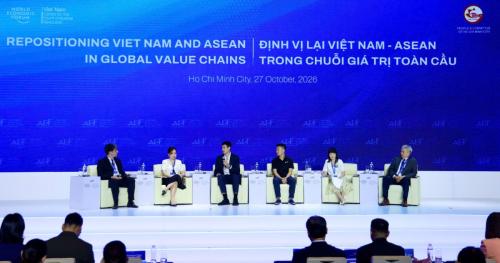
At the Autumn Economic Forum 2026 on October 27, Vietnamese and international experts shared experiences to help ASEAN and Vietnam not only attract foreign direct investment (FDI) but also retain higher added value from production and export activities.

During the discussion session “Repositioning Vietnam - ASEAN in Global Value Chains” on October 27, co-organized by the World Economic Forum (WEF) and the Fourth Industrial Revolution Center in Vietnam (C4IR), in the framework of the Autumn Economic Forum 2026 in Ho Chị Minh City, representatives from businesses, international organizations, and regulatory agencies pointed out that attracting investment in the ASEAN region is just the beginning.

The greater challenge is how domestic enterprises can participate more deeply in the regional production network, enhance added value, and better utilize the capital and technology flows moving into ASEAN.

ASEAN attracts investors but internal connectivity remains limited

According to Mr. Kyriakos Triantafyllidis, Head of Growth and Strategy, Centre for Advanced Manufacturing and Supply Chains, under the World Economic Forum (WEF), ASEAN currently has about 700 million people, with a combined economic scale of $4.3 trillion. By 2025, the region was expected to attract $245 billion in FDI, a 10 percent increase from the previous year.

The proportion of foreign-origin value in Vietnam's exports increased from about 33 percent in 2010 to nearly 50 percent in 2022. This indicates that Vietnam's exports are increasingly dependent on imported materials, components, and inputs.

To create more value domestically, Vietnam needs to enhance the capacity of local enterprises to participate more deeply in supply chains and become tier-1 suppliers for FDI corporations. On a regional scale, intra-ASEAN trade accounts for only about one-fifth of the region's total trade turnover, indicating that member economies still have significant room to strengthen connectivity and production cooperation.

These issues require ASEAN not only to continue attracting investment and expanding exports but also to develop the capacity of local enterprises, strengthen supply chain links within the region, and participate more deeply in high-value stages such as technology, design, and product innovation.

Expert perspectives on trade and investment potential

Mr. Sacha Dray, an Economist at the World Bank in Economic Policy Unit for Vietnam, agreed that ASEAN has a favorable foundation for trade and investment development, with abundant labor, high trade openness, and an extensive network of trade agreements. However, the region has not yet fully exploited the benefits of integration.

In terms of production, ASEAN has deeply participated in the global value chain, from automobile and electric vehicle production in Thailand, assembly in Vietnam, to semiconductor manufacturing, testing, and packaging in Malaysia and Singapore. However, the intra-regional value chain remains limited: global value chain participation based on regional links accounts for only about one-third in ASEAN, compared to 70 percent in the EU.

Specifically, of ASEAN’s total export turnover of about $2 trillion, only 22 percent is consumed within the region, compared to about 60 percent in the EU. This makes ASEAN economies more dependent on external demand, while also limiting the ability to spread benefits among countries in the region.

According to Mr. Dre, the income disparity among member countries - where the gap between the poorest and richest nation reaches up to 70 times, compared to eight times in the EU- also creates uneven market demand and resource allocation. To bridge this gap, he suggested increasing cross-border investment among ASEAN countries, connecting foreign enterprises with local suppliers, and removing non-tariff barriers.

Business views on ASEAN’s appeal

From a business perspective, Ms. Jessica Nguyen, General Director, Country Holding Officer, and Board Chairwoman of ABB Vietnam, believes that ASEAN’s appeal comes from three factors: market size; increasingly developed production capacity; and regional connectivity.

According to her, ASEAN no longer competes solely on low labor costs. Evidence is that Vietnam, Thailand, Malaysia, and Indonesia are investing more in advanced manufacturing, digitization, and developing technical human resources. At the same time, trade agreements and regional connectivity allow businesses to build supply chains across multiple countries instead of being limited to a single market.

Trust in the supply chain is built through quality, traceability, reliability, and product consistency. These are the conditions for Vietnamese suppliers to transition from fulfilling orders to becoming partners with higher technical and management capabilities.

However, after more than 32 years of operation in Vietnam, ABB observed that technology and machinery can be acquired relatively quickly, whereas operational and management capabilities take time to build. “The long-term value that multinational corporations bring is not just automation equipment, but also operational knowledge, global standards, and the ability to build resilient supply chains,”Ms. Nguyen emphasized.

Policy recommendations for supplier development

From a state management perspective, Ms. Pham Quynh Mai, Deputy Director General of the Multilateral Trade Policy Department under the Ministry of Industry and Trade, noted that reducing tariffs is not enough to promote regional trade. ASEAN countries need to address behind-the-border barriers, including customs procedures, standards, certifications, logistics, and differences in rules of origin among trade agreements.

According to her, the time and costs incurred at each stage, from sourcing materials, organizing production, meeting rules of origin to transportation and delivery, all affect the efficiency of the entire supply chain. Therefore, ASEAN needs to enhance information exchange, improve enforcement capacity, and limit the duplication of inspection and certification procedures.

For Vietnam, she proposed building a national supplier development program involving the Ministry of Industry and Trade, local governments, industry associations, and FDI enterprises. This program would help small and medium-sized enterprises access finance for technology investment, production upgrades, and workforce training.

The Autumn Economic Forum 2026, themed “The Convergence of New Global Growth Poles,” took place from October 26 to October 29 in Ho Chi Minh City, directed by Prime Minister Le Minh Hung and chaired by the Ho Chi Minh City People’s Committee in collaboration with C4IR.


Ho Chi Minh City unveils 12 investment projects worth over $13bn at AEF 2026

Ho Chi Minh City unveils 12 investment projects worth over $13bn at AEF 2026

Ho Chi Minh City has unveiled 12 investment projects worth more than US$13 billion, spanning seaports, logistics, urban development, and high technology, at the Autumn Economic Forum 2026 (AEF 2026).

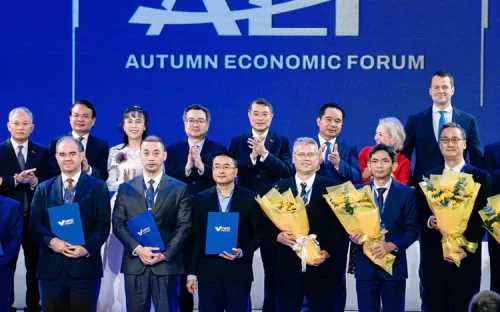
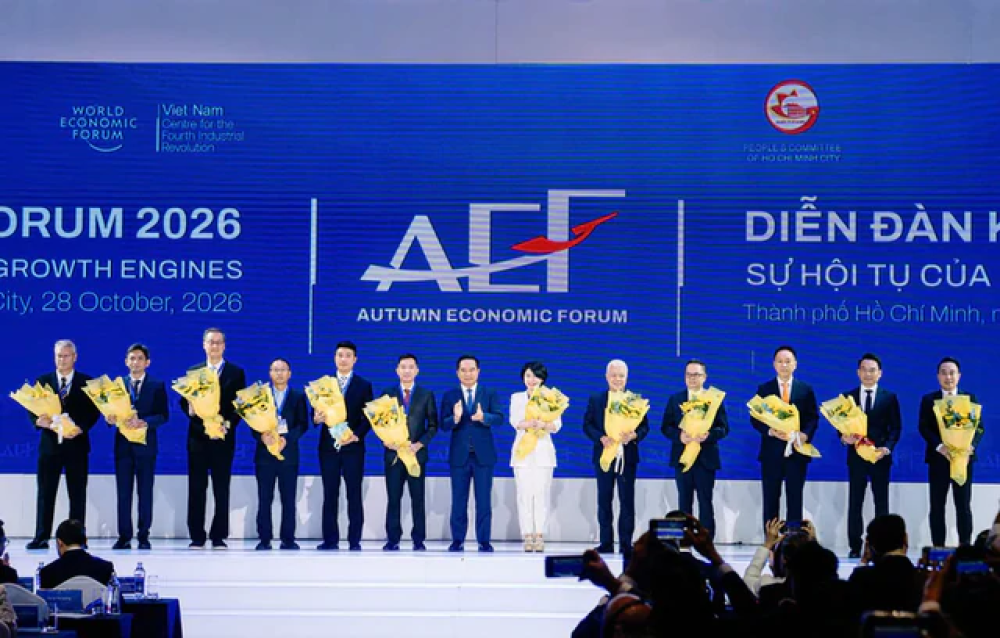
On Wednesday morning, during a high-level dialogue session at AEF 2026, chairman of the Ho Chi Minh City People’s Committee Nguyen Van Duoc presented investment policy approvals or investment registration certificates to investors for 12 domestic and foreign-invested projects.

Major projects include Can Gio International Transshipment Port, a smart complex in Thu Thiem New Urban Area, the International University Urban Area, and Cai Mep Gemadept–Terminal Link Port.

Major seaport, urban development projects

In seaport infrastructure, Can Gio International Transshipment Port has an estimated investment of $4.9 billion. The project involves Vietnam Maritime Corporation, Saigon Port JSC, and Terminal Investment Limited Holding S.A.

Cai Mep Gemadept - Terminal Link Port in Tan Phuoc Ward has an estimated investment of $770 million. Another project in the sector is My Xuan 6 Port, with an investment of about $66.6 million.

In logistics, Swift Logistics has an estimated investment of $987.4 million and is being developed by Singapore-based Tokgistic.

In urban development, Lotte Properties HCMC Co. Ltd. is implementing the Smart Complex project in Thu Thiem New Urban Area, with an estimated investment of $2.29 billion.

The International University Urban Area, developed by Berjaya Vietnam International University Urban Development JSC, has a revised total investment of approximately $6.61 billion.

Industrial, high-tech projects

Ho Chi Minh City also granted investment approvals for the first phase of the Vinh Lap Industrial Park infrastructure construction and business project, with registered capital of more than $379 million.

The project involves Vietnam-Singapore Industrial Park Joint Venture Co. Ltd., Becamex Group, and VSIP Quang Ngai Co. Ltd.

In industrial manufacturing, the GL Cables high-tech power cable manufacturing plant has registered investment capital of approximately $23 million.

Xinyi Glass Vietnam Co. Ltd. will invest approximately $230 million in manufacturing energy-saving float glass, low-emissivity coated glass, laminated safety glass, and specialized automotive glass.

Chang Yue Technology (VN) Co., Ltd. has an investment of approximately $70 million for a project involving the casting of iron, steel and non-ferrous metals, as well as mechanical processing.

In the high-tech sector, II-VI Vietnam Co. Ltd. is developing a project to manufacture thermoelectric semiconductor materials and thermoelectric coolers, with investment capital of $45 million.

ITO Automation Technologies Vietnam Co. Ltd. has an investment of approximately $8 million in manufacturing automation machinery, robots and sensors, and developing data management solutions.

Ho Chi Minh City chairman meets WEF managing director

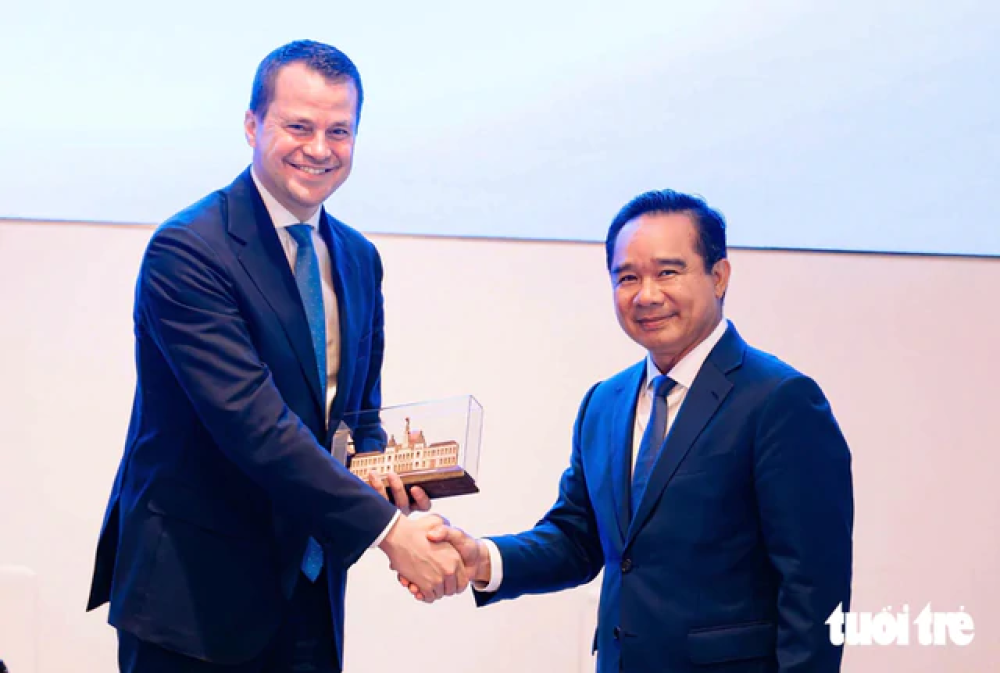
Chairman of the Ho Chi Minh City administration Nguyen Van Duoc met Stephan Mergenthaler, managing director of the World Economic Forum (WEF) on Wednesday, on the sidelines of the Autumn Economic Forum 2026, to discuss directions for strengthening cooperation between the city and the organization.

Duoc thanked Mergenthaler for attending AEF 2026 and praised his personal support and that of the WEF, saying the third edition of the forum had made a promising start and largely achieved its objectives.

With its theme focusing on the convergence of new growth drivers, AEF 2026 had served as a bridge between Vietnam and the international community, among businesses, and between businesses and government, Duoc said.

He added that the forum's discussions and dialogues had been frank and substantive, earning positive feedback from delegates.

Earlier that morning, Ho Chi Minh City leaders presented membership certificates for the city's Center for the Fourth Industrial Revolution to 10 founding members.

Through a message from Vietnamese Prime Minister Le Minh Hung, Vietnam had affirmed that it sought to be not only a destination for foreign direct investment but also a partner in cooperation and investment, Duoc said.

Ho Chi Minh City hoped the WEF would continue to convey this message to the global investment community.

The city believed that connecting the WEF's annual meeting in January in Davos, its summer forum in China and the autumn forum in Vietnam would create a more complete, comprehensive and substantive ecosystem of economic forums, he added.

Mergenthaler expressed pleasure at returning to Ho Chi Minh City and confidence in the city's development prospects, as reflected in the scale and atmosphere of AEF 2026 and Prime Minister Hung's keynote address at the forum.

The continued growth and positive development of AEF marked an important milestone in the city's ambitions, he said.

The WEF was committed to maintaining cooperation with Ho Chi Minh City through C4IR and other joint activities, making practical contributions to the development goals of the city and Vietnam, Mergenthaler said.

He also invited Ho Chi Minh City leaders to attend the WEF Annual Meeting in Davos in January 2027 alongside Vietnamese government leaders, underscoring the long-term and enduring partnership between the two sides.

Regarding the idea of combining AEF 2027 with the APEC Economic Leaders' Meeting hosted by Vietnam in Phu Quoc, Mergenthaler said the WEF was ready to provide support, particularly by connecting participants and convening high-level events within the APEC framework.

If implemented, the combination would build on and strengthen the successful cooperation model established by Ho Chi Minh City, he said.

It would also elevate the relationship between the WEF and the city as APEC draws considerable international attention.

The Autumn Economic Forum 2026 is taking place in Ho Chi Minh City from October 26 to 29 under the theme 'Collaboration in a New Era,' bringing together government officials, business leaders, investors, and international experts to discuss new drivers of economic growth.

Its two main days, Tuesday and Wednesday, are co-branded with the World Economic Forum for the first time.

The forum serves as a platform for Ho Chi Minh City to strengthen international partnerships, showcase its investment potential, and advance its ambition to become a regional financial and economic hub.

See all blog