Vietnam pushes to build groundwork for domestic high-speed rail technology capability by 2028
Vietnam is accelerating efforts to develop homegrown technological capabilities for its planned high-speed railway network as the government seeks to reduce dependence on foreign contractors and turn the multi-billion-dollar infrastructure program into a catalyst for industrial upgrading.
At a meeting with several major Vietnamese corporations in Hanoi last Friday, Construction Minister Tran Hong Minh said the initiative is intended not only to support the proposed North-South high-speed railway, but also to establish a domestic railway industry capable of handling the full value chain, from surveying and design to construction, component manufacturing, operations and maintenance.
“The greater value lies in using the project to build industrial and technological capacity, as well as a highly skilled workforce,” Minh said at the meeting.
Le Van Duong, director of the department of science, technology, environment and construction materials under the Ministry of Construction, said Vietnam has accumulated experience in major infrastructure projects such as expressways, long-span bridges, tunnels, and underground works.
However, substantial gaps remain in high-speed rail technology, particularly in specialized standards, ballastless track systems, testing facilities, and skilled engineering personnel, he added.
Vietnam still relies heavily on foreign consultants, technologies and contractors for complex railway systems, Duong noted, adding that reducing such dependence is critical if the country wants greater autonomy in future strategic infrastructure projects.
The ministry said the technology development program will be implemented as a national science and technology initiative involving government agencies, universities, research institutes and private enterprises. Businesses are expected to play a central role in technology transfer, localization and commercialization, while the state will coordinate and commission research programs.
At the meeting, millitary-run telecoms giant Viettel Group said it could contribute to the development of centralized operating systems, signaling technology, train control systems, operations control centers, and smart management platforms for high-speed rail operations.
Meanwhile, steelmaker Hoa Phat Group (HoSE: HPG) proposed participating in the production of railway tracks, large-span steel structures and mechanical components for construction and maintenance.
Minister Minh asked the department to finalize a detailed task list by May 15, including deliverables, lead agencies and research coordinators. Relevant agencies, institutes and companies were also asked to submit registrations by May 25 for consolidation and reporting to the government in coordination with the Ministry of Science and Technology.
The minister also ordered the establishment of an industry-level steering committee and a specialized scientific council to coordinate implementation. Between May 25 and May 30, ministry officials and project leaders are expected to survey defense industry facilities and manufacturing enterprises to assess their capacity to support equipment manufacturing, technology integration and related research tasks.
Vietnam aims to complete priority technology development tasks by 2028, a milestone officials describe as critical for establishing initial self-reliance in high-speed rail construction technologies.
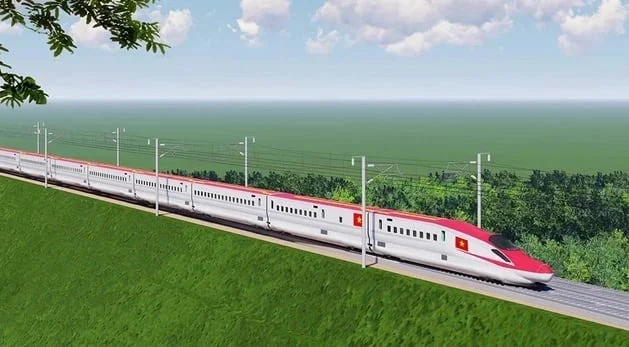
The push comes as Vietnam advances preparations for the North-South high-speed railway, the country’s largest-ever infrastructure project. The planned line is expected to connect Hanoi and Ho Chi Minh City while serving as the backbone of a broader modernization drive for Vietnam’s transportation network and industrial base.
Source: Hai Yen
Photo: Illustration courtesy of the government's news portal