Lumen Vietnam Fund

Blog

Vietnam PM backs expanded energy cooperation with Russia's Zarubezhneft

Vietnam PM backs expanded energy cooperation with Russia's Zarubezhneft

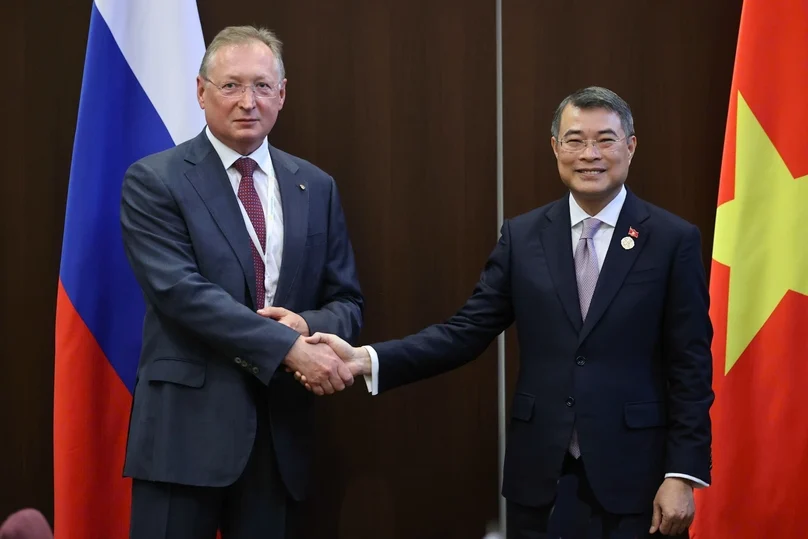
Vietnamese Prime Minister Le Minh Hung met with Sergei Kudryashov, CEO of Russian state oil company Zarubezhneft, on Wednesday and expressed support for expanding bilateral cooperation in oil and gas, offshore wind power and other energy projects.

The meeting took place on the sidelines of the ASEAN-Russia Summit commemorating the 35th anniversary of diplomatic relations between the two sides in Kazan, the capital of Russia's Republic of Tatarstan.

Zarubezhneft has worked with state-owned Petrovietnam for more than four decades through two joint ventures, Vietsovpetro in Vietnam and Rusvietpetro in Russia, focusing on oil and gas exploration and production.

PM Hung praised Zarubezhneft's contribution to energy cooperation between the two countries and reaffirmed that collaboration with Russia remains a priority in Vietnam's energy strategy.

He voiced support for the company to study additional investments and sign new oil and gas contracts for open offshore blocks in Vietnam, provided projects ensure commercial viability, balance the interests of stakeholders, and comply with Vietnamese law. He also encouraged the company to explore opportunities for joint projects in third countries.

The cabinet leader called on Petrovietnam and Zarubezhneft to effectively implement amended intergovernmental agreements governing Vietsovpetro and Rusvietpetro, as well as agreements expanding geological exploration and hydrocarbon production activities on Vietnam's continental shelf and in Russia.

Hung urged Zarubezhneft to consider long-term and stable commercial cooperation with Vietnamese energy companies to strengthen Vietnam's energy security and support economic development.

He encouraged closer collaboration with Petrovietnam and Vietsovpetro to accelerate proposals for establishing wind power equipment manufacturing facilities and developing an offshore wind supply chain in Vietnam.

The prime minister asked Zarubezhneft to expand the operations of Rusvietpetro in Russia by enlarging its production areas and acquiring additional oil and gas fields to maximise the use of existing infrastructure, technology and personnel.

Kudryashov said he welcomed the Vietnamese government's support and Zarubezhneft would continue working closely with its Vietnamese partners to implement the strategic directions discussed during the meeting.

He updated PM Hung on the performance of the company's projects in both Vietnam and Russia and outlined its future development plans.

The CEO said Zarubezhneft would continue implementing agreements signed during the May 2025 visit to Russia by Vietnam's Party chief and President To Lam. He added that the company is currently the largest Russian supplier of coal to the Vietnamese market.

Highlighting the significant potential for further cooperation, Kudryashov proposed expanding collaboration into offshore wind power, renewable energy and joint projects in third countries, particularly in markets where Vietnam has established a strong reputation.

PM Hung reaffirmed that the Vietnamese government would continue creating favorable conditions for Zarubezhneft and other Russian energy companies to operate and invest effectively in the country.


Source: Thai Ha

Photo: Photo courtesy of the government's news portal
Latest Posts

Five-month imports from Japan up 16.7%, led by technology products

Five-month imports from Japan up 16.7%, led by technology products

VOV.VN - Vietnam's imports from Japan rose strongly during the five-month period of 2026 to US$11.28 billion, up 16.7% year-on-year, with technology-related products posting the strongest growth as companies stepped up purchases to fulfill previously signed orders.

According to the Vietnam Customs, Vietnam's imports from Japan stood at US$2.28 billion in May 2026, up 20.44% from a year earlier. Cumulative imports in the January-May period reached US$11.28 billion.

The import structure reflects sustained demand for production-related goods. Computers, electronic products and components remained the largest import category, totaling US$4.25 billion, up 37.14% year-on-year. Machinery, equipment, tools and spare parts ranked second, with imports exceeding US$2.11 billion.

Meanwhile, imports of several basic industrial materials and products declined from a year earlier, including iron and steel, ferrous scrap and fabrics. Petroleum-derived products recorded the sharpest increase, surging 445% year-on-year. Growth was also seen in completely built-up automobiles, auto parts and seafood.

With the positive momentum seen since the beginning of the year, Vietnam's imports from Japan are projected to maintain double-digit growth throughout 2026. Electronic components, computers and high-tech machinery are expected to remain key drivers of import demand, supported by rising manufacturing and export-oriented assembly activity in the months ahead.

Higher imports of technology products and machinery are also intended to meet the needs of Japanese manufacturers operating in Vietnam. Japan is currently Vietnam's third-largest foreign investor, with about 5,630 projects and total registered capital surpassing US$79.4 billion.

If Vietnamese businesses continue to make effective use of bilateral and multilateral trade agreements, including the Vietnam-Japan Economic Partnership Agreement (VJEPA) and the Comprehensive and Progressive Agreement for Trans-Pacific Partnership (CPTPP), the flow of high-quality goods from Japan to Vietnam could remain steady and reach a new high by the end of this year.

The growth in bilateral trade reflects the stable and sustainable development of economic ties between the two countries, while reaffirming Japan's position as one of Vietnam's leading trading partners in the region and globally.


PM asks HCM City to accelerate major infrastructure projects

PM asks HCM City to accelerate major infrastructure projects

The southern city playing important role in fulfilling the country's target of double-digit growth this year.

Prime Minister Le Minh Hung has called on Ho Chi Minh City to accelerate key infrastructure projects, launch a series of large-scale developments in the second half of 2026, and resolve long-delayed investments to create new growth momentum for the country's largest economic hub.

During a recent working session with the Standing Committee of the Ho Chi Minh City Party Committee, the Prime Minister stressed the need to improve administrative efficiency by reducing processing times and compliance costs by 50%.

The city was instructed to update its economic growth scenarios in line with current conditions and unlock potential across key sectors, including manufacturing, pharmaceuticals, logistics, and financial services. Authorities were also asked to address obstacles facing businesses and ensure stable supplies of goods and production materials.

On public investment, the Prime Minister emphasized the importance of accelerating disbursement and assigning clear responsibilities to agencies and officials, with the goal of achieving a 100% disbursement rate.

The city was also directed to speed up major transport projects, including Ring Road 3, the An Phu and My Thuy interchanges, and National Highway 50. In the second half of the year, the city is expected to begin construction of several landmark projects, including Metro Line 2, the Can Gio–Ba Ria-Vung Tau sea bridge, Cai Mep Ha Port, the Thu Thiem–Long Thanh railway, Thu Thiem 4 Bridge, and Binh Tien Road.

The PM further urged the city to strengthen its role as a national center for trade and services, expand logistics infrastructure linked to major seaports, and accelerate the development of an international financial center to attract global investors and financial institutions.


Vietnam’s air carriers expand international networks, grow fleets

Vietnam’s air carriers expand international networks, grow fleets

Vietnam’s aviation industry is entering a new phase of expansion, with major carriers launching new international routes, increasing flight frequencies, and accelerating fleet growth plans.

A significant milestone was reached on Tuesday when national flag carrier Vietnam Airlines operated the country’s first-ever direct flight between Hanoi and Amsterdam.

Flight VN83 departed Noi Bai International Airport in Hanoi at 3:50 am carrying nearly 300 passengers to the Dutch capital.

The route is operated using an Airbus A350 aircraft, with a flight time of some 12 hours.

Vietnam Airlines operates the Hanoi-Amsterdam air service on Tuesdays, Thursdays, and Saturdays.

The new route eliminates the need for passengers to transit through other hubs while providing convenient onward connections from Amsterdam to destinations across Europe.

Nguyen Quang Trung, deputy CEO of Vietnam Airlines, said that the route was part of the carrier’s strategy to selectively expand its international network and strengthen links between Vietnam and major global hubs of commerce, tourism, and trade.

With the addition of the air route to Amsterdam, Vietnam Airlines now operates 12 direct routes between Vietnam and Europe, serving eight destinations, including Paris, London, Frankfurt, Munich, Milan, Copenhagen, Moscow, and Amsterdam.

The national carrier is planning to increase the flight frequency on its Hanoi-Moscow route from three to four round-trip flights per week, starting from July 1.

Low-cost carrier Vietjet is also strengthening its European presence.

The airline is scheduled to launch a Hanoi-Prague (Czechia) service on October 10 using Airbus A330 aircraft.

The route will operate twice weekly and include a stopover in Almaty, Kazakhstan.

Travel firms view the simultaneous expansion by Vietnamese airlines into Europe as a positive development that will provide travelers with more options while supporting tourism, business travel, family visits, and cargo transportation.

Another carrier Vietravel Airlines, on the domestic front, opened its Hanoi-Buon Ma Thuot route on Monday and resumed operations on the Hanoi-Cam Ranh route for the peak summer season.

The Hanoi-Buon Ma Thuot service operates once daily, while the Hanoi-Cam Ranh route offers two flights per day.

The carrier has also increased frequencies on the Hanoi-Ho Chi Minh City route to five daily flights and added services on routes connecting Da Nang and Cam Ranh.

Internationally, Vietravel Airlines has started ticket sales for a new Ho Chi Minh City-Shenzhen route, scheduled to commence operations on August 15.

The airline is also organizing charter flights between Hanoi and Lanzhou, China, beginning in late June.

The carrier plans to add seven aircraft during the second half of the year, and aims to expand its fleet to up to 50 aircraft by 2030.

Meanwhile, Sun PhuQuoc Airways is preparing to launch three international routes connecting Vietnam with Russia, China, and Malaysia.

The airline had previously established agent networks in Taiwan, South Korea, Hong Kong, Singapore, Thailand, and India.

According to aviation experts, the wave of new routes and increased flight frequencies indicates that Vietnam’s aviation market is transitioning from a recovery phase to a period of network expansion and long-term growth.


See all blog