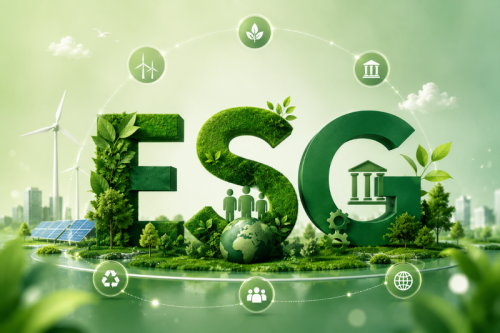
Hanoi has directed municipal departments to implement government guidelines for classifying green projects, circular economy initiatives, and Environmental, Social, and Governance (ESG) frameworks, paving the way for eligible businesses to access interest rate subsidies.
Mr. Bui Duy Cuong, Vice Chairman of the Hanoi People’s Committee, signed Official Dispatch No. 6035/UBND-NNMT regarding the implementation of Prime Minister Decision No. 46/2026/QD-TTg dated September 17, 2026 (Decision 46).
The decision provides technical guidelines for classifying green projects, evaluating circular economy criteria, and applying ESG criteria.
Under Decision 46, enterprises, business households, and individual business entities executing certified green or circular projects and presenting ESG implementation reports will qualify for interest rate support considerations under applicable regulations.
Under the city’s directive, the Hanoi Department of Agriculture and Environment will serve as the focal agency, collaborating with relevant departments, sectors, and commune-level People's Committees to disseminate the decision.
The department is tasked with guiding the implementation of environmental and agricultural criteria for green and circular projects under its state management scope.
The department must compile the list of projects under the scope of Decision 46 to report to the Ministry of Agriculture and Environment. It will advise the municipal People's Committee on publishing the certified list of green, circular, and ESG-compliant projects biannually on the city's portal on June 30 and December 31.
Additionally, the department will inspect, monitor, and address violations regarding independent evaluation entities operating in agriculture and environment sectors, while supervising project compliance maintenance over time.
Concurrently, the Hanoi Department of Finance is assigned to lead data integration for investment management systems and oversee the implementation of governance frameworks. It will assess financial resources and state budget capabilities according to decentralized authority, alongside mobilizing alternative financial mechanisms to support green and circular programs.
The Department of Finance will also inspect and monitor independent rating agencies and ensure project compliance according to legal auditing and administrative violation frameworks.
The Hanoi Department of Industry and Trade will oversee project implementation across energy, processing, and manufacturing sectors. The department is tasked with promoting resource-efficient, low-emission, and sustainable production models, while evaluating criteria for industrial symbiosis and circular linkages.
The Hanoi Department of Construction will handle projects in construction, urban development, technical infrastructure, and transport, promoting resource-saving materials, low-carbon building technologies, and sustainable urban solutions.
Under Decision 46, a green project must meet specific eligibility requirements across designated sectors. Attached technical appendixes outline requirements for ten energy project categories, three transport categories, two construction categories, three water resource categories, 12 agriculture, forestry, fisheries, and biodiversity categories, six processing and manufacturing categories, and nine environmental service categories.
For circular economy projects, the regulations define eight project groups for circular design and manufacturing, two for circular utilization, five for resource recovery, and four for industrial symbiosis and circular integration.