Lumen Vietnam Fund

Blog

Việt Nam regards EAEU as trustworthy partner in AI development

Việt Nam regards EAEU as trustworthy partner in AI development

Deputy PM Hồ Quốc Dũng suggested Việt Nam and the EAEU establish a policy dialogue forum on the responsible use of AI, data protection standards and cybersecurity.

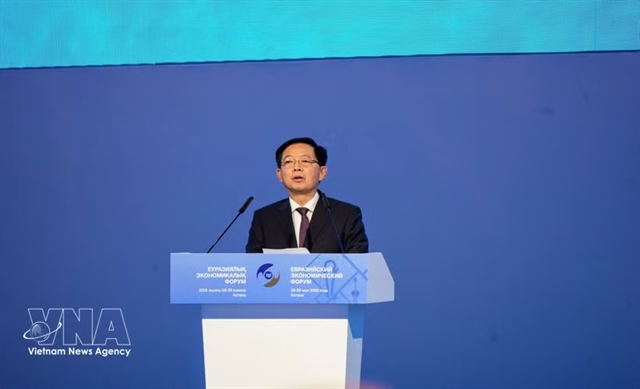
ASTANA — Việt Nam considers the Eurasian Economic Union (EAEU) a trustworthy partner in the development of artificial intelligence (AI) for mutual benefit, Deputy Prime Minister Hồ Quốc Dũng affirmed at the plenary session of the Eurasian Economic Forum held in Astana, Kazakhstan, on Thursday.

In his remarks, Dũng highlighted several of Việt Nam’s achievements in science – technology, innovation, e-government and the digital economy while sharing the country’s approach to AI development. He stressed that Việt Nam identifies science – technology, innovation and digital transformation as foundational drivers and strategic breakthroughs for entering a new era of development.

The Deputy PM also outlined several major directions for advancing the implementation of the free trade agreement (FTA) between Việt Nam and the EAEU amid emerging regional trends such as the digital economy and AI, alongside efforts to promote transcontinental transport corridors and the digitalisation of cross-border trade.

Dũng stressed that the existing agreement between Việt Nam and the bloc provides a solid basis for bilateral economic cooperation. In the current context, they should expand collaboration to new technological areas, including AI research and development covering smart agriculture, urban planning and transport, as well as stronger cooperation between research centres and educational institutions in training personnel in cybernetics and computer science.

The Deputy PM suggested the parties establish a policy dialogue forum on the responsible use of AI, data protection standards and cybersecurity.

On the same day, he held meetings with Chairman of the Board of the Eurasian Economic Commission (EEC) Bakytzhan Sagintayev, Deputy PM of Belarus Natalya Petkevich, and Vice President of Cuba Salvador Valdes Mesa.
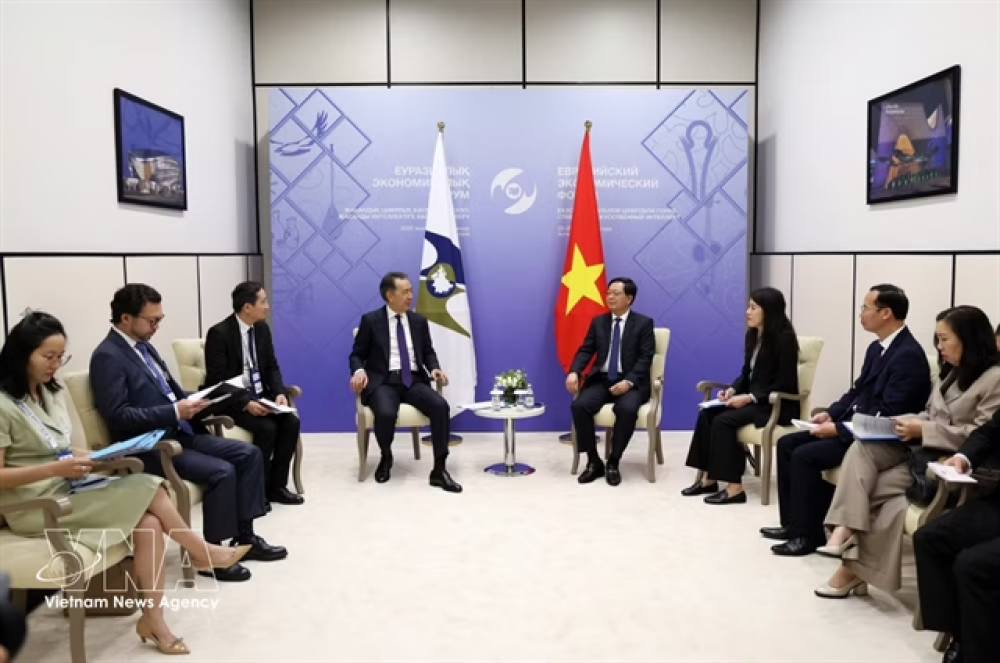
Meeting with Sagintayev, Dũng affirmed Việt Nam’s commitment to cooperation with the EAEU and praised the practical benefits delivered by the EAEU – Việt Nam FTA to businesses and people on both sides over the past decade. He proposed a review of the agreement’s 10-year implementation to identify areas requiring improvement, including the removal of safeguard measures affecting Vietnamese fishery and apparel exports.

The EEC Chairman described the FTA with Việt Nam as a model of successful cooperation for the bloc, noting that trade turnover between the EAEU and Việt Nam reached US$8.3 billion last year. He pledged to work with member states to address Việt Nam’s concerns, while agreeing to strengthen cooperation in digital transformation and technology and to organise activities marking the 10th anniversary of the FTA signing.
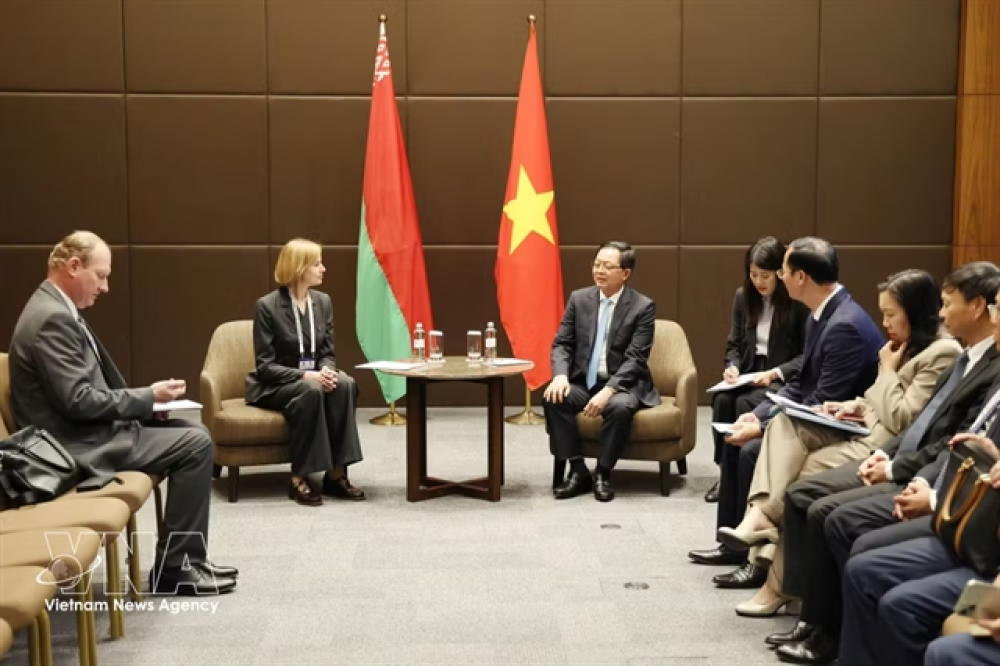
At a separate meeting with the Belarusian Deputy PM, both sides expressed satisfaction with the progress in bilateral relations across politics, trade, tourism and other spheres, especially since Party General Secretary Tô Lâm's state visit to Belarus in May 2025.

Dũng called on Belarus, as an EAEU member state, to support the removal of safeguard measures on Việt Nam's textile – garment products and facilitate access to the EAEU market for the country's agricultural and fishery products. He also urged effective implementation of bilateral agreements, particularly the cooperation roadmap for 2026–2028.

The Belarusian Deputy PM stated that her country views Việt Nam as a strategic and reliable partner in Southeast Asia, and wishes to foster multifaceted cooperation. She voiced confidence that Việt Nam will become a key political, cultural and economic gateway linking Belarus with the wider region.

Petkevich also welcomed Vietnamese investments in Belarus and stronger cooperation between localities of the two countries.

Regarding safeguard measures, Belarus will positively consider raising thresholds for Vietnamese textile products, she noted, requesting that Việt Nam open its market further to some Belarusian agricultural and industrial goods. The official suggested that balancing bilateral trade could help address safeguard concerns.
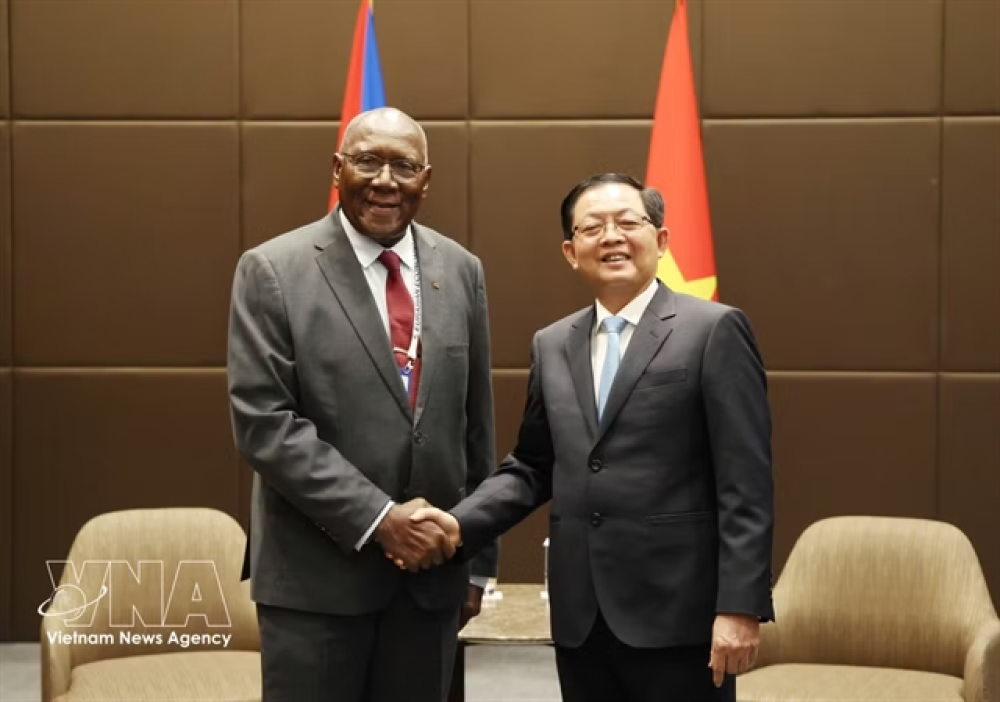
During the meeting with the Cuban Vice President, Dũng described the Việt Nam – Cuba special friendship as a priceless common asset, saying the two countries should continue assisting each other to surmount difficulties.

The two sides agreed to effectively implement the projects on wet rice cultivation and renewable energy, and coordinate to organise activities marking the 100th birth anniversary of Cuban revolutionary leader Fidel Castro in 2026.

On Friday, Deputy PM Dũng is scheduled to meet a Russian deputy prime minister, visit Nazarbayev University and the International Science and Technology Centre, and hold a working session with the Vietnamese Embassy in Kazakhstan.

Source: VNA/VNS

Photo: VNA/VNS
Latest Posts

Green fuel transition gains momentum as E10 goes nationwide

Green fuel transition gains momentum as E10 goes nationwide

Starting June 1, E10 biofuel will officially be distributed nationwide under the Ministry of Industry and Trade (MoIT)’s roadmap, marking a major step in Vietnam’s green energy transition strategy, greenhouse gas emission reduction efforts and commitment to achieving net-zero emissions by 2050.

Under the ministry's Circular No. 50/2025/TT-BCT, all unleaded petrol sold on the domestic market from June 1 must be blended with ethanol to produce E10 for petrol-powered vehicles nationwide. Meanwhile, E5RON92 petrol will continue to be available until the end of 2030.

Expectations mixed with concerns​

Nguyen Duc Thanh, a ride-hailing driver in Hanoi’s Hoang Mai ward, said he previously used E5 petrol and is not overly concerned about switching to E10. His main concerns are fuel prices and consumption efficiency.

​People need sufficient information to feel confident, Thanh said.​

Consumer hesitation largely stems from the earlier rollout of E5 as when many users questioned the quality of biofuels.​

However, according to MoIT, most vehicles currently operating in Vietnam are compatible with E10. Authorities cited technical studies and international experience showing that around 90% of petrol-powered vehicles can use E10 without requiring engine modifications.​

Nguyen Phu Cuong, a resident of Hanoi's Long Bien ward, said transparency and fuel quality control are the most important factors. People will accept the transition if they clearly see the benefits and receive guarantees from authorities. If fuel quality differs between stations, it will be difficult to build trust.

Many vehicle owners in Hanoi also expect E10 adoption to help improve air quality, which remains a major issue in the capital. Environmental experts say ethanol-blended fuel enables cleaner combustion and reduces carbon monoxide and unburned hydrocarbon emissions compared to conventional petrol.

According to authorities, the introduction of E10 will be accompanied by tax and fee adjustments to make it more competitively priced than traditional fossil fuel. The MoIT is proposing revisions to environmental protection and excise taxes to encourage consumers to switch to biofuel.

In Hanoi, many fuel distributors said they have completed upgrades to storage tanks and fuel pumps in preparation for E10 sales from the start of June.

The ministry noted that E10 is already widely used in more than 60 countries, including the US, Japan, the Republic of Korea, Thailand and Brazil.

​Preventing speculation and fraud

Representatives from Hanoi’s market surveillance sub-department said market management teams will coordinate with the municipal Department of Industry and Trade, quality standards authorities and economic police to inspect E10 implementation at fuel retail outlets from June 1. Inspections will focus on fuel quality, price listing, supply stability and acts such as hoarding or selling fuel products that do not meet regulations.

Authorities will strictly handle cases involving fuel speculation, improper fuel sales or arbitrary suspension of sales that disrupt market supply.

Market surveillance officers stressed that the transition to E10 must be implemented in a synchronised manner to prevent profiteering during the policy transition period.

Energy experts described the rollout of E10 as an inevitable trend as Vietnam accelerates its emissions reduction and green transition agenda.

Dr. Ngo Tri Long, an economic expert, said E10 carries not only environmental significance but also positive implications for national energy security. By increasing the ethanol ratio in petrol, Vietnam can reduce dependence on imported fossil fuel while promoting domestic ethanol production.

Technical experts also noted that most modern engines can use E10 normally if the fuel meets quality standards. However, owners of older vehicles or cars with deteriorating fuel systems are advised to conduct regular maintenance checks to avoid corrosion of rubber components or the dissolution of residue inside fuel tanks.

According to specialists, E10 offers clear environmental benefits by helping reduce CO2 emissions, fine dust particles and other toxic pollutants from transport exhaust, a major source of urban pollution in cities such as Hanoi and Ho Chi Minh City.

They added that if implemented methodically, E10 could serve as a stepping stone toward wider adoption of higher-ethanol biofuels such as E15 and E20 in the future.

However, analysts stressed that the biggest challenge remains building public confidence. International experience shows that reasonable pricing, stable quality and transparent market management are essential for biofuels to gain broad consumer acceptance.


Positive momentum of industrial real estate market

Positive momentum of industrial real estate market

Industrial real estate has proven to be robust in recent times, with upwards momentum continuing in the first quarter amid myriad global headwinds.

The latest report from the Ministry of Construction indicates that Vietnam’s industrial real estate market maintained its positive momentum in the opening quarter of 2026, with both rental prices and occupancy rates remaining high. In northern Vietnam, industrial land rents ranged from $90 to $250 per sq m per lease term, with occupancy rates above 80 per cent. Rents in the central region stood at $70 to $120 per sq m, while those in southern Vietnam ranged from $185 to over $280 per sq m, with occupancy exceeding 90 per cent.

Nationwide, rents for ready-built factories and warehouses also edged upwards. Data from DTJ Industrial showed that industrial real estate rents increased by 3-6 per cent year-on-year in the first quarter.

Rising supply, rising rents

According to JLL, the market is expanding in both scale and value. Northern Vietnam currently has nearly 13,000 ha of industrial land across more than 70 operational industrial parks, with new supply in the first quarter exceeding 100 ha. Occupancy stood at 82 per cent, and the cumulative leased area rose to 10,400 ha, up 5 per cent year-on-year. Leading developers, including Kinh Bac City, Deep C, Viglacera, Rox iPark, and VSIP, account for nearly half of developed land.

The ready-built factory segment reached more than 3.6 million sq m across 91 projects, up 14 per cent compared with a year earlier. New supply in the first quarter totaled 159,000 sq m, while occupancy stood at 87 per cent, with leasing activity concentrated in Bac Ninh province and Hai Phong in Vietnam’s north. Rental rates ranged from $4 to $7.1 per sq m per month, reflecting a 4 per cent increase year-on-year.

Modern ready-built warehouses in the north reached a total supply of 2.2 million sq m, representing a 1.7-fold increase year-on-year. The market recorded an additional 162,000 sq m of new warehouse space in the first quarter, including the entry of South Korea’s JIEL Group through the JEIL Logistics Hai Phong project. Average rents climbed to $5.1 per sq m per month, up 10 per cent year-on-year and marking the strongest growth among the three segments.

In the south, the ready-built warehouse segment also posted a positive start to the year. Nearly 50,000 sq m of new supply entered the market in the first quarter, primarily in Dong Nai province, bringing total supply to some 2.5 million sq m. Rental levels rose 0.5 per cent quarter-on-quarter, to $5.07 per sq m per month. Growth was mainly driven by high-quality projects with strong occupancy, while most of the market remained stable or adopted flexible pricing strategies to optimize leasing performance.

Demand continues to come from a diverse range of tenants, including manufacturers, retailers, and e-commerce companies serving both the domestic and export markets. However, occupiers are becoming more selective, prioritizing logistics facilities with strong connectivity, completed infrastructure, and high operating standards in order to optimize costs and improve supply chain efficiency. This shift reflects a growing focus on quality assets and strategic locations, particularly in established industrial parks linked to Ho Chi Minh City and key seaports.

Strategic manufacturing and logistics hub

Despite the global uncertainties, Vietnam remains a strategic destination for manufacturing and logistics. Industrial real estate activity continues to be supported by stable macro-economic conditions, expanding FDI, and ongoing improvements in infrastructure.

Ms. Nguyen Hong Van, Head of Transactions at JLL Vietnam, said geopolitical tensions have not weakened the market but have created short-term pressure through rising logistics costs, which in turn are influencing site selection decisions. Locations with well-developed infrastructure and strong connectivity are increasingly favored, while ready-built industrial properties are emerging as a cost-efficient solution.

Vietnam’s industrial and logistics market is also benefiting from global supply chain diversification and a sustained shift toward ready-built facilities. Investors from South Korea, Singapore, China, Japan, and Europe continue to expand operations, particularly in electronics, semiconductors, automotive components, and high-tech industries. “The availability of diverse real estate solutions, from industrial land to ready-built and build-to-suit facilities, allows manufacturers to enter the market at different scales and expand over time,” Ms. Van said.

According to Mr. Nguyen Quoc Khanh, Chairman of DTJ, several structural drivers are reinforcing market growth. Newly-registered FDI surged in the first quarter of 2026, with capital continuing to flow into manufacturing and processing.

At the same time, Vietnam is piloting next-generation free economic and trade zone models designed to attract high-quality investment through institutional innovation rather than traditional tax incentives. The Hung Yen Free Economic Zone, with a planned scale of 30,538 ha and total investment of $18 billion, has been approved at the provincial level and is moving toward submission to the central government. In Hai Phong, its free trade zone has entered the implementation phase, with a focus on integrating port, logistics, and industrial ecosystems.

Public investment in infrastructure is also accelerating. Major projects such as Ring Roads 4 and 5 in the Hanoi region, Gia Binh Airport, and the Hanoi - Ha Long high-speed railway are expected to strengthen supply chains in the Red River Delta and stimulate industrial real estate demand.

Infrastructure reshaping the market

Mr. John Campbell, Director of Industrial Services at Savills Vietnam, noted that with approximately 234 large-scale projects underway and total investment estimated at VND3,400 trillion ($130.8 billion), the country is entering a new phase of infrastructure-led growth. Key developments such as Long Thanh International Airport, metro systems in Hanoi and Ho Chi Minh City, and more than 380 km of newly-operational North-South expressways are opening new economic corridors and supporting the formation of integrated supply chain ecosystems.

Infrastructure development continues to play a central role in Vietnam’s industrial transformation. In the north, sectors such as electronics, semiconductors, and high-value manufacturing are being driven by sustained investment in seaports, expressways, and logistics networks. In the south, large-scale infrastructure projects are expected to reshape freight flows and support new development corridors, while improved transport links will strengthen interregional connectivity and the efficiency of goods movement.

Mr. Campbell said the market’s growth momentum is expected to strengthen over the course of 2026. Infrastructure rollout will open up new industrial clusters, while policies supporting high-value industries are likely to attract additional quality investment. At the same time, Vietnam’s digital capacity is expanding with the development of large-scale data centers, reinforcing the country’s competitive position as it shifts toward more advanced manufacturing and technology-driven supply chains.

The core of this transformation, he noted, lies in scaling up while improving quality, supported by alignment across infrastructure, technology, human capital, and policy. Future growth is expected to come from high-value industries that depend on stable energy supply, modern industrial and distribution systems, and integrated digital infrastructure.

Looking ahead, JLL expects rental rates in northern Vietnam to rise by 4-6 per cent annually, particularly in areas near seaports, airports, and major expressways. Occupancy is projected to remain high, with industrial land above 80 per cent, while factory and warehouse occupancy should improve from late 2026 as new supply is absorbed.

Western Australia, Vietnam expand cooperation across key sectors

Western Australia, Vietnam expand cooperation across key sectors

VOV.VN - Vietnamese Consul General in Perth Pham Hai Anh on May 28 received David Morgan, Chairman of the Western Australia Vietnam Business Council (WAVBC), at the Consulate General headquarters in Perth.

During the meeting, the two sides discussed measures to deepen cooperation between Vietnam and Western Australia in key areas including trade, investment, science and technology, tourism and people-to-people exchanges.

Pham Hai Anh stressed that the strong political relationship between Vietnam and Australia should continue to be translated into substantive and effective economic and investment cooperation programmes commensurate with the potential and needs of both sides.

Appreciating WAVBC’s role as a bridge in promoting economic and trade links between Vietnam and Western Australia, the consul general called for closer coordination to step up information sharing on investment opportunities and support business connectivity.

Priority areas include science and technology, strategic minerals and high-tech agriculture, alongside stronger promotion of cooperation potential through tourism, cultural activities and people-to-people exchanges.

Congratulating Pham Hai Anh on officially assuming his post in Western Australia, David Morgan said the state holds considerable cooperation potential but remains relatively little known in Vietnam. Likewise, the Australian business community still lacks sufficient information about the capabilities of Vietnamese partners.

WAVBC’s priority in the coming period is to strengthen business connectivity, particularly among small and medium-sized enterprises, Morgan told his guest.

He added that the council places special emphasis on younger entrepreneurs in order to build a solid foundation for future cooperation.

Morgan also noted that technology, innovation, artificial intelligence (AI) and automation will be priority areas for cooperation in the coming period.

At the end of the meeting, the two sides agreed to maintain close coordination in implementing the above directions while further boost locality-to-locality cooperation, particularly business connectivity between Ho Chi Minh City and Perth through representative organisations.

They also concurred to intensify delegation exchanges, networking activities and regular information sharing.


See all blog