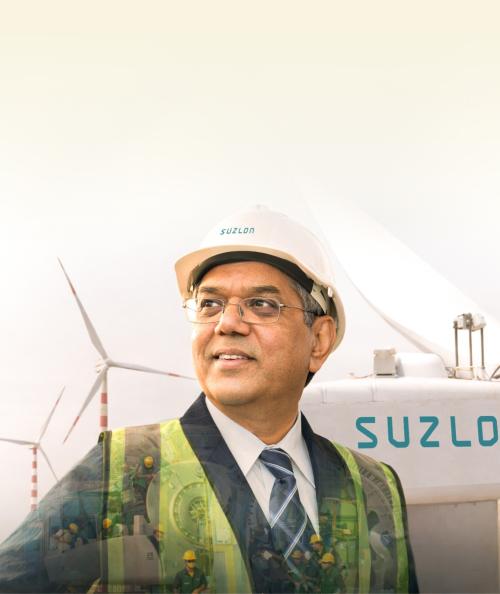
Speaking with Vietnam Economic Times / VnEconomy on the sidelines of the APAC Wind Energy Summit 2026 in Hanoi, Mr. Girish Tanti, Vice Chairman of Suzlon Group, said Vietnam is not only a promising market but also has the potential to become a regional hub for renewable energy development, services, and supply chains.
Nearly seven months have passed since Suzlon first began actively exploring opportunities in Vietnam. How would you assess the current outlook for Vietnam’s wind energy market, particularly in light of the revised Power Development Plan VIII and the country’s long-term energy transition goals?
Vietnam, within Asia, stands out, in terms of its bold targets-almost 24 gigawatts of renewable energy already operational, and 7 gigawatts of wind operational in the country, and set out a very strong goal for energy green transition by 2035, to adoption of renewable energy.
It is the fastest growing renewable energy market in the region, and Suzlon being one of the pioneers in Asia, we have opened up several markets in Asia, with product portfolio ranging from 2 megawatt to almost 6 megawatt now, largely focused on onshore wind.
We see Vietnam market for onshore, near shore also pretty interesting, that is something that is more likely to happen in the immediate future, and we are very confident that we should be able to make a meaningful contribution to Vietnam's growth from here.
Does Suzlon view Vietnam primarily as a potential market for wind turbine sales, or does the Group see Vietnam as a strategic manufacturing and service hub for Southeast Asia in the future?
Vietnam being the largest market in Southeast Asia has a very unique position, because it is an early starter with probably the largest, almost 7 gigawatts installed wind fleet. It is very uniquely placed to play a regional role.
Any company that is focused around renewable energy operating out of Vietnam, will use Vietnam as a regional player, so we too will not just focus on the supply of wind turbines, but also the full scale service of wind turbines, and then using it as a base for the rest of Asia.
If market conditions are favorable, would Suzlon consider establishing its first manufacturing facility or technical service center in Vietnam during the 2027-2030 period?
I think we are in the first phase of kick-starting our build-out in Vietnam, so we are in that stage where we are connecting with all the key developers and customers to see how we can develop long-term portfolio projects with our customers.
And as the outcome of that come out, I think the first phase service business will pick up, then we will have new turbine sales, and with that then we will look at how we can build the supply chain ecosystem in Vietnam, not just for Vietnam, but for the rest of the region.
Suzlon played an important role in helping India develop a strong domestic wind energy manufacturing ecosystem. Based on that experience, what lessons could Vietnam learn to build its own wind power supply chain and supporting industries?
I think Vietnam has a beautiful opportunity right now, we can replicate some of the things we did in India.
First and foremost for any market to grow and develop in a strong way, you need a stable policy.
Vietnam now has a good vision and a stable policy in place, which is very critical.
The second important element is to make sure that you have the right infrastructure to be able to build this.
So your grid infrastructure, your port infrastructure, all the other infrastructure to allow renewable energy adoption.
The third is, you know, having the market development, creating the demand for adoption of renewable energy and energy transition, that is another third important area.
And when we look at building the ecosystem for manufacturing, I think it's important that you do a phased manner adoption of local development of things, otherwise it can hamper your growth.
So while the growth is coming out, not to slow down your growth, it's important that we build out ancillary industries and ecosystems across Vietnam, which can benefit from the growth of the renewable sector also.
Many wind farms in Vietnam are now entering the operational phase and require professional maintenance services. How does Suzlon evaluate the potential of the operations and maintenance (O&M) market in Vietnam?
So you have 77 gigawatts of already installed capacity of wind. Suzlon today operates close to about 21.5 gigawatts globally, around 17 nations that we have this fleet.
Within Asia itself, the largest part of this fleet is there. So very strong competency and we are close to Vietnam geographically also. So I think in India, Vietnam cooperation is very good. So there is a good partnership relationship between the two countries. I think we can leverage that to build a whole ecosystem, which can be of mutual benefit on that.
And definitely the service business is an important piece, and Suzlon has been very strong on the service side. Because we strongly believe it's not just installing the turbines, it's making sure that the green electrons delivered over the life of the project, which ultimately gets investors to kind of reinvest into renewable energy.
Today we see almost 90% of Suzlon's business comes from repeat business, which is primarily because they are happy with Suzlon's performance.
Chinese wind turbine manufacturers have expanded rapidly across Asia with highly competitive pricing. How does Suzlon differentiate itself and compete in markets such as Vietnam?
Cost competitive and affordability of energy is very critical. Suzlon's unique proposition is that, like if you see our current 5 megawatt and 6 megawatt project, which we launched at this conference for the Asian market, the Blue Sky platform, both of these are very uniquely designed to meet the energy profile and the grid requirement of this region and the climate requirement.
The 5 megawatt is largely for the low wind conditions to extract the maximum energy. And you have a 6 megawatt, which is a high wind turbine, which can extract energy from higher 8, 9 meters per second of that.
So I think with this combination of two turbines, today effectively we are able to provide almost 90% coverage of any wind sites that exist in Asia to fit this turbine.
So the competitiveness is coming purely not just from cost, but it is the value delivery.
So from a cost per kilowatt hour, there is a little, at times people just look at the capital cost, but you must also see the life cycle cost, LCOE as we call it.
I think Suzlon product is very competitive on the life cycle cost of a turbine, means a unit cost of generation of electricity from Suzlon will be competitive to any other product. And these two products are powerhouses. They are very strong on performance.
Suzlon is entering a new phase of global growth and business transformation. Within Suzlon’s long-term international strategy, what role do you envision Vietnam playing over the next five to ten years?
We are entering a new phase of Suzlon 2.0, where we are growing the global markets in a big way. We will also grow beyond wind.
So the idea is to do wind solar storage and make firm renewable energy. So we will work with partners and develop plans of not just one or two years from project to project, but build relationships for a decade and help them build their energy portfolio of wind solar storage together.
Technical partner, operational partner, end-to-end service. And Vietnam is uniquely placed with its strong ahead-of-the-curve build-up of renewable energy. So we will be leveraging that for the Asia market build-up.