Lumen Vietnam Fund

Blog

First project breaks ground at Hanoi’s Silver Lake Biotechnology High-Tech Park

First project breaks ground at Hanoi’s Silver Lake Biotechnology High-Tech Park

Pacific Land Vietnam JSC held a groundbreaking ceremony on the morning of November 24, for the Ando Gateway Buildings project, marking the first construction project to get underway at Hanoi’s Silver Lake Biotechnology High-Tech Park in Thuong Cat ward, Hanoi.

Located at the western gateway to the capital, adjacent to Tay Thang Long Boulevard, Silver Lake covers nearly 199.3 hectares and is being developed by Pacific Land Vietnam. The project is envisioned as a multi-functional biotechnology high-tech park integrating research and development, high-tech manufacturing, premium residential areas, commercial and service facilities, education and training, and healthcare.

Its key areas of focus include biomedicine and biopharmaceuticals, high-tech agriculture, microbial technology and environmental treatment, as well as advanced biological equipment and solutions.

With an integrated system of amenities ranging from green spaces and regulating lakes to commercial and service complexes, hospitals, schools, accommodation for senior experts, and Grade A office buildings, Silver Lake also aims to create a modern and attractive environment for living and working. The development is expected to attract high-quality talent and technology businesses, while establishing a centre for biotechnology research, application, and commercialisation in Vietnam, with the ambition of gradually expanding its links across Southeast Asia.

The groundbreaking of Ando Gateway Buildings marks a milestone in the development of Hanoi’s Biotechnology High-Tech Park.

Located on plot D-TMDV05 within the park in Thuong Cat ward, Hanoi, the project covers approximately 23,800 square metres and has a total investment of nearly VND2 trillion ($78 million).

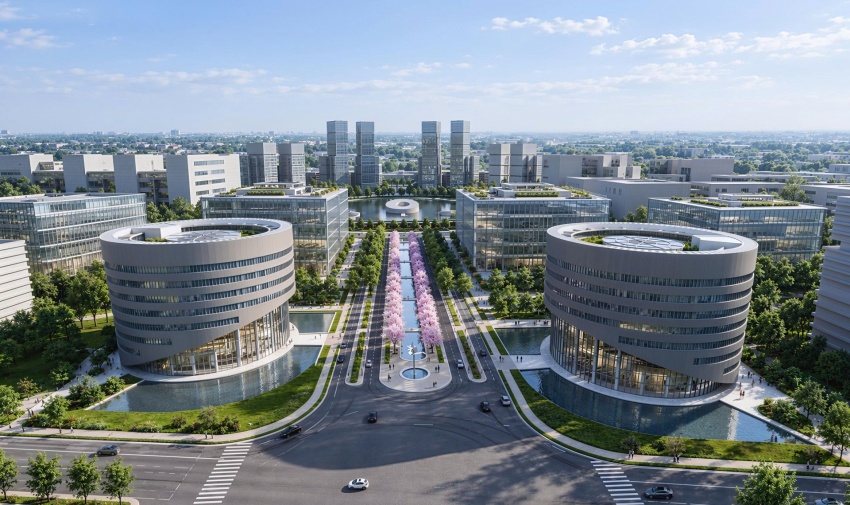
Ando Gateway Buildings comprises two structures, Ando Gateway Building Sakura and Ando Gateway Building Anh Dao. Each building is designed with eight above-ground floors and one rooftop floor. The development follows a multi-functional complex model, combining a premium shopping centre, Grade A office space for lease, and dedicated research and laboratory facilities.

The complex will also incorporate reception areas, exhibition spaces, meeting rooms, and international conference facilities. Bringing these functions together in one development is intended to meet a diverse range of commercial, business, educational, and scientific research needs.

Notably, the two buildings were designed by renowned Japanese architect Tadao Ando, recipient of the prestigious Pritzker Architecture Prize.

For this project, Ando has adopted the central concept of “Two Circles”, inspired by pure geometry and spatial balance. At the gateway to Silver Lake, the two cylindrical buildings share a consistent architectural language and are symmetrically positioned on either side of the boulevard, creating a harmonious overall composition.

The podiums are designed with diagonal cuts facing the boulevard, opening up spacious reception areas and multi-storey atriums. This architectural arrangement reinforces the “Two Circles” concept while giving the development a distinctive identity at the entrance to Silver Lake.
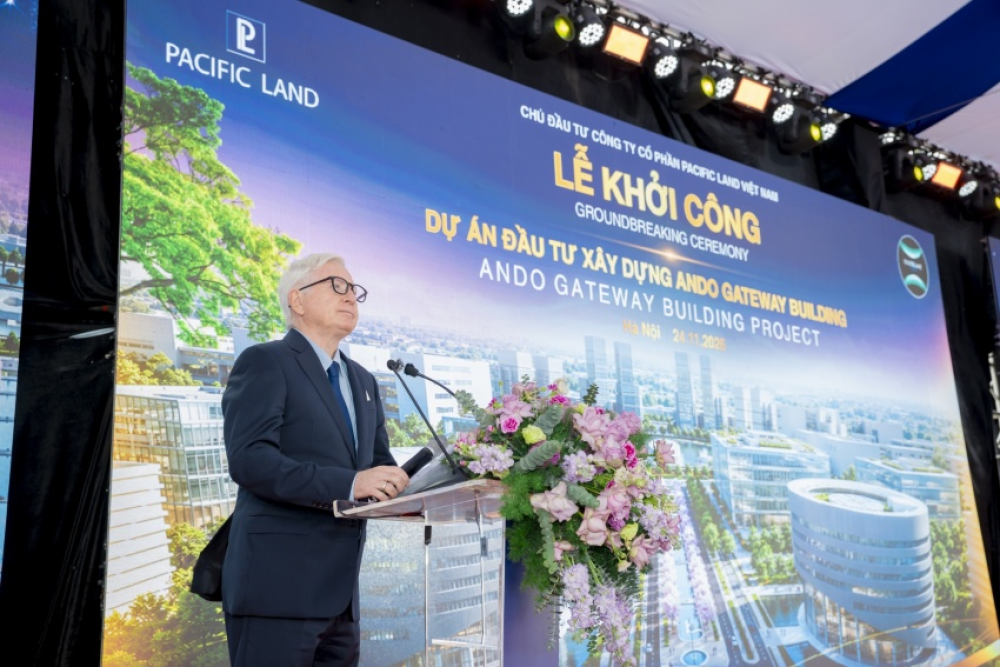
Patrick Gerard McKillen, chairman of Pacific Land Vietnam, said the Hanoi Biotechnology High-Tech Park was a practical step towards implementing the policies and directives of the prime minister, the Hanoi Party Committee, and the Hanoi People's Council. It would also contribute to the implementation of Resolution No.57-NQ/TW on breakthroughs in sci-tech development, innovation, and national digital transformation.

He said the development of Ando Gateway Buildings during Silver Lake's initial phase represented a concrete step towards realising the overall development vision for the project. Upon completion, the complex is expected to become one of the park's key landmarks, helping create new advantages for business operations, research, and international cooperation.

“We see Ando Gateway Buildings as more than an architectural landmark at the gateway to Silver Lake. It is also intended to gradually establish an integrated ecosystem encompassing commerce, services, research, and high-tech manufacturing, providing a platform for businesses, organisations, and experts to connect and contributing to the coordinated development of the entire park," McKillen said.

“Pacific Land Vietnam is committed to mobilising the necessary resources and working closely with relevant partners to deliver the project as planned, with a strong focus on construction quality and long-term value,” he added.


Source: Nguyen Huong
Latest Posts

International flight frequency to Vietnam rises 8.3% in winter 2026

International flight frequency to Vietnam rises 8.3% in winter 2026

Eighty-three airlines are operating international flights to and from Vietnam under the winter 2026 schedule at a total frequency of 3,523 round-trip flights per week, up 271 flights per week, or 8.3%, from the previous winter season, according to the Civil Aviation Authority of Vietnam (CAAV).

The network includes four Vietnamese carriers operating more than 117 international routes to 22 countries and territories, up six routes year-on-year, and 79 foreign airlines from 31 countries and territories running regular services on 159 routes to Vietnam, up 16 routes.

New carrier Sun PhuQuoc Airways also entered international operations this winter with 18 routes to 10 countries and territories at 126 round-trip flights per week.

Among key markets, the Republic of Korea led with 625 round-trip flights per week, followed by China with 595 and Thailand with 343. China recorded the sharpest expansion, adding 60 round-trip flights per week and three airlines compared with winter 2025, while Singapore, Malaysia and the Philippines increased by 47, 34 and 32 round-trip flights per week, respectively.

At major gateway airports, Noi Bai International Airport handled 53 international airlines with 1,299 round-trip flights per week, up 181 from winter 2025, while Tan Son Nhat International Airport served 52 airlines with 1,199 round-trip flights per week. Da Nang, Cam Ranh and Phu Quoc also kept high operating volumes, with Phu Quoc reaching 276 international round-trip flights per week, up 79 flights and seven international routes operated by Vietnamese carriers.

The aviation authority said the expanded network reflects steady international air connectivity demand with Vietnam, supporting passenger transport capacity, tourism, trade and international exchanges.


Ninh Binh approves $117m bridge and road project

Ninh Binh approves $117m bridge and road project

The project is expected to establish a direct transport link between the Gian Khau urban and industrial area and the left bank of the Day River.

Authorities of northern Ninh Binh Province have approved a project to build a bridge across the Day River and a connecting road linking National Highway 1A with the No. 07 Longitudinal Road.

The project has a total investment of nearly VND3 trillion (approximately $117 million), funded by the provincial budget, and is scheduled for implementation between 2026 and 2028.

Stretching nearly 12 kilometerss across three communes – Gia Tran, Phong Doanh and Tan Minh – the project is expected to establish a direct transport link between the Gian Khau urban and industrial area and the left bank of the Day River.

The road will run approximately 11.84 kilometers, starting at its junction with National Highway 1A in Gia Tran Commune and ending at an intersection with National Highway 37B in Tan Minh Commune. It will have four motor vehicle lanes, with three different cross-sectional designs to suit existing operating conditions and future expansion plans.

A key feature of the project is the construction of two major bridges, each with a deck width of 22.5 meters, including a 613.9-m bridge across the Day River, and a 301.4-m bridge crossing the eastern section of the North-South Expressway (CT.01).

The approval marks a step towards completing Ninh Binh’s strategic transport infrastructure following its administrative merger. Once completed, the new bridge and connecting road are expected to overcome the natural barrier created by the river, strengthen regional and inter-provincial connectivity, and shorten travel and trading distances between the Gian Khau urban and industrial area and communities on the river’s left bank.


French-led consortium signs consultancy contract for Vietnam’s North-South high-speed railway

French-led consortium signs consultancy contract for Vietnam’s North-South high-speed railway

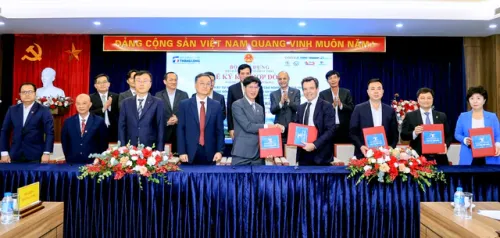
A consortium of eight firms from France, South Korea, and Vietnam signed a consultancy contract for Vietnam’s North-South high-speed railway project with the Thang Long Project Management Board on Wednesday afternoon.

Led by France’s SYSTRA, the consortium includes three South Korean firms – Sambo Engineering, Yooshin Engineering Corporation, and Korea National Railway (KNR) – and four Vietnamese firms – TEDI, TEDI SOUTH, TRICC, and HOANG LONG.

Speaking at the signing ceremony, Dinh Cong Minh, director of the Thang Long Project Management Board, said the railway would span about 1,541 kilometers, with 23 passenger stations and five freight stations.

It will feature double tracks with a standard gauge of 1,435 millimeters, a design speed of 350 kilometers per hour, and an axle load of 22.5 metric tons.

The railway is a national key project of exceptional scale and strategic significance, expected to play a vital role in Vietnam’s socioeconomic development in the years ahead.

Minh said the consultancy package, which includes a feasibility study and front-end engineering design (FEED), would provide a crucial basis for investment approval, technology selection, technical standards, cost estimates, and contractor selection for subsequent packages.

He urged the consortium to promptly mobilize personnel and experts, draw up a detailed implementation plan, and leverage its international experience to ensure the quality and timely completion of the consultancy work.

A consortium representative said the group aimed to strengthen Vietnam’s railway industry through close cooperation, hands-on training, and active participation by Vietnamese experts and organizations.

The consortium also pledged to develop realistic implementation plans, prepare rigorous cost estimates, carefully assess alternatives, identify risks early, and provide well-founded recommendations to Vietnamese authorities.

Quality, progress remain top priorities

Deputy Minister of Construction Bui Xuan Dung said this was Vietnam’s first high-speed railway project of such scale and technical complexity, making the preparatory phase critical to its feasibility, quality, and investment efficiency.

He called on the consortium to establish a professional management structure, mobilize key personnel, and set clear deadlines for each deliverable.

Survey data must be comprehensive, accurate, and reliable to support route alignment, engineering design, and investment cost estimates.

The deputy minister also stressed the need to structure bidding packages appropriately to ensure competition, transparency, and compliance with Vietnamese law.

The feasibility study and FEED must incorporate advanced technologies and technical standards suited to local conditions, ensuring safety, operational efficiency, and effective long-term maintenance.

The consortium was also urged to prioritize technology and expertise transfer to help Vietnamese engineers gradually master high-speed railway technology.

He said timely completion of package TV-02 was a top priority, with clear milestones, defined responsibilities, and regular progress monitoring.

“All parties must strictly honor their contractual commitments and refrain from shifting responsibility. Accelerating progress must go hand in hand with maintaining quality,” he emphasized.

See all blog