Lumen Vietnam Fund

Blog

Cutting the cost of adoption of climate-resilient technologies

Cutting the cost of adoption of climate-resilient technologies

A recent report found that lowering trade barriers to climate-resilient technologies, expertise, and data could help Vietnam’s agricultural sector respond to rising climate risks.

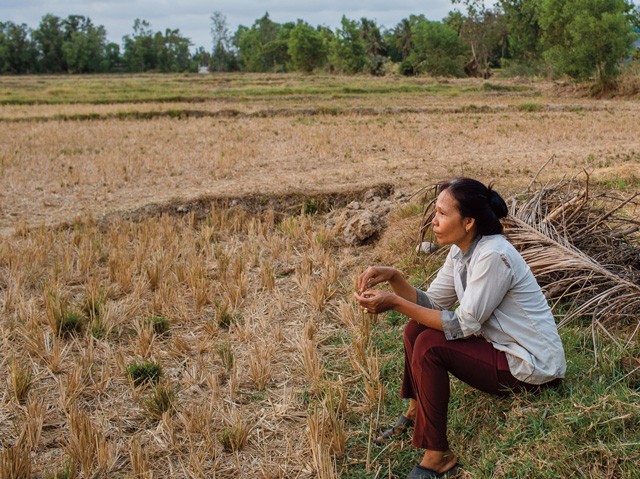
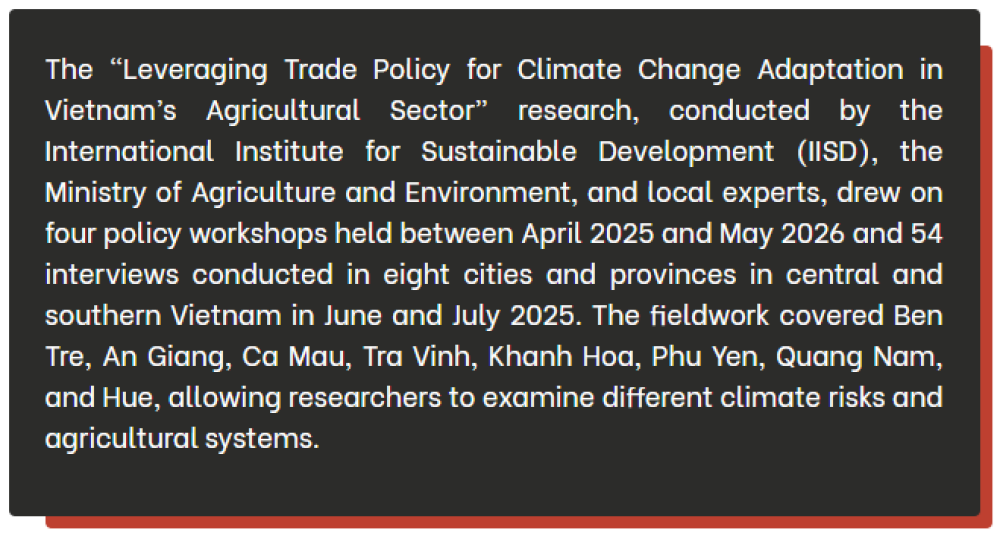
Vietnam’s agricultural sector is confronting a widening range of climate threats, from saltwater intrusion and drought to floods, typhoons, and rising temperatures. A new report from the International Institute for Sustainable Development (IISD) argued that trade policy could become an important, but so far underused, tool for helping farmers and agricultural businesses adapt.

The report, entitled “Leveraging Trade Policy for Climate Change Adaptation in Vietnam’s Agricultural Sector,” identified the goods and services needed to advance Vietnam’s adaptation priorities and examined the barriers that could prevent them from reaching the market. Its central finding was that while tariffs have generally declined as Vietnam has integrated into the global trading system, non-tariff measures and regulatory requirements can still make adaptation technologies more costly and difficult to access.

Adoption priorities

The report found that climate change is affecting all eight cities and provinces studied, though the risks vary considerably by region. In the Mekong Delta, saline intrusion is among the most pressing threats. Ben Tre, Tra Vinh, and Ca Mau provinces experienced their most severe saline intrusion in more than 60 years during the 2015-2016 and 2019-2020 dry seasons, damaging rice and fruit and causing major economic losses. In An Giang province, increasingly irregular cycles of flooding and drought have disrupted traditional rice production and aquaculture.

Central coastal provinces face a different combination of risks. Khanh Hoa and Phu Yen are exposed to stronger storms, drought, and coastal erosion, while Quang Nam and Hue have suffered repeated typhoons, floods, and landslides.

Citing World Bank estimates, the report said climate-related damage could cost Vietnam 12-14.5 per cent of GDP by 2050, equivalent to cumulative losses of $400 billion-$523 billion. Agriculture alone has about $1 billion in annual GDP and 1.5 million workers directly exposed to intense flood risks, while 1.1 million tons of aquaculture production worth almost $1 billion in exports are at risk from flooding each year.

Vietnam’s National Adaptation Plan for 2021-2030, with a vision to 2050, identifies 27 adaptation priorities for agriculture. The IISD report found that 19 of them have an international trade dimension because they involve goods or services that can be bought, sold, or provided across borders.

The solutions required are highly-dependent on local conditions. In the north, farmers may need cold-tolerant crop varieties, soil stabilization technologies, and small-scale irrigation. Central localities have greater demand for drought-resistant crops, decentralized water storage, and storm-resilient infrastructure. In the Mekong Delta, meanwhile, priorities include salt-tolerant rice, brackish-water aquaculture breeds, and equipment for monitoring salinity.

The report grouped adaptation goods into four broad categories: climate-resilient crop and livestock varieties; efficient irrigation systems; post-harvest handling and storage equipment; and protective infrastructure.

It also identified consulting and technical training, water-quality monitoring, weather forecasting, early-warning systems, disease detection, agricultural insurance, market services, and engineering as part of the adaptation toolkit.

Its research found that many of these solutions are already being adopted. In the Mekong Delta, farmers and cooperatives in Ben Tre, Tra Vinh, and Ca Mau are moving away from conventional rice production toward rice-shrimp systems that can operate in brackish water.

In An Giang, adaptation has focused on irrigation, resilient rice varieties, and closed-loop aquaculture. The province has invested in the VND147 billion ($5.9 million) Bay Nui irrigation system, while farmers have diversified into vegetables and flowers grown in greenhouses. In Khanh Hoa, aquaculture operators are adopting storm-resistant high-density polyethylene cages and automated systems, while more than 800 ha of rice land have been converted to higher-value crops.

Hidden barriers

Since joining the WTO in 2007, Vietnam has signed more than 17 free trade agreements, including the Comprehensive and Progressive Agreement for Trans-Pacific Partnership (CPTPP) and the EU-Vietnam Free Trade Agreement (EVFTA). But the report found that specific adaptation technologies can still face residual tariffs or classification problems. Specialized equipment such as hydrological sensors and precision irrigation components may fall under tariff lines that do not qualify for zero-duty treatment, raising the cost of adoption.

More significant, however, are non-tariff measures. Importers of climate-resilient seeds, livestock breeds, and agricultural technologies can face authorization, testing, product registration, certification, labeling, and traceability requirements. While these measures can serve legitimate goals such as protecting human, animal, and plant health, the report said they can also delay market entry and raise costs.

For specialized, low-volume adaptation products, those costs can be particularly burdensome. Imported salt-tolerant seeds, for example, may require labels containing detailed information that differs from the original packaging used by international suppliers, forcing importers to undertake additional relabeling.

The barriers extend beyond physical products. Foreign providers of specialized adaptation services can encounter restrictions on foreign ownership and commercial presence, while climate modelers, agronomists, and engineers may need work permits or additional recognition of their qualifications. The report said the resulting administrative requirements can increase the time, cost, and regulatory uncertainty involved in bringing specialized expertise into Vietnam.
Data rules could become another constraint as climate services become increasingly digital. Advanced weather forecasting and AI-driven climate models depend on continuous, two-way data flows. The report noted that Vietnam’s evolving cybersecurity and data-localization framework may affect the transfer of non-personal scientific and meteorological data, potentially creating operational hurdles for international providers.

Coordinated trade

The IISD report called for Vietnam to establish an official category of climate adaptation goods and services and to regularly update it as climate risks, technologies, and agricultural needs change.

That list could then become the basis for reviewing tariffs, customs procedures, standards, and services regulations. The report recommended reducing or eliminating import tariffs on identified adaptation goods where appropriate, simplifying tax exemptions and customs procedures, and using digitalization and risk-based controls to accelerate trade.

It also called for greater regulatory convergence, including alignment with international standards and mutual recognition agreements that could reduce the need for repeated testing and certification.

For services, the report recommended mutual recognition of professional qualifications, faster visa and work permit procedures for foreign specialists, and trade provisions that facilitate cross-border flows of non-personal climate data.

The report stopped short of presenting trade liberalization as a solution on its own. Rather, it argued for closer coordination between trade, agriculture, water, and infrastructure policy-makers, supported by technical assistance, climate finance, and capacity building.

Its broader message is that the goods and services needed for adaptation will evolve, and policy will need to evolve with them. Vietnam must identify where domestic supply is sufficient, where imports or foreign expertise are necessary, and where international cooperation can fill gaps.

For an agricultural economy increasingly exposed to climate shocks, the report suggested that trade policy should not be viewed only as a mechanism for moving goods across borders. Properly designed, it can also help determine how quickly farmers gain access to the technologies, knowledge, and services needed to keep producing in a changing climate.

Source: Linh Dan
Latest Posts

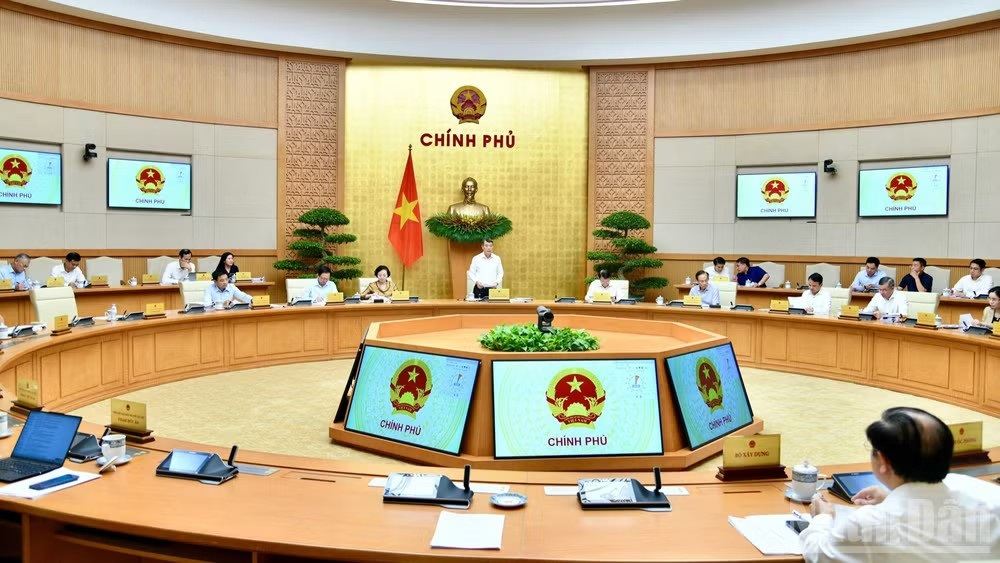
PM pushes to remove legal overlaps and bottlenecks, unlock resources

PM pushes to remove legal overlaps and bottlenecks, unlock resources

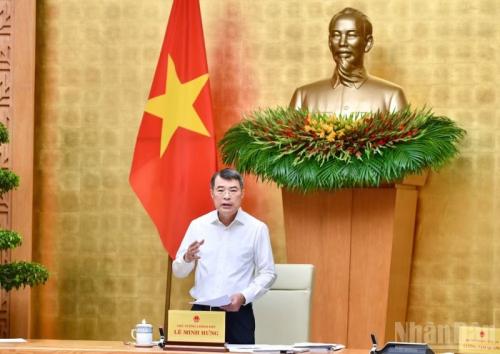
Chairing the September thematic session on lawmaking, Prime Minister Le Minh Hung called for the thorough resolution of overlapping and inadequate regulations, the unlocking of resources, the protection of the legitimate rights and interests of citizens and businesses, and greater efficiency in state management.

Chairing the Government's September thematic session on lawmaking, Prime Minister Le Minh Hung called for the thorough resolution of overlapping and inadequate regulations, the unlocking of resources, the protection of the legitimate rights and interests of citizens and businesses, and greater efficiency in state management.

The session, held on September 16, considered and gave opinions on eight draft laws and resolutions scheduled to be submitted to the second session of the 16th National Assembly.

The Government leader asked ministers to personally direct the full incorporation of appropriate comments from Government members, the Ministry of Justice's appraisal opinions, and the conclusions reached at the session. Ministries were instructed to urgently finalize the dossiers for the draft laws and resolutions and report them to the Deputy Prime Minister in charge before September 21.

Regarding the draft amendment to the Land Law, the PM described it as a particularly important legislative project with a direct and far-reaching impact on socio-economic life.

The draft must also ensure consistency with the Housing Law, the Law on Real Estate Business and other relevant legislation. The Government will accelerate the development and integration of land databases based on the principle of maximum transparency and promote transactions in the market. It will also continue decentralizing and delegating authority while simplifying administrative procedures according to the principle of “one point of contact, one-stop service.”

For the draft revised Housing Law, PM Hung assigned the Ministry of Construction to continue studying and refining mechanisms concerning the useful life of apartment buildings, different types of rental housing, and accompanying financial mechanisms.

The regulations should aim to simplify procedures for investment in, development of and access to housing, meeting people's need for stable, long-term accommodation. At the same time, they should clearly establish criteria for restricting the subdivision and sale of residential land plots and preventing speculation.

The PM also asked the ministry to study and report to the National Assembly on a proposal to pilot a mechanism under which the State could buy back commercial housing projects from developers that are no longer capable of implementing them or are unable to transfer them to another party.

Regarding the draft revised Law on Real Estate Business, the Ministry of Construction was tasked with completing mechanisms to make the real estate market a public, transparent, healthy, stable and sustainable channel for allocating land resources.

The draft law should clearly define criteria for identifying speculative activities and market manipulation, while ensuring legal certainty and protecting the rights and interests of market participants, particularly homebuyers.

It should also provide for the connection and sharing of real estate data with land, planning, tax, notarization, population and credit databases.

For the law amending and supplementing a number of provisions of the Investment Law, the Government's objective is to continue removing institutional barriers and bottlenecks while ensuring policies that are stable, transparent and easy to implement, as well as fair and consistent treatment of investors.

Investment incentives and support policies should focus on attracting high-quality and high-tech projects that involve technology transfer and linkages with domestic enterprises. At the same time, overlapping provisions with laws on land, construction, planning, bidding and the environment must be definitively resolved.

Easing difficulties for production and ensuring major economic balances

Alongside lawmaking, PM Hung directed several key and urgent socio-economic tasks, with a particular emphasis on achieving the country's growth target.

Ministries and sectors were instructed to continue promoting public investment and removing obstacles so that delayed and long-standing projects can be put into operation. They must also ensure progress on key projects and works, particularly in infrastructure, transport, science and technology, and energy, while maintaining macroeconomic stability, controlling inflation and safeguarding major economic balances.

The Prime Minister asked the Ministry of Finance to coordinate with the Ministry of Industry and Trade and local authorities to assess the situation facing businesses, particularly small and medium-sized enterprises, and promptly address their difficulties and obstacles in order to facilitate production and business activities.

Regarding the fuel and electricity markets, the Ministry of Industry and Trade was instructed to closely monitor developments and ensure adequate reserves and supplies from now until the end of the year. It was also asked to urgently submit amendments to Decree No. 83 on petroleum trading, finalize the amended and supplemented Power Development Plan VIII, and complete the overall plan for restructuring the electricity sector.

Vietnam sees market upgrade as starting point for new stock market development cycle: PM

Vietnam sees market upgrade as starting point for new stock market development cycle: PM

From September 21, Vietnam’s stock market will officially be classified as a “Secondary Emerging Market” under FTSE Russell’s classification framework.

Vietnam views its upgrade to emerging-market status as the starting point for a new phase of higher-quality, larger-scale and more professional development of its stock market, according to Prime Minister Le Minh Hung.

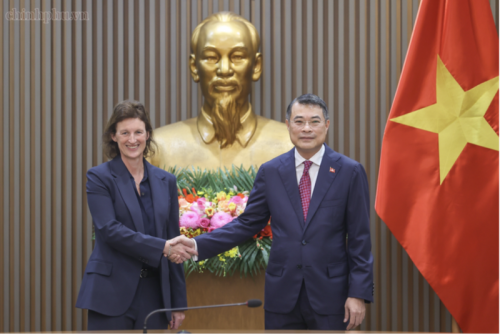
He made the remark during a reception in Hanoi on September 17 for Ms. Fiona Bassett, Chief Executive Officer of FTSE Russell, and a delegation representing global investment institutions visiting and working in Vietnam.

The delegation included executives from global investment funds, including BlackRock and Vanguard, the world’s two largest asset managers. Vanguard’s emerging-market index funds have committed to investing in and adding Vietnamese stocks to their portfolios from September 21, 2026.

At the meeting, Prime Minister Hung praised FTSE Russell for monitoring, assessing and supporting Vietnam’s stock market, helping promote greater transparency, efficiency and alignment with international standards. From September 21, Vietnam’s stock market will officially be classified as a “Secondary Emerging Market” under FTSE Russell’s classification framework.

The government will focus on maintaining the new status through transparent and regular dialogue with market participants and FTSE Russell, ensuring reforms operate smoothly and addressing any issues identified during future assessments.

Vietnam also plans to accelerate the introduction of a central counterparty (CCP) mechanism, effectively address issues raised by global securities firms and custodians, and strengthen support for companies in adopting environmental, social and governance (ESG) standards, greater disclosure and OECD corporate governance principles.

Prime Minister Hung said cooperation with FTSE Russell and global partners would help Vietnam’s stock market maintain its new classification and further strengthen its regional position. He also asked FTSE Russell to continue providing objective, accurate and comprehensive assessments reflecting the actual conditions of Vietnam’s economy and capital market.


Vietnam-Australia Forum highlights leadership capacity for two-tier local governance

Vietnam-Australia Forum highlights leadership capacity for two-tier local governance

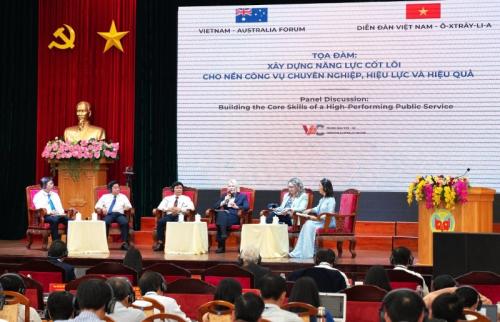
Nearly 300 delegates gathered in the central city of Da Nang to share insights on public leadership, workforce development, and local governance models at the Vietnam-Australia Forum 2026.

Opening the forum, themed “Enhancing Local Leadership Capacity for an Effective Two-Tier Governance Model,” on September 16 in central Da Nang city, Assoc. Prof. Dr. Doan Trieu Long, Director of the Ho Chi Minh National Academy of Politics Region III, highlighted Australia’s successful track record in administrative reform, state apparatus efficiency, and local governance.

Dr. Long noted that Australian practices provide valuable references for Vietnam to explore innovative approaches to institutional reform and establish effective mechanisms to bolster national and local governance performance.

Discussions focused on emerging leadership demands, organizational management, and policy implementation to support Vietnam’s two-tier local administration system. Participants shared practical experience in developing leadership talent, managing human resources, delivering public services, and implementing evidence-based decision-making.

A central focus was how state agencies can foster essential leadership skills and qualities to deliver effective public services, meet citizen expectations, and maintain public trust amid ongoing institutional and administrative reforms.

Ms. Naomi Cook, Acting Deputy Ambassador of Australia to Vietnam, expressed Australia's readiness to support Vietnam’s public sector governance.

“Australia is delighted to share its experience in leadership development and institutional connectivity to assist Vietnam in enhancing governance and public sector efficiency,”shesaid.

“However, public sector reform is a continuous journey. As public expectations, technology, and society evolve constantly, Australia also continuously learns alongside and from its partners.”

The forum serves as a flagship initiative of the Vietnam-Australia Centre (VAC), implemented with support from the Australian Embassy in Vietnam and the Ho Chi Minh National Academy of Politics.


See all blog