Lumen Vietnam Fund

Blog

Construction materials market shows signs of easing after price surge

Construction materials market shows signs of easing after price surge

Several steel companies have announced price cuts for construction steel products, marking the first downward adjustments this year and offering some relief to contractors facing rising project costs.

HÀ NỘI — The domestic construction materials market is showing early signs of easing after months of sharp price increases, although some key materials are expected to remain elevated amid strong demand and supply constraints.

Several steel companies have announced price cuts for construction steel products, marking the first downward adjustments this year and offering some relief to contractors facing rising project costs.

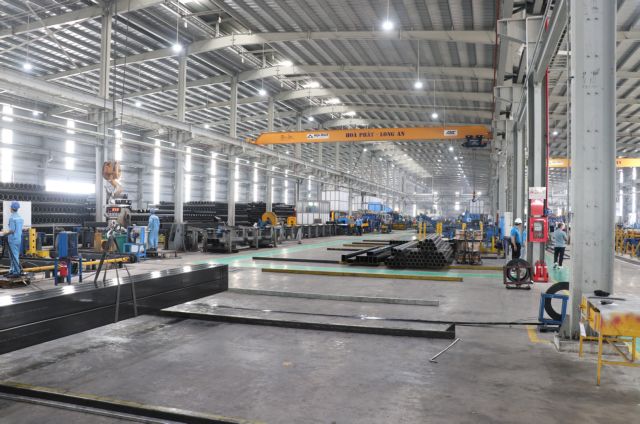
From early June, a branch of Hoa Phat Steel Pipe Co in Bình Dương reduced prices for rebar and wire rod products by between VNĐ150,000 and VNĐ300,000 (US$5.75-11.50) per tonne, depending on product type and region,baoxaydung.vnreported.

In the northern region, rolled steel prices fell by VNĐ170,000 per tonne, while larger reductions were recorded in the central region, where prices dropped by as much as VNĐ220,000 per tonne.

Viet Duc Steel Plant also announced similar price cuts.

The reductions follow a volatile first five months of 2026, during which the industry recorded at least three rounds of steel price increases. Construction steel prices rose above VNĐ15.6 million per tonne after cumulative increases of VNĐ100,000-300,000 per tonne in each adjustment.

Cement prices also increased in the first quarter and early May, rising by VNĐ50,000-100,000 per tonne. Bagged cement currently sells for between VNĐ1.5 million and VNĐ2.4 million per tonne, while bulk cement ranges from VNĐ1.25 million to VNĐ1.85 million per tonne.

Meanwhile, prices of construction materials such as sand, bricks and stone remain under pressure due to localised supply shortages and strong demand from major public infrastructure projects.

Prices for some materials have risen by 15-25 per cent since the start of the year, with occasional increases of up to 50 per cent in certain areas. Yellow sand is currently priced at VNĐ600,000-750,000 per cubic metre, while construction stone costs around VNĐ750,000-780,000 per cubic metre, up from about VNĐ500,000 dong earlier this year.

Thái Duy Sâm, vice chairman of the Vietnam Association of Building Materials, said the market was being shaped by rising input costs and supply-demand dynamics.

Steel producers' recent price cuts reflected efforts to stimulate demand as activity in the residential construction sector remained cautious, he said.

By contrast, cement, stone and sand continue to face upward pressure from elevated electricity and coal costs, while tighter regulations on mineral extraction have constrained supply.

The imbalance between strong demand from public investment projects and available supply has been a key driver of higher prices for construction materials, Sâm toldbaoxaydung.vn.

Industry experts expect the market to stabilise at new price levels in the second half of 2026, with clearer differentiation among material groups.

Steel prices are likely to remain stable or edge lower in the near term as the rainy season slows construction activity. Meanwhile, sand, stone and cement prices are expected to remain elevated or increase modestly, supported by demand from major transport infrastructure projects entering peak construction phases later this year.

They said prices of these materials are also heavily influenced by local mining and licensing policies, making them more volatile than industrially manufactured products.


Source: VNS

Photo: VNA/VNS

Latest Posts

HCMC launches double-digit growth plan for 2026-2030 period

HCMC launches double-digit growth plan for 2026-2030 period

Strategic technology sectors prioritized for development include Artificial Intelligence (AI), semiconductors, Big Data, Cloud Computing, biotechnology, new materials, and renewable energy.

With the goal of maintaining double-digit economic growth during the 2026–2030 period, Ho Chi Minh City is finalizing a comprehensive action plan, which prioritizes strategic infrastructure, science and technology, innovation, and digital transformation to create a foundation for long-term growth.

Under Plan No. 83-KH/TU recently issued by the municipal People’s Committee, the city aims for rapid and sustainable development. HCMC intends to further solidify its role as the nation's economic engine and the primary growth pole of the country's Southeast region while striving for annual double-digit growth rates throughout 2026–2030.

By 2030, the city aims to become a civilized, modern urban center and a Southeast Asian hub for innovation, finance, and services. Looking further ahead to 2045, the city aspires to become a leading international megacity and a top Asian center for economics, finance, trade, and services.

To realize these goals, the city will focus on refining its development institutions to be more modern and synchronized, while promoting decentralization and the delegation of authority. A key part of the strategy involves building a digital government, digital economy, and digital society. Science, technology, innovation, and digital transformation have been identified as the primary drivers of growth in the coming period.

Strategic technology sectors prioritized for development include Artificial Intelligence (AI), semiconductors, Big Data, Cloud Computing, biotechnology, new materials, and renewable energy.

Simultaneously, Ho Chi Minh City will continue to restructure its economy to enhance productivity, quality, and competitiveness. This includes promoting the maritime economy, logistics, international financial center, high-quality tourism, and other high-value-added service industries.

Regarding public investment, resources will be prioritized for strategic infrastructure, national key projects, regional connectivity initiatives, and projects with high "spillover effects" that create growth momentum for both the city and the surrounding region.

The plan also emphasizes the necessity of balancing economic growth with social progress and justice. This includes improving the quality of education, healthcare, culture, and social welfare; protecting the environment; and adapting to climate change. Furthermore, the city will ensure national defense and security while stepping up international integration to improve the quality of life for its citizens and ensure fast, sustainable development.


Fuel prices fall for third straight week

Fuel prices fall for third straight week

Fuel prices fell for a third straight week, keeping retail rates in Việt Nam below those in neighbouring countries.

HÀ NỘI — Retail fuel prices in Việt Nam were cut for a third consecutive week from 3pm on Thursday, with E5RON92 petrol recording the sharpest decline in the latest adjustment.

Under a joint decision by the ministries of Industry and Trade and Finance, the maximum retail price of E5RON92 was reduced by VNĐ452 to VNĐ21,332 per litre (US$0.81).

Diesel 0.05S fell by VNĐ989 to VNĐ25,877 per litre, while mazut 180CST 3.5S dropped by VNĐ1,037 to VNĐ18,608 per kilogramme.

The ministries also decided to continue allocations to the petroleum price stabilisation fund, with contributions set at VNĐ100 per litre for biofuel petrol and VNĐ200 per litre or kilogramme for diesel and mazut products.

Meanwhile, E10RON95 petrol remains outside the State's price management mechanism. Retail prices are determined by fuel distributors based on production costs, taxes, logistics expenses and other factors.

At Petrolimex stations, E10RON95-III is selling at VNĐ22,330 per litre and E10RON95-V at VNĐ23,230 per litre.

The Ministry of Industry and Trade said global oil markets during the latest pricing period were influenced by geopolitical developments, including tensions in the Middle East and the continuing conflict between Russia and Ukraine.

Average international prices used for the adjustment declined across major fuel products. RON92 gasoline fell 0.32 per cent, diesel dropped 1.63 per cent and mazut decreased 3.98 per cent compared with the previous pricing period.

The ministry said it would continue monitoring market developments and coordinate with relevant agencies to ensure adequate fuel supplies nationwide while taking action against any violations of fuel trading regulations.

Fuel prices in Việt Nam remain lower than in neighbouring countries.

As of June 11, gasoline prices in Thailand, Cambodia, Laos and China ranged from VNĐ30,743 to VNĐ37,560 per litre, while diesel prices stood between VNĐ30,893 and VNĐ33,505 per litre, compared with VNĐ21,332 and VNĐ25,877, respectively, in Việt Nam.


Việt Nam auto sales rise 20% in five months as hybrid vehicles lead market

Việt Nam auto sales rise 20% in five months as hybrid vehicles lead market

Hybrid vehicles continued to gain momentum. Monthly hybrid sales reached 1,670 units in May, representing a 59 per cent increase from April.

HÀ NỘI — The automotive market continued its strong recovery in the first five months of 2026, with total vehicle sales rising 20 per cent year-on-year.

Hybrid vehicle sales surged 80 per cent, emerging as one of the strongest growth drivers in the country’s accelerating vehicle electrification trend.

Earlier this week, the Việt Nam Automobile Manufacturers Association (VAMA), whose members account for roughly 62 per cent of the country’s automotive market, reported total sales of 29,935 vehicles in May. While the figure was down 6 per cent from April, it remained 6 per cent higher than the same month last year.

Passenger vehicles accounted for 19,182 units sold during the month, down 10 per cent from April. Commercial vehicle sales increased 5 per cent to 10,288 units, while sales of specialised vehicles fell sharply by 45 per cent to 465 units.

Sales of domestically assembled vehicles reached 13,080 units in May, down 6 per cent from the previous month. Imports of completely built-up (CBU) vehicles also declined by 6 per cent to 16,855 units.

Hybrid vehicles continued to gain momentum. Monthly hybrid sales reached 1,670 units in May, representing a 59 per cent increase from April. Cumulative hybrid sales for the January–May period totaled 8,518 units, up 80 per cent compared with the same period in 2025.

Toyota remained the market leader in May with sales of 5,653 vehicles. Ford ranked second with 3,493 units, followed by Mitsubishi with 3,111 vehicles, Kia with 2,512 units and Mazda with 2,304 units.

The Mitsubishi Xpander was the best-selling vehicle in May with 1,236 units sold, narrowly ahead of the Toyota Yaris Cross at 1,214 units. The Mazda CX-5 ranked third with 1,159 units, followed by the Toyota Veloz Cross with 797 units and the Mitsubishi Xforce with 693 units.

According to VAMA data, cumulative sales during the first five months of 2026 reached 156,729 vehicles, an increase of 20 per cent year-on-year. Passenger vehicles remained the dominant segment with 103,802 units sold, up 13 per cent, while commercial vehicle sales rose 32 per cent to 50,270 units.

Battery electric vehicles (BEVs) reported by VAMA members totaled 64 units during the period, highlighting the gradual expansion of electrified vehicle offerings in the Vietnamese market.

VAMA said sales of domestically assembled vehicles increased 11 per cent during the first five months of the year compared with the same period in 2025. Meanwhile, imported vehicle sales jumped 27 per cent, reflecting intensifying competition from foreign-made models in Việt Nam.

The figures suggest that Việt Nam’s automotive sector has maintained a positive growth trajectory in 2026 despite a short-term sales slowdown in May.

Demand for personal mobility, commercial transportation and fuel-efficient vehicles, particularly hybrids, is expected to remain a key growth catalyst in the months ahead.

However, industry analysts caution that the VAMA data does not provide a complete picture of the market. Several automotive brands operating in Việt Nam do not publicly disclose sales figures, including Audi, BYD, Jaguar Land Rover, Geely, GAC, Lynk & Co, Omoda & Jaecoo, Mercedes-Benz, Nissan, Subaru, Volkswagen and Volvo.

In addition, major industry players such as Hyundai Thanh Cong and VinFast have yet to release their latest sales results, making it difficult to fully assess overall market performance so far this year.

Strong domestic production

Việt Nam’s automotive industry also achieved a significant milestone on the supply side, with domestic vehicle production and assembly reaching a record level in May and substantially outpacing imports.

According to the General Statistics Office, approximately 76,837 new vehicles were supplied to the Vietnamese market during May, the highest monthly figure recorded since the beginning of the year. The total represented a 13.2 per cent increase from April.

The strongest performance came from domestic manufacturing and assembly operations. Vehicle output reached 53,700 units during the month, up 4.7 per cent from April and 40 per cent higher than in May 2025.

Domestic production significantly exceeded imported vehicle volumes, which totaled approximately 23,137 completely built-up units. The gap of more than 30,000 vehicles in a single month underscores a notable shift in supply dynamics toward local assembly plants.

During the first five months of 2026, domestic manufacturers produced an estimated 232,100 vehicles, representing year-on-year growth of 26.7 per cent.

The increase in local production has enabled manufacturers to reduce logistics costs and improve supply-chain efficiency. From a broader economic perspective, the trend is viewed as a positive development, supporting job creation, reducing import dependence and contributing to improvements in Việt Nam’s trade balance.


See all blog