Lumen Vietnam Fund

Blog

Vietnam’s trade turnover reaches $945 billion by mid-October, up 31.4%

Vietnam’s trade turnover reaches $945 billion by mid-October, up 31.4%

Vietnam recording a trade surplus of approximately $1.82 billion, marking its second consecutive period of export surplus.

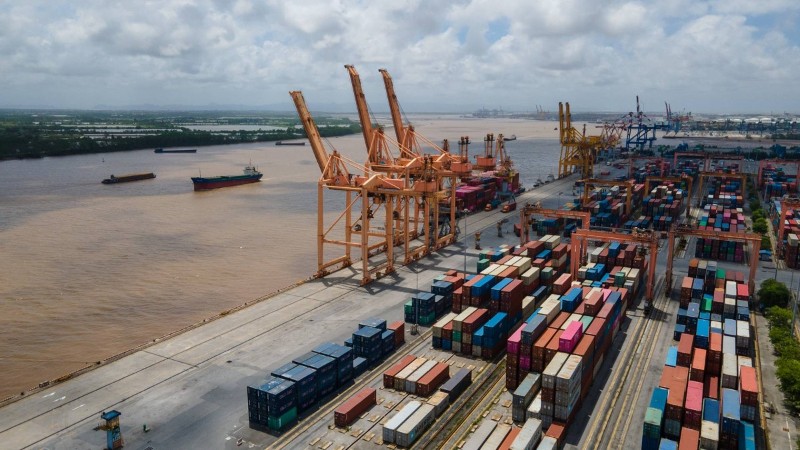
Vietnam’s total import-export turnover reached an estimated $56.68 billion in the first half of October 2026, up 3.31% from the first half of September, according to preliminary data from the Vietnam Customs.

Exports reached $29.25 billion, up 12.41%, while imports totalled $27.43 billion, down 4.9%. The country therefore recorded a trade surplus of approximately $1.82 billion in the period, marking its second consecutive period of export surplus.

Cumulative trade turnover reached $945.07 billion by October 15, marking a 31.43% increase compared with the same period last year.

Export growth remained concentrated in several key product categories rather than being evenly distributed across the country’s export structure.

Computers, electronic products and components continued to lead, generating approximately $11.59 billion in exports during the first half of October, up 21.17% from the previous period. The increase of more than $2.03 billion was the largest in absolute terms among major export categories, underscoring the sector’s importance to Vietnam’s export performance.

Exports of machinery, equipment, tools and spare parts reached around $3.58 billion, rising 5%, or $170.41 million, compared with the first half of September.

Textile and garment exports totalled approximately $1.57 billion, up 2.8%, while footwear exports approached $980 million, an increase of 23.82%.

In contrast, imports fell by nearly 5% from the previous period, declining by approximately $1.41 billion.


Source: Hoang Son

Latest Posts

Vietnam records 30 transactions worth $1.74 billion in September

Vietnam records 30 transactions worth $1.74 billion in September

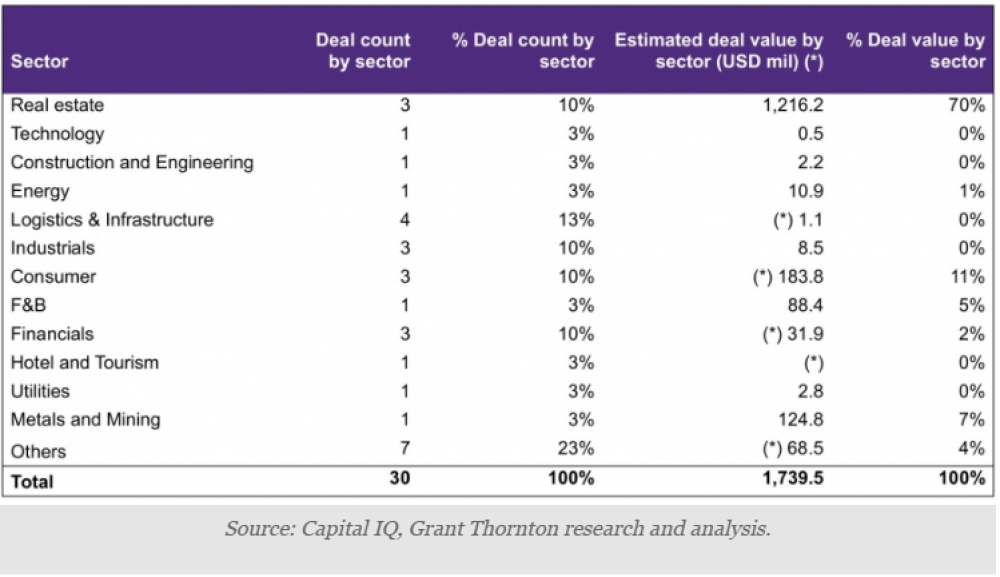
Vietnam's merger and acquisition market recorded 30 announced transactions in September, with 23 disclosing or estimating values totalling approximately $1.74 billion.

According to a monthly report released on October 22 by Grant Thornton Vietnam, September's activity was driven by restructuring and related-party transactions, with four deals contributing approximately $1.23 billion, or 70.7 per cent of total transaction value.

The most notable transaction was VinFast Vietnam JSC's agreement to acquire 100 per cent of the equity interests in Ngoc Hoi Real Estate Investment JSC for approximately $1.2 billion.

By volume, logistics and infrastructure led with four deals, accounting for 14 per cent of transactions during the month. Real estate, consumer, industrials, and financials each recorded three deals, together accounting for 40 per cent of announced transactions.

Excluding restructuring and related-party transactions, consumer, metals and mining were the leading sectors in September, recording total deal values of approximately $183.8 million and $124.8 million, respectively, and together accounting for 61 per cent of total disclosed/estimable transaction value.

Notable transactions included the transfer of shares in Thanh Thanh Cong – Bien Hoa JSC, valued at nearly $179 million, and Elmet Group’s acquisition of a 4.99 per cent stake in Masan High-Tech Materials Corporation at approximately $138 million.

The food and beverage sector ranked third, with a transaction value of approximately $88.4 million, equivalent to 18 per cent of the market’s total deal value.

In logistics, CMC JSC approved the acquisition of a 99.9 per cent equity in TTL Holdings Investment Co., Ltd, the transaction value was not disclosed. Previously, TTL Holdings planned to acquire more than 25 per cent of the shares in Thang Long Joint Stock Corporation from TNG Investment and Construction Co., Ltd, a shareholder holding approximately 50.5 per cent of TTL’s capital.

The transaction is viewed as part of an ownership restructuring within the broader Tasco-DNP ecosystem associated with Vu Dinh Do, chairman of Tasco JSC.

Specifically, CMC is a subsidiary of DNP Holdings, while TNG Investment and Construction is also connected to this ecosystem through Pham Quoc Khanh, TNG’s largest shareholder. Khanh has also been a major shareholder of DNP Holdings since 2014 and is a founding shareholder of VII Holding, a major shareholder of Tasco.

In consumer, Thanh Thanh Cong Investment JSC (TTC Investment) and Huynh Bich Ngoc registered to sell a combined total of more than 200 million shares in Thanh Thanh Cong – Bien Hoa JSC, with an estimated value of approximately VND4.65 trillion ($178.8 million).

In metals and mining, Elmet Group completed the acquisition of 55.14 million shares in Masan High-Tech Materials Corporation from Masan Horizon Co., Ltd., representing 4.99 per cent of its charter capital, for a total transaction value of approximately VND3,240 billion (approximately $138 million).

The transaction forms part of a plan to restructure MSR’s ownership in preparation for a listing on the Ho Chi Minh Stock Exchange.

In financials, Bolt Holdings JSC and Chu Tuan An, the chairman of UP Securities JSC, registered to subscribe for more than 62.6 million shares and 5 million shares, respectively, in UPS’s private placement, for an aggregate value of approximately VND676.6 billion (approximately $26 million).

Following the transaction, Bolt Holdings is expected to hold 62.82 per cent of UPS’s charter capital and become its controlling shareholder.

In energy, REE Energy Co., Ltd. divested its entire holding of over 8 million shares in Su Pan 2 Hydropower JSC to Ha Thanh Energy Development JSC for an estimated value of approximately VND282 billion ($10.8 million).

Following the transaction, Ha Thanh Energy became SP2’s largest shareholder, with a 39.12 per cent stake. Established in 2006, SP2 owns the Su Pan 2 Hydropower Project in Lao Cai Province, with an installed capacity of 34.5 MW and a total investment of VND1,245 billion ($47.9 million).

In agriculture and livestock, BAF Vietnam Agriculture JSC will acquire a 75 per cent stake in the charter capital of Hung Phat Farm Mot Co., Ltd. from Nguyen Tran Tuan Cuong for VND162 billion (approximately $6.2 million).

Following the transaction, BAF will increase its ownership in the company from 25 to 100 per cent. Hung Phat Farm Mot is one of the entities associated with BAF’s strategy to expand high-tech livestock farming in Gia Lai.

Beyond, Sojitz Corporation completed the acquisition of more than 14.9 million shares in Taseco Air Services JSC for approximately VND 1,053 billion ($40.5 million) and Mekong Capital completed the sale of its entire investment in Mutosi Group JSC to Ariston Group, a multinational group specialising in heating and water solutions, the deal value was not disclosed. Following the transaction, Ariston Group will hold 83 per cent of Mutosi’s charter capital, while the management team will continue to hold a 17 per cent equity stake.

Funding the new growth cycle

Funding the new growth cycle

Vietnam is capable of diversifying its funding sources and building a multi-tier capital ecosystem to support its annual growth target through 2030.

Vietnam is entering a new phase of development, with a target of average annual GDP growth of at least 10 per cent from 2026 to 2030. Supporting this target is estimated to require total investment of around VND38,500 trillion ($1.48 trillion).

According to Deloitte, investment demand in the new growth cycle will focus on strategic infrastructure; energy and the green transition; technology, innovation, and high-value industries; and the development of the private sector. These are all areas that require large amounts of long-term capital, with varying levels of risk.

Multi-tier capital ecosystem

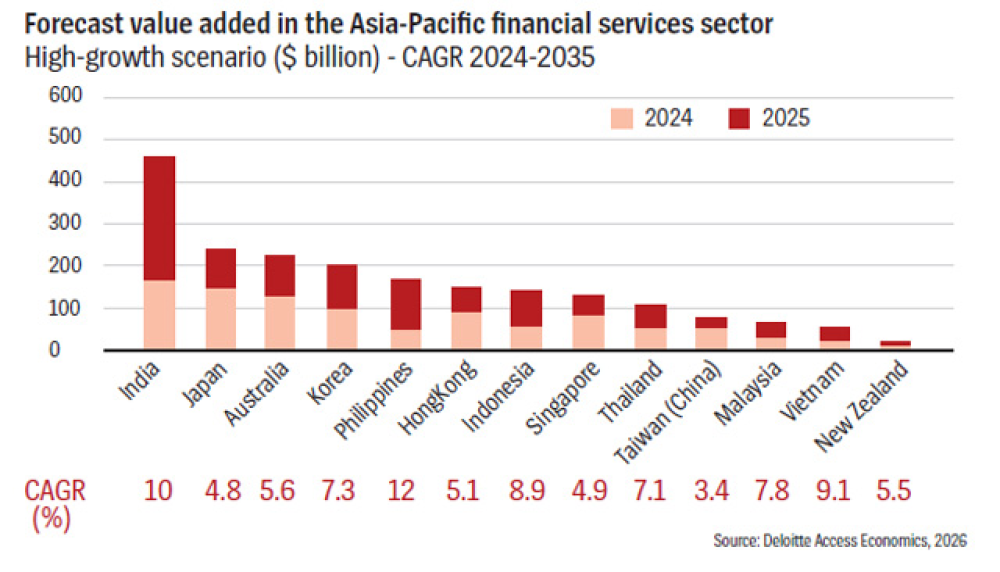
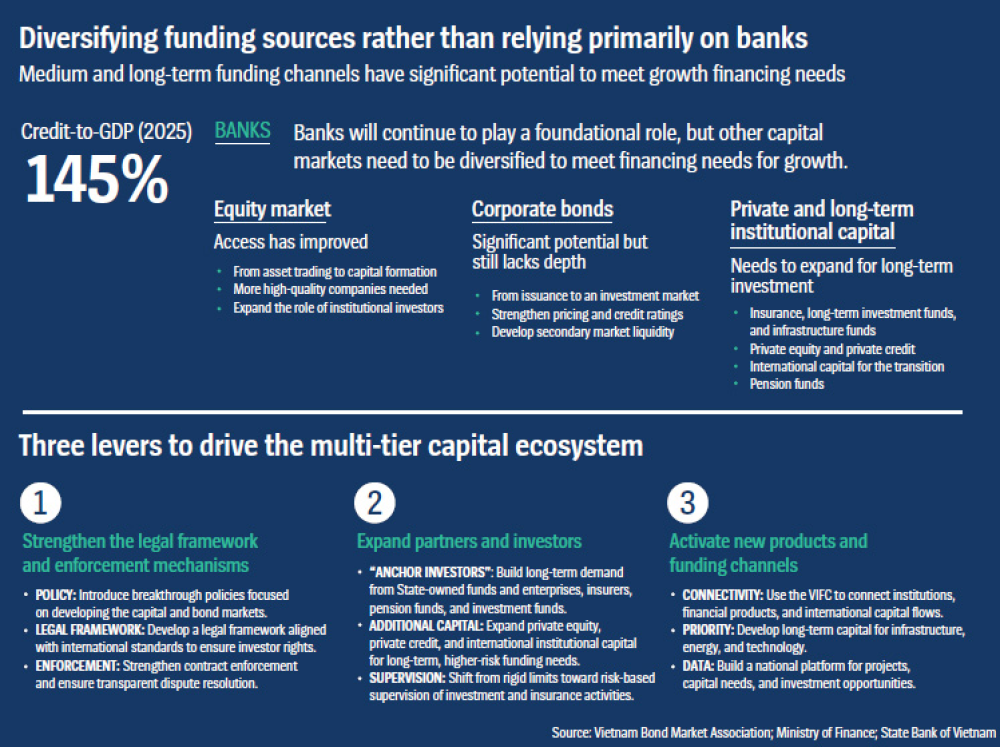
The banking system currently remains the dominant channel for financing the economy. Vietnam’s credit-to-GDP ratio stood at around 145 per cent in 2025. A similar situation is found across the Asia-Pacific region. According to analysis by Deloitte Access Economics, bank credit across 13 major economies in the region is equivalent to an average of 122 per cent of GDP, or around $54 trillion. However, banks cannot meet the full demand for long-term capital required by Vietnam’s investment priorities in the new growth cycle.

Over the longer term, Vietnam’s financial market still has significant room for development. The country’s financial market remains considerably less developed than those of other economies in the region in terms of market depth, access to capital, and operational efficiency. However, the value added of Vietnam’s financial services sector is forecast to achieve a compound annual growth rate (CAGR) of 9.1 per cent between 2024 and 2035 under a high-growth scenario, placing Vietnam among the region’s high-growth economies.

The objective, therefore, is not to reduce the role of banks, but to build a multi-tier capital ecosystem that facilitates and accelerates the development of other funding channels, allocating capital according to maturity, risk, and investment objectives.

Fundamentally, this multi-tier capital ecosystem consists of three main layers.

First is foundational capital from banks. This remains the primary source of working capital, corporate credit, cash flow-based financing, co-financing, and guarantees.

Second is growth and long-term capital. This comes from equity markets, bond markets, private equity, private credit, and institutional investors. These sources of capital are better suited to business expansion, technological innovation, infrastructure, and energy.

Third is the international connectivity platform. The Vietnam International Financial Center (VIFC) is not a separate “pool of capital.” Its role is to connect Vietnam with international institutions, financial products and models, global standards, and international capital flows.

Three levers

Drawing on Deloitte’s advisory experience, the ability to convert capital into growth depends on three closely interconnected conditions.

First, strengthen the legal framework and enforcement mechanisms. Vietnam needs to align three pillars: breakthrough policies to deepen the capital and bond markets; a clear legal framework that approaches international standards; and transparent enforcement mechanisms to protect investors and strengthen confidence.
Vietnam is known for its strong reform efforts. However, meaningful reform will depend not only on the number of laws and regulations introduced, but also on the ability to translate policies into concrete processes that can be implemented, measured, and effectively supervised.

Second, expand partners and investors. To create sustained demand for the capital markets, Vietnam needs more “anchor investors,” including State-owned funds and enterprises, insurers, pension funds, and investment funds. It also needs to expand private equity, private credit, and international institutional capital to meet long-term funding needs with higher risk profiles.

However, expanding the investor base does not mean loosening controls. Rather, it requires risk-based supervision, stronger post-investment monitoring, and clearer accountability. Sustainable capital flows can only emerge when investors are matched with appropriate risk-return structures and credible governance mechanisms.

The final lever is turning connectivity into transactions. The VIFC can serve as a gateway connecting Vietnam with international institutions, financial products, and capital flows. The immediate priority should be developing long-term capital for infrastructure, energy, and technology.

But having financial products alone is not enough. The market also needs a reliable data platform covering projects, capital requirements, cash flows, and investment opportunities so that investors can assess opportunities and make informed decisions. Drawing on Deloitte’s experience in operating models, data, and transformation, products can only create meaningful impact when data, accountability, and implementation mechanisms are designed to work together.

Turning capital into growth

The challenge for Vietnam’s new growth cycle is therefore not simply to mobilize more capital, but to ensure that capital is converted effectively into productive capacity and economic growth.

This requires the financial system to allocate capital according to the characteristics of each investment need. Banks will continue to provide foundational financing, while equity and bond markets, private capital, institutional investors, and international funding can play a greater role in providing medium and long-term capital for infrastructure, energy, technology, innovation, and business expansion.
At the same time, expanding the supply of capital must go hand-in-hand with stronger connections between investors and viable investment opportunities. Reliable data on projects, capital needs, cash flows, and investment opportunities will be critical for investors to assess risks and make decisions.

Ultimately, Vietnam needs an ecosystem in which each source of capital has a clearly-defined role, different funding channels are effectively connected, and capital can reach the areas where it can generate the greatest long-term economic impact. This will be critical to transforming the country’s ambitious growth targets into sustainable economic growth.

Vietnam targets November launch of financial transactions at international financial centers

Vietnam targets November launch of financial transactions at international financial centers

All operational preparations expected for completion in October with the aim of facilitating actual transactions from November.

Deputy Prime Minister Nguyen Van Thang has called on the operating authorities of Vietnam’s international financial centers in Ho Chi Minh City and Da Nang to complete all operational preparations in October 2026, with the aim of facilitating actual transactions from November.

Speaking at a meeting on October 22, he stressed the need to ensure financial security, address institutional obstacles promptly and establish the conditions necessary for the centres to begin operating effectively.

According to a recent report by the Ministry of Finance, the ministry and relevant agencies have reported to Prime Minister Le Mình Hung and Deputy Prime Minister Nguyen Van Thang on the consolidation of the centers’ executive councils, the issuance of a development plan through 2035 and the adoption of operational regulations.

Ho Chi Minh City and Da Nang have approved staffing structures and allocated personnel, funding, office premises and technological infrastructure to support the centers

Investment promotion activities have also been conducted in several countries. Banks, securities firms, asset management organisations and investors have signed memorandums of understanding, made commitments or submitted applications to participate.

The Ministry of Finance’s leadership has held direct discussions with commercial banks and financial institutions to identify transactions that could be launched in the near term, marking a shift from institutional development and membership recruitment towards actual financial activity.

Deputy Prime Minister Thang said financial products traded at the international financial centres could be considered for introduction in Vietnam, provided they suit domestic conditions, regulatory capacity and risk-control requirements.

Initial priorities will include transactions with established links between capital providers and borrowers, particularly products that mobilise and supply medium- and long-term funding in line with Vietnam’s development priorities.


See all blog