Lumen Vietnam Fund

Blog

Vietnam's manufacturing sector records 15-year selling price hike amid Middle East tensions

Vietnam's manufacturing sector records 15-year selling price hike amid Middle East tensions

The Middle East war caused a marked acceleration in the Vietnamese manufacturing sector's rate of input cost inflation during March, with selling prices subsequently raised at the fastest pace in almost 15 years, according to S&P Global.

"Given the country's reliance on oil imported from the affected region, the impact on prices and supply chains would have been expected to some extent," Andrew Harker, economics director at S&P Global Market Intelligence, wrote in a release on Wednesday.

"Output and new orders remained in expansion territory in March, but rates of increase were well down on February and at least some of the growth seen was due to customers placing advanced orders to try to get ahead of price rises. The near-term outlook therefore appears bleak, unless a speedy resolution to the war and the disruption through the Strait of Hormuz can be achieved," he added.

Intensifying price pressures acted to limit demand, and rates of growth in both new orders and output slowed as a result. In turn, employment and purchasing activity were scaled back.

Meanwhile, suppliers' delivery times lengthened substantially. The impacts of the war also resulted in weaker business confidence, with optimism easing to a six-month low, according to the release.

The S&P Global Vietnam Manufacturing Purchasing Managers' Index (PMI) remained above the 50.0 no-change mark in March, extending the current sequence of improving business conditions to nine months.

The PMI dropped to 51.2 from February's 54.3 and pointed to the least marked strengthening of operating conditions since last September. A key feature of the March PMI survey was the impact of the war in the Middle East on inflation.

An increase in the price of oil resulted in higher costs for freight, fuel and transportation. As a result, close to half of respondents recorded an increase in their input costs during March, with the pace of inflation the sharpest since April 2022.

With higher input costs often passed on to customers, output prices increased at one of the sharpest rates since the survey began in 2011. The pace of inflation seen in March was the steepest in just under 15 years, S&P Global analysts noted.

Sharply rising prices in the sector acted to limit demand. Total new orders continued to rise as some firms reported that clients had purchased in advance to try to get ahead of price increases. The rate of expansion was only modest, however, and the weakest since last September.

Meanwhile, international demand suffered, with new export orders decreasing markedly following stable new business from abroad in February. In line with the picture for total new business, manufacturing production increased at a much-reduced pace during March.

The latest rise in output was the 11th in as many months, but least pronounced since June 2025. Slower growth of new orders and higher input costs led to a reluctance among manufacturers to commit to additional purchases in March.

Input buying decreased markedly, ending an eight-month sequence of expansion. Stocks of purchases were also down. Where firms did buy inputs, they faced a substantial lengthening of suppliers' delivery times, one that was the most pronounced in four years.

Respondents indicated that higher fuel costs resulted in transportation delays. As well as scaling back purchasing activity, manufacturers also signalled a reduction in employment. Staffing levels decreased for the first time in six months. Firms reported difficulties replacing departing staff members, and a drop in the number of temporary workers.

With employment down and firms facing difficulties securing materials, backlogs of work increased in March. The slight accumulation was the first in four months. In some cases, manufacturers used stocks of finished goods to help satisfy order requirements, resulting in a marked fall in post production inventories.

Business confidence dropped to a six-month low in March amid concerns around the impact of the war in the Middle East on international demand, prices and the supply of materials.

"That said, hopes that underlying demand would remain solid and support growth of new orders and output meant that firms on balance continued to predict an increase in production over the coming year," S&P Global analysts added.

In an analysis published on Tuesday, VinaCapital stated that they estimate the damage that the month-long U.S.-Israel-Iran war has already done to Vietnam’s economy are a 2 percentage point increase in inflation and a 1.5 percentage point reduction for GDP growth, unless the Government takes decisive actions to support the economy and limit petrol price increases, including bigger petrol price subsidies than it has done in the past (petrol subsidies in Vietnam never exceeded 0.5%/GDP vs ~3%/GDP in Indonesia).

Those economic impact estimates assume that the conflict will wind down within the next 2-3 weeks (with a resumption of ships passing through the Strait of Hormuz), and then it takes another 4-5 months for global energy markets to normalize.

Source: Thai Ha

Photo: Photo courtesy of VnEconomy magazine
Latest Posts

Foxconn pours additional $58.3 mln into northern Vietnam unit

Foxconn pours additional $58.3 mln into northern Vietnam unit

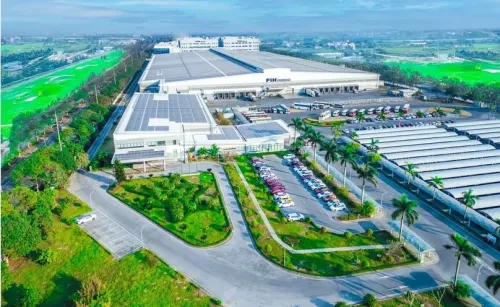
Taiwan’s Hon Hai Precision (Foxconn), a key electronics supplier to Apple, said it will invest an additional $58.32 million in its Vietnamese subsidiary, Fushan Technology (Vietnam), according to a filing to the Taiwan Stock Exchange.

Foxconn’s unit Chief Expertise Limited will implement the investment, bringing Foxconn’s total investment in Fushan Technology (Vietnam) to $226.29 million while maintaining 100% ownership.

The move is aimed at “long-term investment.” However, the filing did not specify which items the funds would be allocated to.

Before the latest capital hike, Fushan Technology (Vietnam), located at VSIP Bac Ninh Industrial Park in the northern province of Bac Ninh, had been featured in an expansion plan in late 2025.

According to an environmental impact assessment filing for the expansion of its Bac Ninh plant, Fushan Technology (Vietnam) said it plans to install additional production lines to add products such as Xbox gaming devices, electronic components and chargers for smart ring wearables, while lifting smartphone capacity by 30 million units a year to 140 million units annually.

The document also shows the facility would produce up to 100,000 unmanned aerial vehicles (UAVs) each year, with full operations planned from April 2026.

Fushan Technology (Vietnam) was established in November 2011 as Nokia Vietnam. It was renamed Microsoft Mobile Vietnam in December 2014 after US tech giant Microsoft acquired Nokia that year.

In 2017, Microsoft sold its handset business to FIH Mobile, part of the Foxconn ecosystem, after which Microsoft Mobile Vietnam was renamed Fushan Technology (Vietnam) as it is known today.

Fulian receives fresh hundreds of millions in capital injection

Beyond Fushan Technology (Vietnam), another wholly-owned unit of Foxconn in northern Vietnam - Fulian Precision Technology Component - also posted a strong capital increase in Q1/2026.

In January, Fulian Precision Technology Component was approved to raise its charter capital from VND8.48 trillion ($322.08 million) to VND9.13 trillion ($346.77 million), before increasing it further to VND9.46 trillion ($359.3 million) in February.

In March, Foxconn poured a further $287 million into Fulian Precision Technology Component via its subsidiary Ingrasys (Singapore) Pte. Ltd. Following this, Foxconn’s total investment in Fulian Precision Technology Component rose to about $668.5 million, while maintaining 100% ownership. The move ranks among the group’s largest disclosed investments in Vietnam so far this year.

Since beginning its investment in Vietnam in 2007, Foxconn has established a presence in Bac Ninh, Hanoi, Quang Ninh and Nghe An, with Bac Ninh emerging as its key hub.

Speaking at the opening ceremony of the Foxconn Vietnam headquarters office in Hanoi last week, Pham Hoang Son, Chairman of the Bac Ninh People's Committee, said Foxconn has run 20 projects in Bac Ninh with total investment of about $4 billion, creating around 130,000 jobs.

Beyond its economic contributions, Foxconn has also advanced technology transfer, workforce training and the development of a high-tech electronics ecosystem in the locality, he added.

The establishment of the company’s Vietnam headquarters office is a strategic step to enhance operational efficiency and strengthen engagement with regulators and partners, according to Foxconn Vietnam CEO Chou I Wen.

He added that Vietnam is not only a key manufacturing hub, but also an increasingly notable destination for innovation in the region.

Michael Chiang, rotating CEO of Foxconn, said the inauguration not only marks an expansion of operations but also reaffirms the group’s long-term commitment to Vietnam.

Amid shifting global economic dynamics, Vietnam - particularly Hanoi - is playing an increasingly strategic role in Foxconn’s development network, he stressed.

Foxconn is committed to further expanding investment, advancing technology transfer, developing a high-quality workforce, strengthening cooperation with domestic firms, and contributing to the growth of high-tech industries and sustainable supply chains in Vietnam, the CEO said.

Vietnam, UNIDO sign deal for sustainable industrial development

Vietnam, UNIDO sign deal for sustainable industrial development

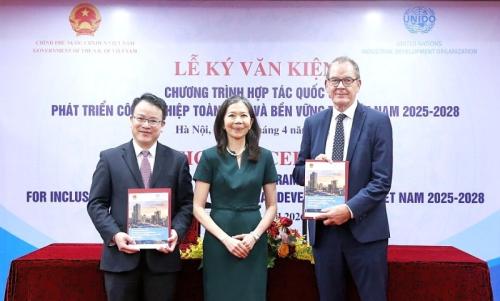
The Country Program for Inclusive and Sustainable Industrial Development for 2025–2028 has an estimated budget of $72 million.

Vietnam and the United Nations Industrial Development Organization (UNIDO) have signed a new Country Program for Inclusive and Sustainable Industrial Development for 2025–2028, marking a further step in their long-standing partnership.

The agreement was signed on April 20 in Hanoi by the Ministry of Finance and UNIDO.

With an estimated budget of $72 million, the program focuses on green industrial transformation, strengthening competitiveness and sustainable value chains, and improving industrial policies and institutions.

Since the official establishment of the partnership, UNIDO has collaborated with Vietnam to implement over 170 projects since 1978 in areas such as small and medium-sized enterprise development, quality infrastructure, energy efficiency, clean production, and sustainable supply chains. Based on this, within the framework of the new program, cooperation between the two parties will continue to be expanded through comprehensive intervention programs and activities, combining policy advice, technical support, and investment mobilization. The program is expected to open up new cooperation opportunities in the field of agricultural processing, particularly for value chains with potential such as rice and tea, focusing on value addition, meeting sustainable standards, enhancing resilience to climate change, and improving livelihoods in rural areas.


Steel giant Hoa Phat inaugurates $76 mln steel pipe plant in southern Vietnam

Steel giant Hoa Phat inaugurates $76 mln steel pipe plant in southern Vietnam

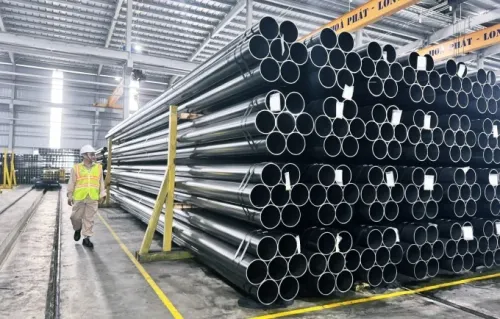
Vietnam’s conglomerate Hoa Phat Group (HoSE: HPG) on Saturday inaugurated a new steel pipe plant in the southern province of Tay Ninh with an investment of VND2 trillion ($75.6 million), as the country’s top steelmaker expands capacity to capture recovering demand in construction and infrastructure.

The facility has an annual capacity of 400,000 tons and produces a range of products, including black steel pipes, galvanized steel, and large-diameter pipes for industrial use.

With the addition, Hoa Phat’s total steel pipe capacity rises to 1.2 million tons per year, reinforcing its leading position in the domestic market with an estimated market share of nearly 35%.

Located in the Thuan Dao Industrial Park, the 15-hectare plant benefits from proximity to Ho Chi Minh City and is about 30 km from Long An international port, allowing the company to optimize logistics costs and expand its reach in southern Vietnam and export markets.

The plant is already supplying steel pipes for major infrastructure projects such as Long Thanh International Airport in Dong Nai province and Phu Quoc airport off An Giang province, the company said.

In addition, the facility is equipped with a rooftop solar power system with a capacity of 10 MW, enabling the firm to meet more than half of its electricity demand and reduce operating costs.

In the first quarter of 2026, the group sold more than 241,000 tons of steel pipes, up around 30% from a year earlier. Southern Vietnam accounted for roughly 90,000 tons.

The company targets revenue of VND210 trillion ($7.97 billion) and net profit of VND22 trillion ($835.47 million) this year, up 33% and 42% respectively from 2025. If achieved, this would mark a record high for the group, with steel continuing to contribute about 95% of total revenue.

HPG shares were traded at VND24,800 ($0.94) each on Monday afternoon.

See all blog