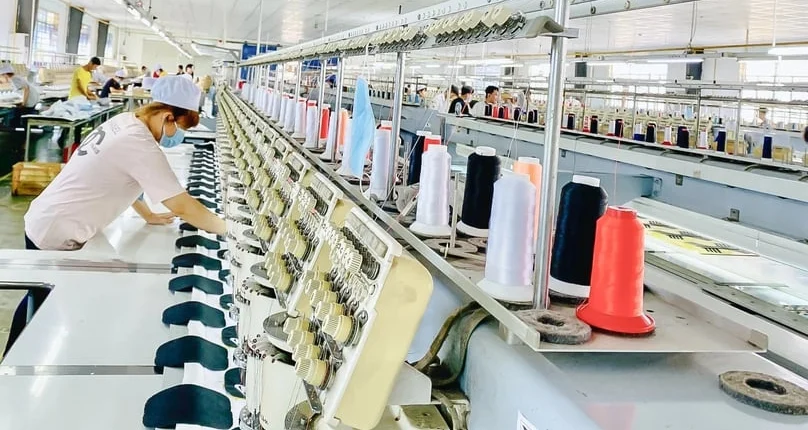
Vietnam textile-garment industry remains cautious despite order recovery
Vietnam’s textile and garment industry is targeting $50 billion in export turnover in 2026, but rising costs driven by U.S. tariff shifts and geopolitical tensions in the Middle East are keeping businesses cautious, even as orders show signs of recovery.
Exports remain the backbone
According to the National Statistics Office, Vietnam’s textile and garment exports in Q1/2026 reached over $10.54 billion, up 2.3% year-on-year. March alone generated $3.82 billion, marking a 4.4% increase.
While growth remains modest, it underscores the relative stability of export markets, which continue to serve as a key pillar for the industry.
Vietnam National Textile and Garment Group (Vinatex – UPCoM: VGT) reported solid Q1 results, with estimated garment segment profit of VND198 billion ($7.52 million), fulfilling 26% of the year's target and rising 4% year-on-year.
Many subsidiaries have secured orders through the end of Q2, with some locking in contracts for the full year.
Vinatex’s revenue structure remains relatively balanced between domestic and export markets. In 2025, of its total revenue exceeding VND18 trillion ($683.71 million), nearly VND10 trillion came from the domestic market, with the remainder from exports. Core segments such as yarn, textiles, and garments accounted for approximately 95.8% of total revenue.
Similarly, Thanh Cong Textile Garment Investment Trading JSC (HoSE: TCM) derived the bulk of its revenue from core operations. In 2025, textile and garment activities generated over VND3.54 trillion ($134.46 million), representing about 97.3% of total revenue. Of which, export turnover reached VND3.1 trillion, or roughly 85.2%.
This reflects the company’s structure, as its parent, E-Land Asia (Singapore), is part of South Korea’s E-Land Group, resulting in significant intra-group transactions. Related-party revenue totaled nearly VND1 trillion during the year.
Meanwhile, Song Hong Garment JSC (HoSE: MSH) demonstrates an even stronger reliance on exports. Although its financial statements do not break down revenue by market, its client base including Columbia Sportswear, Haddad Brands, Walmart, and Target suggests it is almost entirely export-driven. According to estimates by Asia Commercial Bank Securities (ACBS), the U.S. accounts for about 80% of MSH’s export revenue.
MSH’s profit structure also stands out. In 2025, revenue from semi-finished goods reached VND3.62 trillion ($137.5 million), with cost of goods sold at VND3.13 trillion, implying a gross margin of about 13.5%.
In contrast, its services segment generated nearly VND1.92 trillion ($72.93 million) in revenue with costs of only VND1.23 trillion, resulting in a much higher gross margin of 35.8%. This indicates that contract manufacturing (CMT) continues to yield higher margins than finished goods (FOB), as it avoids raw material costs.
Overall, Vietnam’s textile and garment companies remain heavily dependent on export markets, particularly the U.S. and the EU. This dependence, however, leaves the sector vulnerable to rising logistics costs and raw material prices, especially petroleum-based polyester, amid geopolitical instability in the Middle East.
Against this backdrop, the $50 billion export target for 2026 appears ambitious and challenging.
Cautious plans for 2026
Despite improving order flows, companies are maintaining conservative growth strategies.
Thanh Cong targets revenue of VND4.39 trillion ($166.75 million) and after-tax profit of VND293 billion ($11.13 million) for 2026, implying modest profit growth of about 8.1% compared to 2025. The company is also accelerating its domestic retail expansion in collaboration with E-Land to enhance margins.
Following a strong 2025, when after-tax profit exceeded the year's plan by 137%, Song Hong aims for 2026 revenue of VND6 trillion ($227.9 million) and profit of VND900 billion ($34.19 million), representing increases of 8.34% and 9.34%, respectively. It also plans to maintain a high dividend payout ratio of 40-50%.
Meanwhile, TNG Investment and Trading JSC targets revenue of VND9.5 trillion ($360.85 million) and after-tax profit of VND450 billion ($17.09 million), up approximately 9.2% and 14.5% year-on-year, respectively.
Industry players generally expect continued uncertainties in 2026, prioritizing stability and improved growth quality over aggressive expansion.
A notable trend is the shift from traditional contract manufacturing models such as CMT (Cut, Make, Trim) and FOB (Free On Board) toward ODM (Original Design Manufacturer), which allows companies to take on design and product development. This transition is seen as key to boosting value-added and improving long-term margins.
At the same time, elevated U.S. tariffs on Chinese goods continue to create opportunities for Vietnamese exporters to gain market share. However, competition is intensifying, particularly from countries like India and Bangladesh, which retain advantages in labor costs.
As a result, many companies are moving away from large-volume, low-margin orders toward more complex, higher-value contracts with shorter delivery times to optimize profitability. This shift also raises challenges in securing a skilled workforce.
According to the Vietnam Textile and Apparel Association, companies are actively working to meet increasingly stringent sustainability standards in key markets such as the U.S., EU, Japan, and South Korea. Requirements related to traceability, supply chain transparency, and ESG (Environmental, Social, and Governance) reporting are becoming mandatory, requiring more comprehensive preparation from businesses.
Source: Vu Dang, Minh Hue
Photo: Photo courtesy of Vinatex