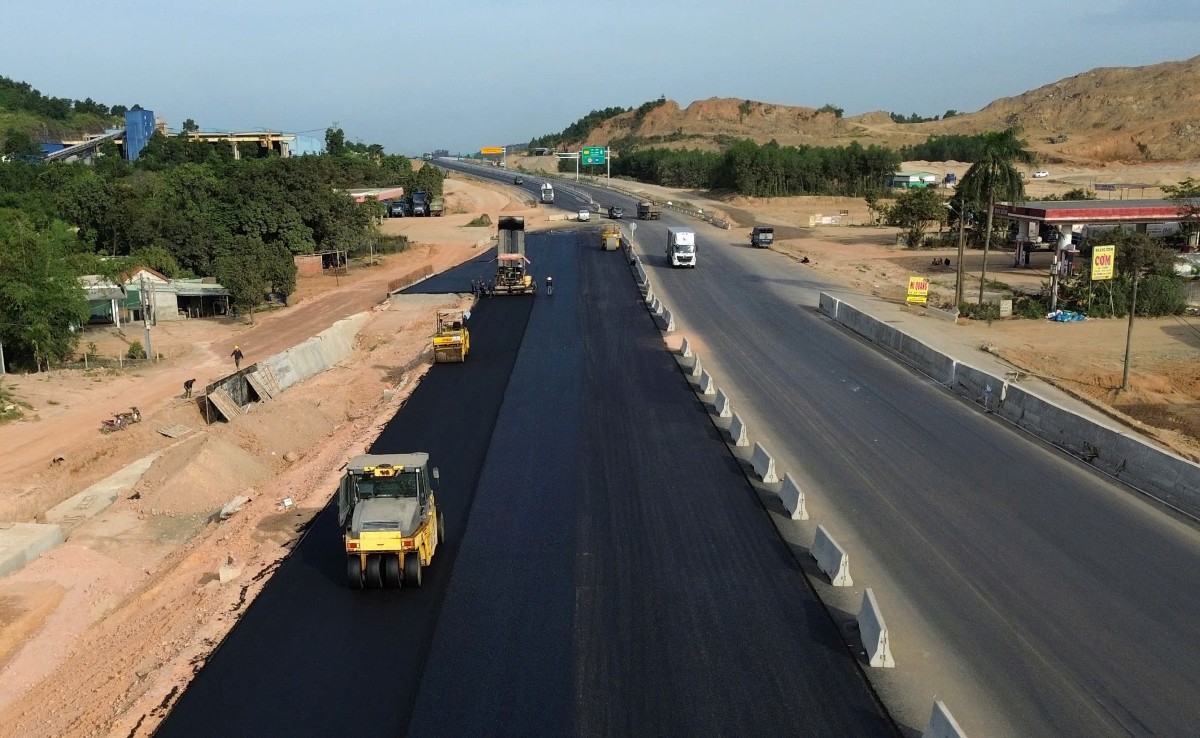
Vietnam slates $35 billion in PPP capital for 29 priority expressways
The Ministry of Construction has identified 29 priority expressway projects requiring over VND920 trillion ($35 billion) under the public-private partnership (PPP) model for the 2026 to 2030 period.
According to the Ministry of Construction, Vietnam plans to construct 2,829 km of new expressways and expand 1,187 km of existing routes from 2026 to 2030, with a total capital requirement estimated at VND1,269 trillion ($48.25 billion).
To date, about VND423 trillion ($16.08 billion) has been allocated from the state budget and investor commitments. The remaining capital needed to be balanced and mobilized amounts to roughly VND846 trillion ($32.17 billion).
15 Projects in Priority Group 1
In Priority Group 1, there is a project to expand the Eastern North-South Expressway section from Mai Son to Cam Lo from four lanes to six complete lanes. Passing through Ninh Binh, Thanh Hoa, Nghe An, Ha Tinh, and Quang Tri provinces, this 415 km section of the expressway requires a total estimated investment of nearly VND72.2 trillion ($2.75 billion).
Also in this group is the expansion of the Eastern North-South Expressway section from Quang Ngai to Dau Giay from four to six lanes. Spanning approximately 551 km across Quang Ngai, Gia Lai, Dak Lak, Khanh Hoa, Lam Dong, and Dong Nai, the project carries a total investment of over VND78.2 trillion ($2.98 billion).
In the Mekong Delta region, Priority Group 1 includes the project to expand the Eastern North-South Expressway section from My Thuan to Can Tho from four to six lanes. This 23 km route requires a total investment of about VND6.4 trillion ($243.35 million).
This list also features a series of Western North-South Expressway routes. Among them, the section from Duc Hoa to My An spans 74 km with four lanes and a total investment of over VND29.3 trillion ($1.11 billion). The 49 km section from Phu Tho to Co Tiet to Yen Bai carries an investment of over VND25.5 trillion ($969.58 million). The 40 km section from Tuyen Quang to Phu Tho, planned for expansion from a limited four lanes to four complete lanes, requires nearly VND3.6 trillion ($136.88 million).
In the Central Highlands, Priority Group 1 includes the Pleiku - Buon Ma Thuot route (149 km, VND23.4 trillion or $889.73 million) and the Buon Ma Thuot - Gia Nghia route (105 km, VND18.9 trillion or $718.63 million). Both projects are planned for four lanes with provisions for six lanes.
Connecting the Central and South Central regions are several other key projects, including the 56 km Cam Lo - Lao Bao expressway (nearly VND14 trillion or $532.32 million), the 87 km Ha Tien - Rach Gia section (nearly VND56 trillion or $2.13 billion), the 81 km Nha Trang - Da Lat section (over VND25 trillion or $950.57 million), and the 75 km Phan Thiet - Bao Loc section (about VND26 trillion or $988.59 million).
In the Mekong Delta, the 77 km Vinh Long - Can Tho section, part of the Ho Chi Minh City to Vinh Long to Can Tho to Ca Mau expressway, is proposed with a total investment of over VND41.4 trillion ($1.57 billion).
Priority Group 1 also encompasses two major ring road developments. Ring Road 5 in the Hanoi Capital Region is planned for six lanes through Hanoi, Ninh Binh, Bac Ninh, Thai Nguyen, and Phu Tho. Estimated investments for the respective sections are nearly VND31.7 trillion ($1.21 billion), VND26 trillion ($988.59 million), VND16.7 trillion ($634.98 million), over VND21.2 trillion ($806.08 million), and over VND31 trillion ($1.18 billion).
Meanwhile, the project to expand Ring Road 3 in Ho Chi Minh City from four to eight lanes spans approximately 76 km across Ho Chi Minh City, Dong Nai, and Tay Ninh, with a total investment of about VND38 trillion ($1.44 billion).
14 Projects in Priority Group 2
Priority Group 2 consists of 14 projects aiming to complete the Western North-South Expressway network and connect previously underserved regions.
Specifically, the Western North-South Expressway section from Ngoc Hoi to Pleiku covers 106 km through Quang Ngai and Gia Lai with an investment of about VND16.2 trillion ($615.97 million). The 84 km section from Chon Thanh to Duc Hoa across Dong Nai, Tay Ninh, and Ho Chi Minh City is proposed for expansion from two to four lanes, costing about VND16.4 trillion ($623.57 million).
The 125 km Phu Yen to Buon Ho section of the Phu Yen - Dak Lak expressway project is planned for four lanes with an investment of VND 35 trillion ($1.33 billion).
The 44 km Western North-South Expressway branch from Viet Tri to Hoa Binh requires nearly VND16 trillion ($608.37 million), while the 65 km Vung Ang to Cha Lo expressway through Ha Tinh and Quang Tri carries a total investment of about VND27.6 trillion ($1.05 billion).
In the Mekong Delta, Group 2 features three sections: An Huu to Tra Vinh (90 km, VND31.5 trillion or $1.2 billion), Dinh Ba to Cao Lanh (68 km, nearly VND29.9 trillion or $1.14 billion), and An Huu to Cao Lanh (27 km, expanded to four complete lanes for nearly VND4 trillion or $152.09 million).
Additionally, the Ho Chi Minh City to Vinh Long section (64 km) requires about VND35 trillion ($1.33 billion), while the Can Tho to Ca Mau section (133 km) carries a total investment of about VND70 trillion ($2.66 billion).
In Northern Vietnam, Group 2 includes upgrading the 30 km Noi Bai to Bac Ninh section from a Grade II four-lane road to a six-lane expressway for nearly VND3.6 trillion ($136.88 million). The 25 km Phu Ly to Nam Dinh route will be upgraded to a four-lane expressway for nearly VND11.5 trillion ($437.26 million). The 110 km Northern Midlands Ring Road section from Thai Nguyen to Lang Son carries a four-lane design with an investment of about VND29 trillion ($1.10 billion).
Finally, the 34 km Ha Tinh to Ho Chi Minh Road section, part of the Ha Tinh to Cau Treo expressway project, is proposed for four lanes with provisions for six lanes, carrying a total investment of about VND10 trillion ($387.83 million).
Source: Dan Tien