Lumen Vietnam Fund

Blog

Vietnam, EU elevate ties to Comprehensive Strategic Partnership

Vietnam, EU elevate ties to Comprehensive Strategic Partnership

State President Luong Cuong suggested making science, technology, and innovation a new pillar of cooperation…

Vietnam and the EU have upgraded relations to a Comprehensive Strategic Partnership and agreed to develop an action plan to effectively implement the Joint Statement in the coming time.

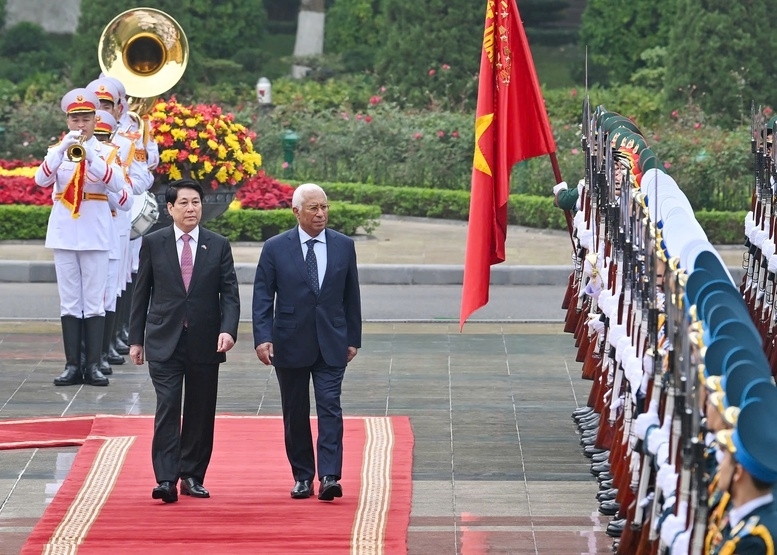
The official upgrade of Vietnam-EU relations was announced during a press briefing on January 29, co-chaired by State President Luong Cuong and European Council President António Costa following their high-level talks in Hanoi.

The European Council President paid an official visit to Vietnam at the invitation of President Cuong from January 28 to 29.

The Vietnamese State leader affirmed that the visit opens a new chapter in Vietnam-EU relations. The decision to upgrade ties to a Comprehensive Strategic Partnership reflects an increasingly high level of political trust and the substantive development of bilateral relations after 35 years of diplomatic ties.

Highly valuing the EU’s role and position as a leading global political, economic, scientific-technological, and cultural hub, the President affirmed that Vietnam always considers the EU one of its top priority partners in its foreign policy. He expressed a desire to develop deep, wide-ranging, and comprehensive relations with the EU while continuously strengthening friendship and cooperation with EU member states.

Informing the European Council President of the key outcomes of the 14th National Party Congress, President Cuong outlined Vietnam’s two "centenary goals": to become a developing country with modern industry and upper-middle income by 2030, and a developed, high-income country by 2045, when the 100th anniversaries of the Communist Party of Vietnam and the Democratic Republic of Vietnam (now the Socialist Republic of Vietnam) will be celebrated, respectively.

He affirmed that Vietnam is determined to build a new growth model based on science, technology, innovation, digital transformation, and green transition. He identified these as core tasks in the new development phase and areas with significant potential for cooperation with the EU.

On this basis, President Cuong proposed that both sides coordinate closely to implement the Joint Statement on the Vietnam-EU relationship upgrade across six key orientations. These include: strengthening political trust through the exchange of high-level delegations and contacts; effectively implementing existing cooperation mechanisms while expanding new frameworks; and identifying economic cooperation as a vital driver of bilateral ties.

The President suggested making science, technology, and innovation a new pillar of cooperation and promoting respect for international law and multilateralism. He also requested that the EU enhance maritime economic cooperation, support Vietnam in building sustainable fisheries, and soon lift the "yellow card" regarding Illegal, Unreported, and Unregulated (IUU) fishing for Vietnamese seafood.

President Luong Cuong reaffirmed that Vietnam supports the promotion of ASEAN-EU relations and stands ready to serve as a bridge to make these ties more substantive, looking toward the 50th anniversary of ASEAN-EU diplomatic relations in 2027.

For his part, Mr. António Costa affirmed that the EU considers Vietnam a key partner within the ASEAN region and the Indo-Pacific Strategy. He noted that both sides share many similarities, including a respect for international law and support for free trade and freedom of navigation.

According to President Costa, the visit holds historical significance as Vietnam becomes the EU’s first Comprehensive Strategic Partner in ASEAN. This milestone reflects a 35-year journey of cooperation and a shared strategic vision amidst a volatile global landscape.

The European Council President emphasized the vast potential for cooperation in trade, sustainable development, innovation, maritime economy, governance, security, and people-to-people exchanges. He expressed a desire to strengthen collaboration in traditional sectors such as trade-investment, agriculture, and climate change response, while expanding into emerging fields including the green and digital transitions, the Just Energy Transition, infrastructure, and transport connectivity.

During their talks, both sides also agreed to promote cooperation in science, technology, and innovation; effectively implement the EU-Vietnam Free Trade Agreement (EVFTA); and work toward the early ratification of the Investment Protection Agreement (EVIPA). Furthermore, they committed to maintaining the Vietnam-EU Defense and Security Dialogue mechanism and enhancing cooperation in UN peacekeeping, maritime security, cybersecurity, and crisis management.

Source: Dũng Hiếu

Photo: VGP
Latest Posts

Vietnam’s footwear exports gain $29 bln in 2025

Vietnam’s footwear exports gain $29 bln in 2025

The country ranking as the second largest footwear exporter worldwide.

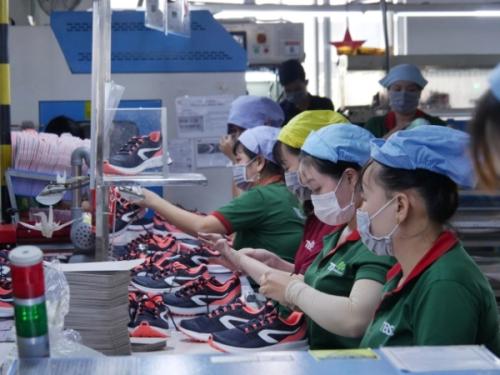
Vietnam earned nearly $29 billion from footwear exports in 2025, up 5% year-on-year, according to the Vietnam Leather, Footwear and Handbag Association (Lefaso).

The foreign-invested (FDI) sector remained the main growth driver, contributing $22.82 billion, or 80% of total export value, representing a sharp 17% increase compared to the previous year.

With these results, Vietnam ranked as the world’s third-largest footwear producer and the second-largest exporter.

The United States continued to be Vietnam’s biggest footwear market, importing products worth $11.01 billion. It was followed by the European Union with $6.88 billion, China with $1.78 billion, Japan with $1.61 billion, and the Republic of Korea with $776 million.

The sector now comprises nearly 3,000 enterprises and employs about 1.5 million workers, with an annual production capacity of approximately 1.3–1.4 billion pairs of shoes.

Investor approved for Ca Na LNG Power Plant project

Investor approved for Ca Na LNG Power Plant project

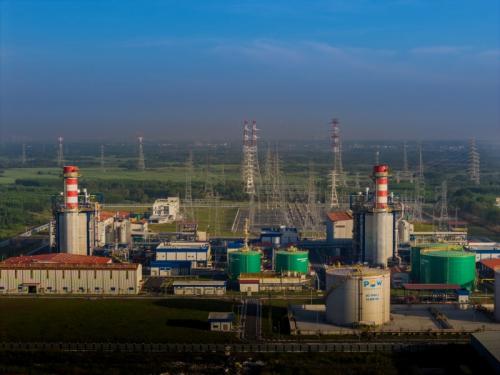
The project will include a 1,500 MW gas-fired power plant and an LNG terminal with a capacity of 1 to 1.2 million tons per year.

Under a recent decision of the People’s Committee of Khanh Hoa Province in South central Vietnam, an investor has been selected for the Ca Na LNG Power Plant project.

Accordingly, the Trung Nam - Sideros Rive Joint Venture has been awarded the investment and construction contract with a total capital of over VND57.384 trillion (over $2.2 billion), funded directly by the investor.

The Ca Na LNG Power Plant will be constructed in Ca Na Commune, spanning an area of approximately 265 ha.

The project’s primary objective is the commercial generation of electricity. Specifically, it will include a 1,500 MW gas-fired power plant and an LNG terminal with a capacity of 1 to 1.2 million tons per year, alongside other auxiliary facilities to ensure national energy security.

In addition, the project involves the construction of an LNG import port, a 2,400-meter-long eastern breakwater, and various supporting infrastructure works for the import terminal.

The project is scheduled to be completed and operational by December 31, 2030. The operational lifespan of the project is 50 years, starting from the date the investor is granted land allocation, land lease, or permission for land-use conversion by the competent authorities.

The plant is situated adjacent to Phase 1 of the Ca Na Industrial Zone (a 378-hectare site developed by the Trung Nam Ca Na Industrial Zone Infrastructure Investment Joint Stock Company) and the Ca Na General Seaport. This project cluster is expected to attract investment toward green energy usage and selective manufacturing activities that meet green and sustainable criteria.

Vietnam pushes for zero tariffs as tough US demands loom in trade talks

Vietnam pushes for zero tariffs as tough US demands loom in trade talks

Vietnam has proposed a list of goods eligible for zero tariffs when entering the U.S. market as the two countries prepare for a sixth round of reciprocal trade negotiations next week, a senior trade official said, acknowledging that Washington’s demands remain “very high.”

“We will make every effort to achieve positive progress and reach agreement with the partner on key issues,” Deputy Minister of Industry and Trade Nguyen Sinh Nhat Tan told a press briefing on Thursday.

To prepare for the upcoming talks, the Ministry of Industry and Trade (MoIT) and Vietnam’s negotiating delegation have coordinated with other ministries and agencies to develop negotiation scenarios, report to competent authorities, and convey Vietnam’s positions to the U.S., including the proposed zero-tariff product list, he said.

Tan acknowledged that the negotiations are challenging. “The partner’s demands are very high. Some requests go beyond reasonable levels and create difficulties for the talks, but we will continue to explain and persistently persuade them,” he said.

Alongside negotiations, Vietnam is taking steps to facilitate greater imports of U.S. goods and encourage American companies to invest in the country, aiming to address the trade imbalance as the U.S. records a significant trade deficit with Vietnam.

“The trade gap does not stem from direct competition between the two sides, but rather from the international division of labor and production,” the deputy minister explained, noting that the U.S. specializes in high-value, high-technology products.

According to MoIT data, Vietnam’s exports to the U.S. in 2025 are estimated at $153.2 billion, up 28.2% year-on-year, accounting for 32.2% of the country’s total export turnover.

The five product categories with highest export values accounted for 67.5% of Vietnam’s total exports to the U.S. They included computers, electronic products and components (estimated at $42.1 billion); machinery, equipment, tools and spare parts ($24.1 billion); textiles and garments ($17.9 billion); mobile phones and components ($9.9 billion); and wood and wood products ($9.5 billion).

Vietnam imported $19.3 billion worth of goods from the U.S. last year, up 27.7% year-on-year. Of this, five out of 44 major imported product categories accounted for 51.5% of total import value from the U.S., including computers, electronic products and components ($5.5 billion); cotton of all kinds ($1.4 billion); machinery, equipment, tools and spare parts ($1.3 billion); plastic raw materials (nearly $1.2 billion); and wood and wood products ($0.6 billion).

Vietnam and the U.S. on October 26, 2025 issued a joint statement on the Framework for a Balanced and Fair Reciprocal Trade Agreement after many months of negotiations. Accordingly, Vietnam will expand market preferences for most U.S. industrial and agricultural goods.

Meanwhile, the U.S. will maintain a 20% reciprocal tax rate for goods originating from Vietnam and consider applying a 0% tax rate to some products. The U.S. will identify products in the list set out in Annex III of Executive Order No. 14356 dated September 5, 2025 – “Potential Tariff Adjustments for Likely-Oriented Partners” – to enjoy a 0% reciprocal tariff rate.

Earlier, on August 1, 2025 (Vietnam time), the White House announced a Presidential Executive Order signed by Donald Trump, adjusting reciprocal tariff rates for 69 countries and territories listed in Annex I. Under the revision, the U.S. reduced the reciprocal tariff rate on Vietnam from 46% to 20%.

See all blog