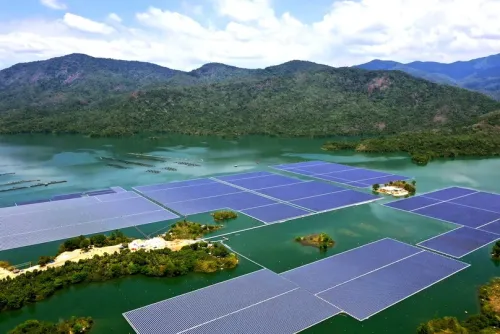
Vietnam’s state utility EVN has urged regulators to clarify the economic and operational benefits of solar power projects equipped with battery energy storage systems (BESS), warning that the technology could raise electricity costs while delivering uncertain benefits to the national grid.
In comments submitted to the Electricity Authority of Vietnam on the proposed 2026 power generation price framework for ground solar power and BESS-integrated floating solar power projects, EVN said the addition of battery storage significantly increases project investment costs, resulting in higher electricity tariffs than conventional solar plants.
According to current pricing frameworks issued by the Ministry of Industry and Trade, solar projects integrated with battery storage receive tariffs that are approximately VND140-190 (0.53 - 0.73 U.S. cent) per kilowatt-hour higher than equivalent projects without storage, or up roughly 11-14%.
However, EVN said the actual effectiveness of battery storage investments and their contribution to grid operations remain unclear.
“The efficiency of investment and the effectiveness of energy storage systems in power system operations have not yet been clearly demonstrated,” the utility said in its submission.
EVN has recommended the ministry define the rights and obligations associated with battery storage systems, including dispatch authority, operational objectives, storage utilization mechanisms, and developers’ responsibilities for maintaining system availability.
The utility also urged regulators to assess the actual needs of Vietnam’s power system before approving large numbers of renewable projects combined with storage.
Without careful planning, EVN warned, Vietnam could face excess investment similar to situations seen in some neighboring countries where renewable generation and storage capacity expanded faster than system requirements.
Under EVN’s proposed calculations, generation price ceilings for utility-scale solar projects equipped with storage would range between VND1,104 - VND 1,550 (4,2-5.9 U.S. cents) per kWh for ground-mounted projects, depending on location and storage investment assumptions.
For floating solar projects with battery storage, proposed price ceilings would range from VND1,299 - VND1,823 per kWh.
The highest tariff would apply to floating solar projects in northern Vietnam, while the lowest would be available for ground-mounted solar plants in the south.
The utility’s calculations assume storage systems equivalent to 10% of a solar plant’s installed capacity. Investment cost estimates were derived from domestic power-sector tenders, Chinese market data, and global industry averages.
EVN noted that several key assumptions remain preliminary and recommended that the ministry seek additional input from independent consultants and international organizations before finalizing the pricing framework.
The debate comes as Vietnam seeks to rapidly expand battery storage capacity to support growing renewable energy deployment.
Battery Energy Storage Systems (BESS) store electricity during periods of excess generation and discharge power when demand rises, helping stabilize grid operations and improve the integration of intermittent renewable sources such as solar and wind.
Under the revised eighth Power Development Plan VIII (PDP VIII), Vietnam aims to develop between 10,000 MW and 16,300 MW of battery storage capacity by 2030 as part of its broader energy transition strategy.
EVN also requested guidance on how newly merged administrative provinces should be classified into northern, central and southern regions for tariff-setting purposes, warning that the ongoing administrative restructuring could create implementation challenges if regional pricing rules are not clarified.