Lumen Vietnam Fund

Blog

US company to invest $117 mln in battery storage project in central Vietnam

US company to invest $117 mln in battery storage project in central Vietnam

U.S.-based Arbin Energy LLC will invest $117 million in a factory producing battery energy storage systems and battery testing equipment at the Danang Hi-Tech Park in Danang city, central Vietnam.

The Danang Hi-Tech Park and Industrial Zones Authority (DSEZA) has approved the investment policy and Arbin Energy LLC as the investor for the Arbin Energy Danang Factory project.

The project will cover 5.34 hectares at the Danang Hi-Tech Park, with total investment exceeding VND3.05 trillion ($117 million).

The factory will focus on manufacturing battery energy storage systems (BESS), battery testing equipment and machinery used in battery production. Its BESS production line will have a designed capacity of 5,000 containers per year, equivalent to 5 GWh annually.

The project will add energy storage equipment manufacturing to the hi-tech park's industrial portfolio and create opportunities to connect with supply chains involving companies in power electronics, measurement and automation.

Construction is scheduled to begin in December 2026, with production expected to start in the third quarter of 2028. With the latest project, the Danang Hi-Tech Park has attracted a total of 14 foreign direct investment (FDI) projects, with combined registered capital of $830.5 million.

In September 2026, during a working visit to the United States, Chairman of the Danang People's Committee Nguyen Manh Hung held a meeting with Arbin Instruments, chaired by its chairman, Chaojiong Zhang.

The two sides discussed and updated the company's investment plans in Danang, focusing on project scale, technology, products, infrastructure requirements and implementation timelines.

In addition to manufacturing operations, the discussions covered potential cooperation in research and development (R&D), technical training and partnerships with universities and technology companies in the city. The two sides also reviewed investment procedures and agreed on the next steps for implementation.

Founded in 1991, Arbin Instruments is headquartered and operates its manufacturing facilities in College Station, Texas, in the United States. Over its 35 years of operations, the company has grown into one of the world's leading manufacturers of battery testing equipment and energy storage system testing solutions.

Its core business focuses on researching, designing and manufacturing high-precision battery testing equipment, electric vehicle battery pack testing systems, solutions for industrial-scale battery production, and software systems for data management and analysis.

According to the company, its equipment systems are currently used in more than 55 countries. In addition to its approximately 6,000-square-meter headquarters and manufacturing complex in Texas, Arbin Instruments has expanded its operations to Germany, China, India, South Korea, Vietnam and other markets.

Its customers include electric vehicle manufacturers, battery producers, consumer electronics companies, universities and research institutes worldwide.

In Vietnam, Arbin Energy LLC was established in August 2026, with its registered office at Lot A10, Danang Hi-Tech Park, Lien Chieu ward. The company has initial charter capital of VND52.14 billion ($2 million), and is wholly owned by Chaojiong Zhang, a U.S. citizen born in 1945, who also serves as its chairman.

As of August 2026, the United States was one of Danang's key investment partners, with 87 FDI projects worth more than $346 million, ranking seventh among more than 70 countries and territories investing in the city.

With support from U.S. diplomatic missions and investment promotion programs, Da Nang has gradually established ties with several leading global technology corporations, including Synopsys, Marvell, Nvidia and Qualcomm.

The city is currently home to around 10 U.S. companies operating in the semiconductor chip design sector, with Marvell serving as a key strategic partner.


Source: Thanh Van, Nguyen Quang
Latest Posts

Vietnam’s electronics exports surge 71% to $149.4bln in 10M

Vietnam’s electronics exports surge 71% to $149.4bln in 10M

Key export markets including the US, China, Hong Kong (China), South Korea and Mexico.

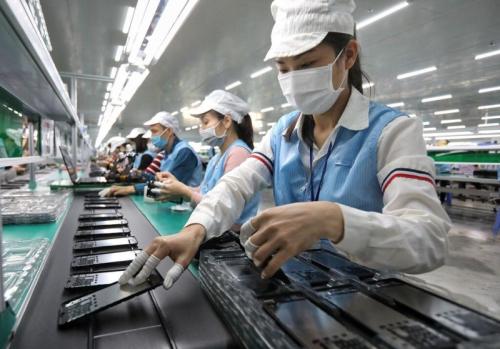
Computers, electronic products and components remained Vietnam’s largest export category in the first 10 months of 2026, generating $149.41 billion, up 71% year-on-year, according to the Vietnam Customs.

The group accounted for 29.9% of the country’s total export turnover in the ten-month period. Shipments in October alone reached $25.68 billion.

The US was the largest destination, with exports worth $53.47 billion, up 56.5%. Shipments to China rose 107.2% to $28.97 billion, while exports to Hong Kong (China) surged 109.9% to $18.52 billion. Exports to South Korea and Mexico reached $8.32 billion and $2.83 billion, respectively.

The electronics category made the largest contribution to Vietnam’s overall export growth. Of the $107.63 billion increase in national export turnover during the 10-month period, the group accounted for $62.02 billion.

Phones and components also recorded strong growth, with exports reaching $57.61 billion, up 18.4% year-on-year and accounting for 11.5% of total exports. China, the US, the EU and South Korea were the main markets.

On the import side, computers, electronic products and components reached $215.25 billion, up 74.4% and accounting for nearly 42% of total imports. October imports stood at $26.28 billion, down 3.2% from September. However, cumulative imports were $91.85 billion higher than in the same period of 2025.


Corporate bond issuance reaches $19.3b in 10M

Corporate bond issuance reaches $19.3b in 10M

Corporate bond market contracting in October after recording four consecutive months of modest growth.

Vietnam’s corporate bond market contracted in October after recording four consecutive months of modest growth, with monthly increases ranging from 1.1% to 2.9%.

The decline was driven by a sharp drop in new issuance and rising bond maturities.

Outstanding corporate bonds stood at VND1.48 quadrillion ($56.2 billion) at the end of October, down 0.1% from the previous month but still 7% higher than at the end of 2025, according to FiinTrade data.

New issuance totalled VND46.7 trillion ($1.77 billion) in October, falling 38.3% month-on-month. This was lower than the combined value of maturing bonds and early redemptions, which reached VND23.6 trillion and VND24 trillion, respectively. Maturities rose 20.4%, while early redemptions fell 15.9% from September.

By sector, banks issued VND35.1 trillion in bonds, down 22.5% month-on-month. Real estate companies issued VND7.6 trillion, a decline of 68.7%.

The average issuance interest rate for banks fell to 8.1% per year, while that for real estate companies increased to 12.5%.

In the first 10 months of 2026, total corporate bond issuance reached VND509.1 trillion ($19.3 billion), up 1.4% year-on-year. However, funding trends diverged: bank issuance fell 20.3% to VND274.7 trillion, while non-bank issuance rose 48.9% to VND234.4 trillion, largely driven by a 73.7% increase in the real estate sector.


Vietnam seeks to double fruit and vegetable exports to US$20 billion

Vietnam seeks to double fruit and vegetable exports to US$20 billion

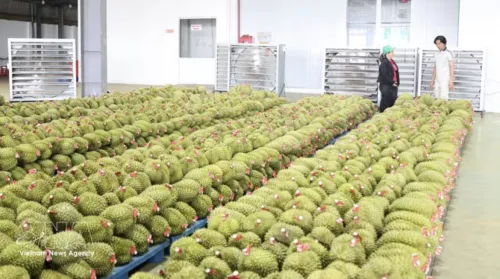
With exports forecast to reach US$9.5-10 billion in 2026, Vietnam’s fruit and vegetable sector is stepping up efforts to strengthen production chains, apply advanced technologies and expand high-value products to achieve its US$20 billion target in the coming years.

Expanding the billion-dollar product portfolio

According to Dinh Cao Khue, Vice Chairman of the Vietnam Fruit and Vegetable Association (Vinafruit), Chairman and General Director of Dong Giao Export Food Joint Stock Company (Doveco), beyond key export products, several other fruits are showing strong potential to become high-value commodities.

Passion fruit, pineapple and banana are notable examples of how the application of science and technology, proactive seed supply and market-oriented production organisation can deliver results.

He said that around five years ago, domestic passion fruit production remained fragmented and struggled to compete with South American producers such as Peru and Ecuador. However, with support from the Fruit and Vegetable Research Institute and universities, Vietnam has developed its own supply of disease-free planting materials, replacing imported varieties from Taiwan (China).

This has improved productivity and expanded exports to various markets, including the US and South America, particularly Brazil, the world's third-largest passion fruit producer.

For pineapple, the shift from the Queen variety, with yields of around 50 tonnes per hectare, to Cayenne at 70 tonnes per hectare, and now MD2 at 100 tonnes per hectare, has enhanced competitiveness and enabled producers to meet demand for both fresh fruit and industrial processing.

According to Khue, revenue from one hectare of MD2 pineapple can reach VND900 million to VND1 billion (US$38,757), while passion fruit generates at least around VND500 million, highlighting their potential to develop into high-value export commodities.

The development of the banana industry also demonstrates considerable room for value growth.

Pham Quoc Liem, Vice Chairman of Vinafruit and General Director of U&I Agriculture Corporation (Unifarm), shared that the banana sector should focus not simply on expanding cultivation areas but on standardising growing areas, improving marketable yields and product quality, and developing higher-value markets.

According to the company's estimates, Vietnam will need to standardise around 24,000 hectares of export-compliant banana growing areas, while improving productivity and selling prices, to raise the banana export turnover to US$1 billion.

Further ahead, if 30% of the country's existing banana-growing area were brought up to standard, export revenue from the fruit could exceed US$2 billion, he said.

Restructuring production chains to increase export value

To achieve the US$20 billion fruit and vegetable export target, a key priority is to develop concentrated raw-material growing areas of sufficient scale, with consistent quality and stable supplies for processing and exports.

In the Mekong Delta, Westfood Hau Giang Joint Stock Company has partnered with local producers to develop more than 300 hectares of MD2 pineapple plantations on acid-sulphate and grey soil areas in Can Tho, An Giang and Dong Thap.

Tran Ba Son, Director of the company's raw-material growing area division, stressed that demand for processing materials was substantial. The company aims to expand its MD2 pineapple growing areas to around 1,000 hectares by 2030 to ensure supplies for long-term export orders.

To develop large-scale raw-material areas, Khue called on the Ministry of Agriculture and Environment and local authorities to pay greater attention to planning, infrastructure investment and production organisation.

His company plans to break ground on a major processing plant in the central province of Nghe An, with a capacity of 30 tonnes of products per hour, equivalent to around 60,000 tonnes annually. The plant is expected to purchase pineapples from growers across the area stretching from Nghe An to Quang Tri.

The region has harsh climatic conditions and is frequently affected by storms and heavy rains, but its natural conditions are suitable for pineapple cultivation.

According to Liem, each promising fruit and vegetable product should have at least one enterprise-led partnership model linking businesses with cooperatives and farmers to develop standardised raw-material growing areas.

The State should play an enabling role through policy development, coordination and support, including preferential credit policies tied to production partnership contracts.

Alongside production organisation, science and technology should be applied comprehensively, from plant varieties and cultivation to processing and post-harvest preservation.

Research institutes and universities need to work more closely with businesses in research and technology transfer, Khue said, adding post-harvest technology and processing are other areas requiring commensurate investment.

According to Liem, agricultural pre-processing, packaging and storage facilities are increasingly required to meet stringent standards for food safety, quality control and traceability, including Good Manufacturing Practice (GMP), Hazard Analysis and Critical Control Points (HACCP), and ISO 22000.

If infrastructure is not suited to production technology and the scale of raw-material growing areas, post-harvest operations could become a bottleneck, driving up costs and reducing the ability to fulfil export orders, he stated.

It is therefore necessary to improve regulations to allow the construction of agricultural pre-processing, packaging and storage facilities directly serving production on agricultural land, at scales appropriate to technological requirements, while ensuring environmental standards and compliance with land-use purposes, he noted.

In addition, investment in irrigation systems for fruit-growing areas needs greater attention.

Khue revealed that current irrigation investment programmes primarily focus on rice cultivation, while fruit trees also require support to secure water supplies and stabilise production, particularly in areas frequently affected by climate change.


See all blog