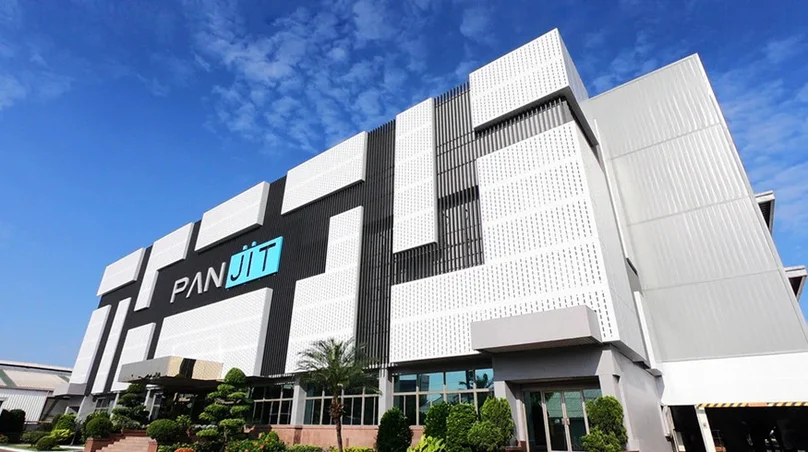
Taiwanese firm Panjit invests $45 mln to expand semiconductor facility in Vietnam
After acquiring a 95% stake in Ho Chi Minh City-based Torex Vietnam Semiconductor, Taiwanese semiconductor manufacturer Panjit has approved an additional $45 million investment in its production facility in Vietnam.
The move reflects the company’s ambition to transform its HCMC plant into a key hub in the supply chain for power semiconductors, integrated circuits (ICs), automotive electronics, and green energy solutions.
In a recent filing with the Taiwan Stock Exchange, Panjit International Inc. said the investment will be implemented in phases following board approval and financed through internal funds and bank loans.
The investment aims to expand the company’s overseas manufacturing capacity, thereby improving flexibility and competitiveness in regional production allocation.
This marks the latest move by the Taiwanese semiconductor company in Vietnam, six months after its acquisition of a majority stake in Torex Vietnam Semiconductor, a subsidiary of Japan’s Torex Semiconductor Ltd.
In November 2025, Panjit announced that its board had approved the acquisition of a 95% stake in Torex Vietnam Semiconductor Co., Ltd. Following the transaction, Torex Semiconductor retained the remaining 5% stake in the company.
According to DigiTimes, Panjit allocated approximately $10 million in internal funds for the acquisition. The deal was aimed at expanding Panjit’s product portfolio by bringing automotive-grade power semiconductor packaging and testing lines to Vietnam, thereby strengthening the company’s position in the AI, automotive, power supply, and green energy sectors.
From acquiring Torex Vietnam to expanding manufacturing
Torex Vietnam Semiconductor was established in 2008 and is located in the VSIP II Industrial Park, formerly in Binh Duong province and now part of HCMC. The factory mainly specializes in semiconductor packaging and testing, including IC packaging and testing services.
The company uses USP (Ultra Small Package) technology, an ultra-miniature packaging technology designed to support the trend toward increasingly compact semiconductor components while maintaining high performance and reliability.
Before the transaction with Panjit, Torex Vietnam had charter capital of $5.8 million and total assets of $6.6 million as of the end of March 2025.
Panjit’s additional $45 million investment in the Vietnamese production facility is therefore significantly larger than Torex Vietnam’s previously disclosed asset base.
This suggests that the HCMC plant will not only continue operating as a packaging and testing facility but will also likely be upgraded to support Panjit’s broader product strategy.
In its November 2025 statement, Panjit said the investment in Torex Vietnam would strengthen the company’s manufacturing footprint in Southeast Asia, increase production flexibility, improve supply chain resilience, and enhance global competitiveness.
The company also emphasized that diversifying manufacturing locations has become increasingly important amid rising geopolitical uncertainties and the ongoing restructuring of global supply chains.
Bringing automotive-grade products to Vietnam
One notable aspect of Panjit’s strategy is the introduction of automotive-grade power semiconductor production at its Vietnam facility.
According to information released by Panjit one month after the signing ceremony with Torex, the company plans to expand automotive-grade manufacturing capacity at the Vietnam plant by installing new equipment and adding two new production lines.
These lines are designed to meet the requirements of Tier 1 automotive customers. Mass production is expected to begin in the third quarter of 2026.
This is a significant development because the automotive industry, particularly electric vehicles and in-vehicle electronic systems, is one of the fastest-growing markets for power semiconductors.
Products such as diodes, MOSFETs (metal-oxide-semiconductor field-effect transistors), SiC components, protection devices, and other power devices play a crucial role in power management, energy conversion, circuit protection, and energy control.
Panjit operates under the IDM (integrated device manufacturer) model, which integrates design, manufacturing, packaging, testing, and sales. Its product portfolio includes ICs, IGBTs (insulated-gate bipolar transistors), MOSFETs, diodes, SiC components, diode rectifiers, protection devices, transistors, and bridge rectifiers. Panjit’s customers span the automotive, power supply, industrial, computing, consumer electronics, and communications sectors.
Source: Quang Minh, Minh Hue
Photo: Photo courtesy of the company