Party General Secretary To Lam's address at first session of 16th National Assembly
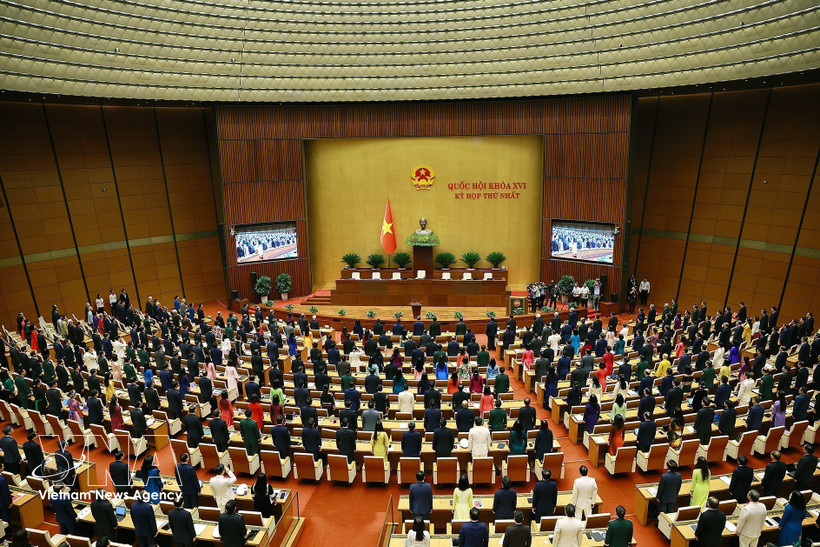
Today, the 16th National Assembly (NA) of the Socialist Republic of Vietnam convenes its first session — a session of particularly important significance, marking the beginning of a new term for the highest representative body of the People and the highest State authority of our country.
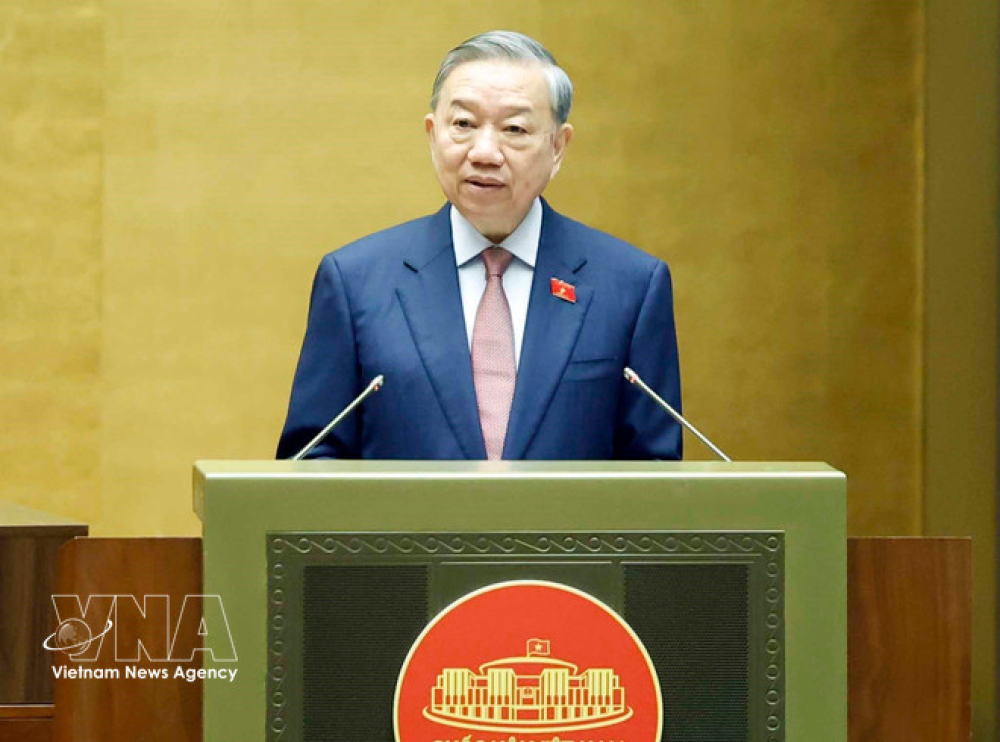
Hanoi (VNA)- General Secretary of the Central Committee of the Communist Party of Vietnam (CPV) To Lam delivered an address at the opening of the first session of the newly-elected 16th National Assembly in Hanoi on April 6.
The Vietnam News Agency (VNA) respectfully introduces a translation of the address.
Distinguished leaders and former leaders of the Party, the State, the National Assembly, the Government and the Vietnam Fatherland Front.
Distinguished Deputies of the 16th National Assembly.
Distinguished guests, representatives of the diplomatic corps and international friends.
Dear voters, compatriots across the country, and the Vietnamese community abroad.
Today, the 16th National Assembly (NA) of the Socialist Republic of Vietnam convenes its first session — a session of particularly important significance, marking the beginning of a new term for the highest representative body of the People and the highest State authority of our country.
This session serves to consolidate the State apparatus in accordance with the Constitution; and at the same time, it focuses on institutionalising the Resolution of the 14th National Party Congress, thereby creating a legal and institutional foundation, as well as policy momentum, for the country to enter a new stage of development: rapid, sustainable, identity-rich growth based on science and technology, innovation, and the strong aspiration to rise of the entire nation.
On behalf of the Party Central Committee, I warmly congratulate the highly successful results of the election of deputies to the 16th National Assembly and People’s Councils at all levels for the 2026–2031 term. I sincerely congratulate National Assembly deputies and People’s Council deputies at all levels who have been entrusted by voters nationwide. This is a great honour, but it also entails a very heavy responsibility before the Party, the People, and the future of the country.
On this occasion, we respectfully acknowledge and highly appreciate the important contributions of the National Assembly, deputies of the 15th National Assembly, and members of People’s Councils at all levels in the 2020–2025 term. During the past term, the National Assembly and People’s Councils at all levels made great efforts to innovate their organisation and modes of operation, improve the quality of legislation and supervision, and make decisions on many critical issues, thereby helping to remove institutional bottlenecks, promote socio-economic recovery and development, strengthen national defence and security, and enhance the country’s international standing. These achievements, together with the proud 80-year tradition of the Vietnamese National Assembly, constitute an important foundation for the 16th National Assembly to inherit, promote, and further develop to new heights.
Distinguished National Assembly deputies, compatriots and voters nationwide.
The world is undergoing rapid and profound changes, both in breadth and depth. Strategic competition among major powers is intensifying, while the world order and international law are facing numerous challenges. Global supply chains, capital flows, technologies, and markets are being restructured. Traditional and non-traditional security challenges are intertwining, increasingly exerting direct impacts on the development environment and space of each nation. In particular, the groundbreaking development of artificial intelligence, big data, and digital technologies, and scientific and technological advances are fundamentally transforming modes of production, growth models, national governance, and social life as a whole. In this context, any nation that adopts proactive strategies, carries out timely institutional reforms, unleashes creativity, mobilises the strength of its entire people, and seizes new opportunities will be the one that advances. Our country, with a 4,000-year civilisation and 96 years under the leadership of the Party, and 40 years of renewal, has achieved great accomplishments of epochal significance.
However, we must also face the truth that the requirements of the new stage of development are placing higher, faster, and more pressing requirements on institutions, growth models, the quality of national governance, policy responsiveness, enforcement discipline, and the improvement of the people’s living standards. The 14th National Party Congress has clearly defined development goals to 2030, with a vision to 2045, while emphasising the need to renew development mindset, unlock all resources, and maximise the strength of great national unity. In that process, the National Assembly must further innovate in a stronger, more substantive, and more effective manner to fully and worthily fulfill its constitutional responsibilities. I would like to emphasise that the National Assembly is where the will, aspirations, and mastery of the People are embodied; where major issues of the country are decided; and where the Party’s guidelines are transformed into laws, policies, and the strength of practical implementation. Each deputy must always be deeply aware that they not only represent their constituencies, nor merely carry the trust of voters, but also bear the responsibility for the nation’s destiny, for the People’s trust, and for the future of generations to come.
From that spirit, I propose the 16th National Assembly focus on effectively carrying out the following four major tasks.
First, it is essential to strongly innovate legislative work, striving to build a modern, unified, stable, feasible, and development-oriented legal system.
The National Assembly must further enhance its capacity to institutionalise and concretise the Party’s resolutions into policies and laws, thereby creating a solid legal framework for the successful implementation of socio-economic development tasks for the 2026–2031 period and beyond. The legal system must truly become the institutional foundation for development, a tool to protect human rights and citizens’ rights, and a driving force to promote innovation, unleash productive forces, and open up new development spaces for the country.
In recent times, although the legal system has been significantly improved, there remain overlap, inconsistency, and lack of coherence; some regulations are unclear, unstable, and not keeping pace with reality, thus increasing compliance costs, slowing development opportunities, and creating difficulties for people, businesses, and even enforcement agencies. Therefore, the National Assembly needs to direct a comprehensive review of the legal system, perfect the structure of the national legal framework, and resolutely address the situation of“restrictive laws,”overlaps, and buck-passing to sub-law documents. Laws must be designed in such a way that once promulgated, they can be effectively implemented in practice, easily understood by the people, easily complied with by businesses, and easily applied by state agencies. In particular, it is essential to fundamentally renew the mindset of law-making towards a development-oriented approach. Laws should not only regulate what already exists, but also pave the way for what is new; not only adjust existing realities, but also shape the future. Laws must not only“open the way”but also“improve the road.”For emerging issues, new sectors, new models, and new productive forces, appropriate approaches are needed, with bold but controlled piloting to create space for innovation and enhance national competitiveness.
The legislative process must be truly scientific, democratic, and transparent, taking into account the voices of experts, scientists, international experiencea, businesses, and the people. Each law must originate from national and ethnic interests, as well as the legitimate interests of the People. It is necessary to resolutely prevent and combat group interests, sectional interests, and all negative influences that distort policies. There must be a strong shift from the mindset of“making laws for the sake of completion”to“making laws for development”; from“good laws on paper”to“good laws in practice.”The effectiveness of implementation and the satisfaction of people and businesses must be the highest measures of legislative quality.
Second, it is necessary to elevate the National Assembly’s supreme supervision towards substance, sharpness, and full accountability for both responsibility and results.
Supervision is a very important power of the National Assembly. However, supervision cannot stop at identifying limitations or pointing out shortcomings. It must truly become an instrument for enhancing the effectiveness and efficiency of national governance; it must help correct what is amiss, improve what is done, remove bottlenecks, provide early warnings of risks, and promote action. In other words, supervision is not only to “review what has been done”, but also to help “shape what needs to be done”, to identify early any shortcomings that may arise, and to pursue to the end the ultimate question: has the issue been resolved or not.
I propose the National Assembly this term focus its supervision on major issues, key sectors, and the “bottlenecks of bottlenecks” in development; on pressing matters of concern to voters and the People; in particular, the implementation of the Party's major guidelines, the enforcement of laws, the use of national resources, the management of public assets, the practice of thrift and the fight against wastefulness, and the accountability of State agencies. Each content must be associated with specific responsibilities, specific timelines, specific outputs, and specific results; the supervision must be based on data, evidence, quantitative indicators, and clear comparisons between set objectives and achieved outcomes.
At the same time, it is necessary to strongly promote the role of National Assembly organs, National Assembly delegations, and each deputy in supervision activities; and to strengthen coordination between the National Assembly’s supervision and the Party’s inspection and supervision, as well as the State’s inspection, audit, and other control institutions, thereby creating a combined strength to ensure that the apparatus acts correctly, swiftly, and effectively.
Third, there is a need to enhance the mettle and vision in deciding on important national matters; decisions must be correct, well-targeted, timely, and for the long-term interests of the nation.
Entering a stage of development of historic significance, the country requires the National Assembly not only to make correct decisions, but to make the right decisions at the right time; since a delayed decision may mean missing a strategic opportunity. Issues relating to socio-economic development, the State budget, public investment, national target programmes, and nationally significant projects… are all major decisions, closely tied to the fundamental and long-term interests of the nation and the people, and must be considered comprehensively, scientifically, and prudently, but must under no circumstances allow delay to become a bottleneck to development.
Under conditions of still limited resources, the National Assembly must further improve the quality of policy analysis, strategic forecasting capacity, and impact assessment; must select the right major tasks, the right breakthroughs, the right key projects, and the right priority sectors on which to concentrate resources; and avoid dispersion, fragmentation, and equal distribution. Investment must not only serve immediate growth, but must also create new drivers of growth, new competitive capacity, and new development space for the country over decades to come.
Each decision of the National Assembly must be placed within the overall national development strategy, in the context of rapidly changing international conditions, and in the requirement to ensure independence, self-reliance, security, safety, and sustainable development. The National Assembly decides for the present, but must be accountable to the future. That is political resolve, strategic vision, legislative intellect, and the depth of the highest organ of State power.
Fourth, it is important to continue renewing the organisation and mode of operation of the National Assembly towards modernity, professionalism, closeness to the people, practical relevance, and more rapid policy responsiveness.
In a constantly changing world, the National Assembly cannot operate at the old pace, by old methods. It must possess greater adaptability, more timely policy responses, and faster decision-making, while still ensuring rigour and correctness. It is necessary to continue studying the reasonable increase in the number of sessions, and to diversify and flexibilise the forms of operation of the National Assembly and its organs, especially through the strong application of digital technology, online modalities, and digital ecosystems, in order to enhance timeliness, proactiveness, and effectiveness in the consideration and decision of policies.
It is a must to further improve the quality and effectiveness of the activities of each National Assembly deputy, especially full-time lawmakers; to consolidate and further promote the role of National Assembly delegations so that they truly serve as a close bridge between the National Assembly and voters and the People; to ensure that each deputy possesses political mettle, professional competence, critical capacity, and the ability to faithfully convey the voice of the people to the parliamentary platform.
The National Assembly must be more closely connected with the People; expand channels for receiving and listening to the opinions of voters, the People, the business community, intellectuals, and scientists; enhance openness and transparency in all its activities; and build a digital, modern, and intelligent National Assembly, but above all, one that is close to the people, understands the people, serves the people, and acts in their interests. When the will of the people is heard, when their views are faithfully reflected, and when decisions originate from practical realities, the National Assembly will be stronger, the State will be more stable, and public trust will be greater.
Distinguished National Assembly deputies, voters and compatriots nationwide.
The term of the 16th National Assembly has begun with extremely heavy responsibilities. I firmly believe and expect that each National Assembly deputy will continuously cultivate political mettle, enhance their qualifications, capacity, and sense of responsibility; truly remain close to, understand, listen to, and faithfully reflect the will and aspirations of the people; and place national and ethnic interests above all else and first and foremost in every decision. These are the core qualities of people’s representatives in the new era.
Standing before a new historic opportunity for the nation, we have every basis for profound confidence that, with the glorious 80-year tradition of the Vietnamese National Assembly; under the Party’s steadfast and wise leadership; with the unity and support of the People; with the close coordination of the Government and the entire political system; and with the democratic spirit, creativity, enthusiasm, and responsibility of all National Assembly deputies, the 16th National Assembly will certainly fulfil excellently the responsibilities entrusted by the Party, the State, and the People, contributing together with the entire Party, people, and army to realise the aspiration of building a peaceful, independent, democratic, strong, prosperous, civilised, and happy Vietnam, firmly advancing towards socialism.
Once again, I wish the leaders and former leaders of the Party, the State, and the Vietnam Fatherland Front; National Assembly deputies; distinguished guests; and all compatriots and comrades good health, happiness, and success.
I wish the first session of the 16th National Assembly great success.
Thank you very much!
Source: VNA
Photo: VNA