Lawmakers approve investment plan for three expressways worth nearly $6.3 bln
The projects are expected to be substantially completed by 2030 and put into operation in 2031.
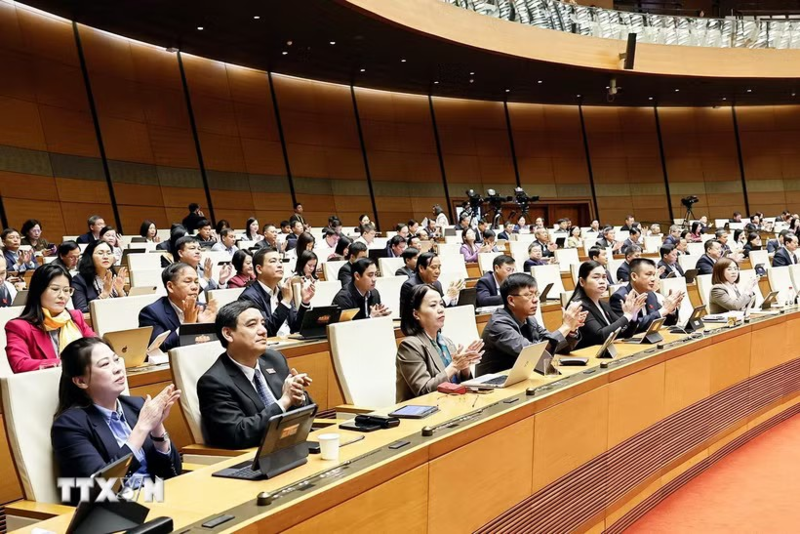
During its second session, the 16th National Assembly, which concluded on November 21, on the same day approved in principle the investment of three expressway projects: the Bao Ha–Lai Chau Expressway (Bao Ha–Tan Phong section), the Quang Ngai–Kon Tum Expressway, and the Moc Chau–Son La–Dien Bien Expressway section passing through northern mountainous Son La Province.
All three projects will be financed through public investment, with a preliminary total investment estimated at VND162.393 trillion (approximately $6.27 billion).
According to the plan, project preparation will take place between 2026 and 2027, while land clearance, compensation, and resettlement work, together with construction, are scheduled to begin in 2027. The projects are expected to be substantially completed by 2030 and put into operation in 2031.
Among the three projects, the Bao Ha–Lai Chau Expressway, specifically the Bao Ha–Tan Phong section, will be approximately 119 km long. It will feature four lanes and a design speed of 80-100 km/h. The route will connect with the Hanoi–Lao Cai Expressway at its starting point and end in the Tan Phong area of Lai Chau Province.
Before the National Assembly voted on the resolution, Minister of Construction Tran Hong Minh presented a report addressing and explaining lawmakers' opinions regarding the investment policy for the three projects.
According to the minister, these are not isolated road projects but rather major interregional transport corridors. They are expected to help remove transportation infrastructure bottlenecks in the Northwest, Central, and Central Highlands regions; narrow the development gap between mountainous and lowland areas; and strengthen national defense and security in strategically important areas.
Notably, once the Bao Ha–Lai Chau Expressway is completed, all 34 provinces and centrally governed cities across Vietnam will have expressway access. Mr. Minh emphasized that the projects will apply advanced technologies in surveying, design, and construction to ensure safety, quality, integrated connectivity, and resilience to climate change. Future operation and management will also incorporate intelligent transportation systems.
The minister noted that upon completion, the expressways will significantly reduce travel times, enhance connectivity among localities, and facilitate the development of border-gate economies, cross-border trade, logistics, tourism, and agricultural product distribution in the Northwest, Central, and Central Highlands regions.
To accelerate implementation, the three projects will benefit from several special mechanisms and policies similar to those previously approved by the National Assembly for major national infrastructure projects.
These mechanisms focus on five key areas: authority to adjust investment policies, compensation and resettlement procedures, contractor appointment, planning adjustments, and the allocation of construction waste disposal sites.
Source: Tuan Khang