Lumen Vietnam Fund

Blog

Indian investor proposes $1.3 bln bio-methanol complex in Thanh Hoa

Indian investor proposes $1.3 bln bio-methanol complex in Thanh Hoa

An Indian investor has proposed a study for a $1.3 billion bio-methanol production complex using bamboo and luong in Thanh Hoa Province, requiring about 200 ha of land.

The Thanh Hoa Provincial People's Committee on November 5 held a working session with an Indian delegation to discuss investment research within the Nghi Son Economic Zone.

Provincial People's Committee Vice Chairman, Cao Van Cuong, hosted the delegation led by MeOH Tech & Applications Pvt CEO, Prashanth Srinivas, alongside representatives from NewEra Cleantech and Sao Thai Duong Investment JSC.

According to the preliminary proposal, the bio-methanol production complex involves a total estimated investment of approximately $1.3 billion. The facility requires about 200 ha of land and is designed for a daily output capacity ranging from 2,300 to 6,900 tons. The project aims to deeply process biomass resources, expanding outlets for local bamboo, luong, and planted forest products.

Thanh Hoa currently has about 72,000 ha of bamboo and luong, including more than 46,000 ha of restored and managed luong forests. The annual harvest output exceeds 65 million trees, with paper material supply reaching approximately 85,000 tons. Raw material supply is projected to remain stable through the 2027 to 2030 period.

Bio-methanol is produced from renewable biomass for use in chemical manufacturing and energy sectors. Alongside bio-methanol, the investor's plan includes producing bamboo pellets and derivative products.

The Management Board of Nghi Son Economic Zone and Industrial Parks has introduced Dong Vang Industrial Park as a potential site based on land requirements and project scale.

Mr. Cuong requested that the investor group clarify its financial qualifications, detailed raw material demands, production technology, and environmental safety processes. He emphasized that Thanh Hoa prioritizes large-scale, modern, and environmentally friendly projects aligned with green growth strategies.


Source: Song Khanh

Latest Posts

Vietnam welcomes 19.5 million foreign visitors in ten months

Vietnam welcomes 19.5 million foreign visitors in ten months

China led the top ten source markets in the ten-month period with nearly 4.4 million arrivals, followed by South Korea with 3.4 million, Russia with 1.25 million, and Taiwan (China) with 1.07 million.

The Vietnamese tourism sector welcomed 19.5 million international arrivals in the first ten months of 2026, up 13.8 percent year-on-year.

According to the Vietnam National Authority of Tourism (VNAT)'s report, a stable environment, enhanced security, direct international flight connections, and favorable visa policies continue to attract global travelers. Diversified tourism products and rich resources also drove double-digit international growth.

The VNAT report also showed that European markets posted strong growth, significantly contributing to overall results alongside traditional Asian source markets.

China led the top ten source markets in the ten-month period with nearly 4.4 million arrivals, followed by South Korea with 3.4 million, Russia with 1.25 million, and Taiwan (China) with 1.07 million.

Other major source markets included the US with 808,700 arrivals, Cambodia 787,100, Japan 757,500, India 744,600, the Philippines 579,200, and Australia 543,000.

By region, Europe posted the highest growth rate at 51.5 percent, followed by Africa up 30.7 percent, Oceania up 21.5 percent, the Americas up 18.1 percent, and Asia up 7.3 percent. Europe registered the largest absolute surge, contributing an additional 1.09 million arrivals year-on-year.

Within Europe, Russia surged 150.0 percent, remaining the largest source market in the region. Other notable European markets included Poland up 45.8 percent, the Czech Republic up 21.9 percent, Switzerland up 23.1 percent, and Sweden up 21.4 percent.

Meanwhile, South Korean arrivals dropped 6.3 percent, signaling a need for targeted promotional policies and product development to retain competitiveness in this key traditional market.

Vietnam reached 19.5 million foreign arrivals in the first ten months of 2026, fulfilling nearly 78 percent of its 25-million annual goal. To secure the remaining 5.5 million visitors, VNAT is launching targeted promotions across key markets including China, South Korea, India, and Russia.

Recent high-level engagements further support this push. Vietnamese officials met with South Korean counterparts to simplify visas and expand high-end golf and culinary offerings. Concurrently, Vietnam is targeting high-spending Austrian tourists by pushing for improved air connectivity to unlock long-haul European growth.


Vietnam's FDI inflows hit highest level since 2009

Vietnam's FDI inflows hit highest level since 2009

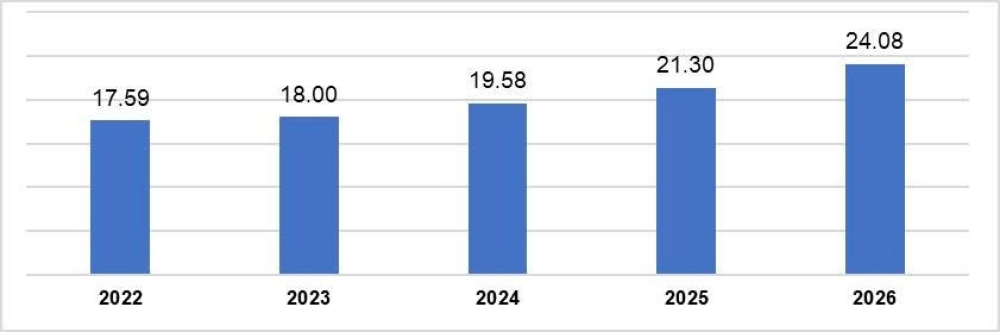
Alongside registered capital, disbursed foreign direct investment (FDI) also reached a record high of $24.08 billion, up 13.1 per cent on-year and the highest 10-month figure in the past five years.

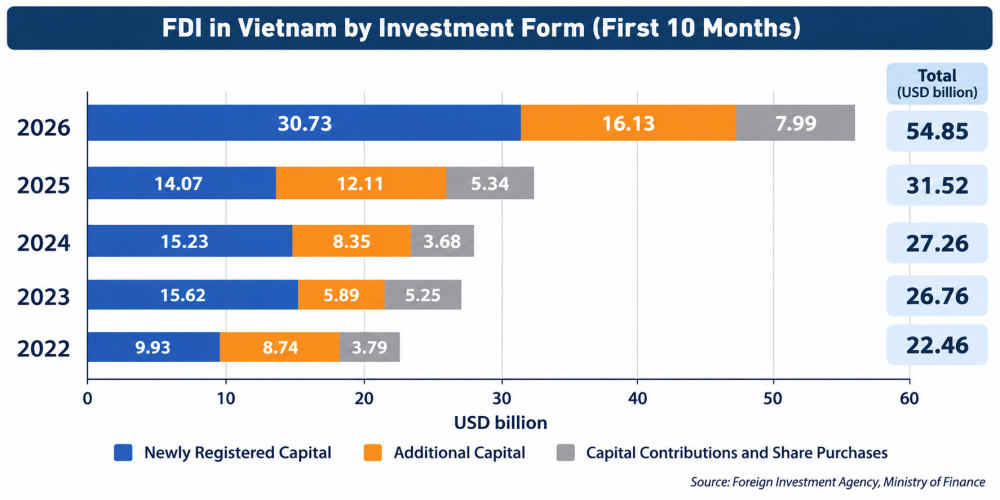
According to the Foreign Investment Agency under the Ministry of Finance, as of October 31, total registered FDI in Vietnam reached $54.85 billion, up 74 per cent on-year and the highest level since 2009.

Apart from the first 10 months of last year, when registered FDI was $31.52 billion, total registered capital during the same period in other years since 2017 had generally remained above $20 billion. The previous high was recorded in the first 10 months of 2019, at $29.11 billion. The corresponding figures were $28.24 billion in 2017, $26.76 billion in 2023, and $27.26 billion in 2024.

Between 2009 and 2016, Vietnam attracted considerably lower levels of FDI in some years. Registered capital stood at just $6.68 billion in the first 10 months of 2012 and $8.88 billion in the same period of 2011. The highest figure during this period was $19.29 billion, recorded in 2015.

Attracting more than $54.85 billion in registered FDI in the first 10 months of 2026 once again underscores Vietnam's appeal as an investment destination. Of the total, $30.73 billion came from newly registered projects, $16.13 billion from additional capital injected into existing projects, and $7.99 billion from foreign investors' capital contributions and share purchases.

Specifically, 3,478 new projects were licensed during the 10-month period, representing a 4.7 per cent increase in the number of projects on-year, while their combined registered capital more than doubled, rising 2.2-fold.

Manufacturing and processing remained the leading sector in attracting newly registered capital, with $14.61 billion, accounting for 47.5 per cent of the total. Transportation and warehousing ranked second with $5.15 billion, or 16.7 per cent, while other sectors attracted a combined $10.98 billion, equivalent to 35.8 per cent.

In terms of investment partners, Singapore was the largest source of newly registered FDI among the 80 countries and territories with new investment projects in Vietnam during the period. Its registered capital reached $9.52 billion, accounting for 31 per cent of the total.

South Korea ranked second with $5.81 billion, or 18.9 per cent, followed by Luxembourg with $4.99 billion (16.2 per cent), Hong Kong with $3.57 billion (11.6 per cent), China with $2.77 billion (9 per cent), Japan with $1.58 billion (5.1 per cent), and the Netherlands with $438.5 million (1.4 per cent).

Alongside the strong performance in registered capital, realised FDI in Vietnam continued its upward trajectory, reaching $24.08 billion in the first 10 months of 2026, up 13.1 per cent on-year. This was the highest disbursement figure recorded for the same period over the past five years.

Manufacturing and processing accounted for the largest share of realised FDI, at $19.96 billion, equivalent to 82.9 per cent of the total. Realised investment in real estate activities reached $1.76 billion, accounting for 7.3 per cent, while electricity, gas, hot water, steam, and air-conditioning supply attracted $785.2 million, or 3.3 per cent.

The continued increase in realised FDI is expected to make an important contribution to expanding production capacity and supporting economic growth.

Regarding additional investment, 1,079 existing projects registered capital adjustments during the first 10 months, with total additional capital reaching $16.13 billion, up 33.2 per cent on-year. As a result, the combined newly registered and additional capital of foreign-invested projects reached $46.86 billion.

Manufacturing and processing accounted for $24.19 billion, or 51.6 per cent of this total, followed by real estate activities with $7.08 billion (15.1 per cent). Other sectors attracted a combined $15.59 billion, equivalent to 33.3 per cent.

Regarding capital contributions and share purchases, foreign investors conducted 2,616 transactions during the 10-month period, with a combined value of $7.99 billion, up 49.6 per cent on-year.

Of these, 828 transactions involved capital contributions and share purchases that increased the charter capital of domestic enterprises, with a total value of $3.28 billion. The remaining 1,788 transactions involved foreign investors acquiring shares in domestic companies without increasing their charter capital, amounting to $4.71 billion.

In terms of sectors attracting investment through capital contributions and share purchases, professional, scientific, and technical activities received $2.78 billion, accounting for 34.8 per cent of the total. Wholesale and retail trade, and repair of motor vehicles and motorcycles attracted $2.17 billion, or 27.1 per cent, while other sectors received $3.05 billion, equivalent to 38.1 per cent.

Vietnam central bank eases long-term funding constraints, boosting stock market hopes

Vietnam central bank eases long-term funding constraints, boosting stock market hopes

The State Bank of Vietnam's (SBV) planned liquidity injection of up to $2 billion through a six-month foreign exchange swap facility is expected to ease pressure on the banking system, improve investor sentiment and support the stock market.

The SBV on Wednesday announced plans to conduct a 182-day foreign exchange swap (FX Swap) operation on Friday, November 6, with a maximum size of $2 billion.

Under the arrangement, the central bank will buy U.S. dollars at a spot exchange rate of VND24,399 per dollar and sell them back at a forward rate of VND24,704 per dollar. The transaction value date is expected to be November 9, 2026, with maturity scheduled for May 10, 2027.

Eligible participants include credit institutions and foreign bank branches with outstanding medium- and long-term foreign loans or international bonds carrying a remaining maturity of at least 12 months. Each bank may register for up to 80% of the operation's total size, subject to the limit of its eligible outstanding foreign currency debt.

Through the operation, eligible banks can temporarily convert their U.S. dollar holdings into Vietnamese dong to supplement liquidity. The maximum amount of VND liquidity potentially injected into the system is estimated at VND48,798 billion ($1.9 billion).

Notably, the latest FX swap operation has a significantly longer maturity than previous interventions. According to brokerage VPS Securities JSC, the SBV has conducted several FX swap operations since the beginning of 2026, typically with maturities ranging from three to 21 days and maximum sizes of $1 billion to $2 billion.

In September alone, the central bank conducted two FX swap operations: a $2 billion facility with a seven-day maturity on September 21 and a $1 billion facility with a three-day maturity on September 28.

Extending the maturity to 182 days therefore marks a notable shift in the SBV's approach to liquidity management.

According to a flash report released on Wednesday, VPS said the SBV was proactively supporting VND liquidity amid rising funding demand across the banking system. With a maximum size of $2 billion, the FX swap operation could help ease liquidity pressures and cool interbank interest rates.

More importantly, the extension of the swap maturity to 182 days would allow banks to maintain more stable funding sources over a longer period, reducing the need to repeatedly roll over funding and limiting the risk of short-term liquidity shortages.

As pressure on the interbank funding market eases, banks may also have less need to compete aggressively for deposits from households and businesses, potentially curbing upward pressure on deposit rates in the domestic deposit market, known as Market 1.

However, VPS cautioned that the exchange rate spread of VND305 per dollar, equivalent to approximately 2.51% per year, does not fully reflect the operation's overall funding costs, as these also depend on the initial cost of raising U.S. dollar funding.

Consequently, the benefits for funding costs and net interest margins (NIM) are likely to vary among banks rather than translate into uniform improvements across the sector.

Additional tailwinds for the stock market

The SBV's move to strengthen liquidity support is also expected to have positive implications for the stock market. According to VPS, additional liquidity in the banking system and expectations of lower interbank interest rates could improve investor sentiment, ease concerns over rising borrowing costs, and support equity valuations.

Sectors particularly sensitive to interest rate movements, including securities, real estate and banking, could stand to benefit.

A stable interest rate environment helps ease companies' funding cost pressures while limiting the relative attractiveness of fixed-income investment products compared with equities.

For securities firms, improved market liquidity could support brokerage activities, margin lending and proprietary trading. Real estate companies, meanwhile, could benefit if interest rate pressures remain under control, helping reduce financing costs and improve homebuyers' access to credit.

For banks, the additional liquidity could ease funding balance pressures and reduce competition for deposits. However, the extent of the benefits will depend on each institution's funding structure, its ability to participate in the FX swap operation and its actual cost of capital.

Nevertheless, VPS noted that the impact of the FX swap operation on the stock market would be largely indirect. Its actual influence on overall interest rates will depend on the volume of transactions conducted, the cost of raising U.S. dollar funding and the SBV's liquidity management through other instruments.

The latest FX swap operation should also be viewed primarily as a targeted liquidity management measure rather than a signal that the central bank is shifting towards broad-based monetary easing.

As the SBV is obliged to sell the U.S. dollars back when the contracts mature in May 2027, the VND liquidity injected into the banking system will also be withdrawn unless the transactions are extended or replaced by other liquidity management instruments.

Overall, the central bank's stronger liquidity support could provide an additional tailwind for the stock market in the short term, particularly as investor sentiment shows signs of improvement.

However, for the VN-Index's recovery to become sustainable, the market will still need confirmation from the ability to maintain trading liquidity, the breadth of capital inflows and actual developments in interest rates in the coming period.

VN-Index rebounds nearly 2%, securities stocks lead gains

On the same day news emerged about the SBV's planned liquidity support, Vietnam's stock market staged a notable recovery on Wednesday. The VN-Index closed up 33.4 points, or 1.97%, at 1,733.02 points. The gain marked the benchmark's first advance after four consecutive losing sessions, allowing it to quickly reclaim the 1,700-point threshold breached in the previous session.

The recovery was broad-based and accompanied by a significant improvement in market liquidity. Trading volume on the Ho Chi Minh Stock Exchange (HoSE) reached approximately 908.59 million shares, with a total transaction value of VND17,955 billion ($699.11 million), up 45.5% and nearly 38.8%, respectively, from the previous session.

Securities stocks were particularly prominent, attracting strong investor inflows, with several major stocks posting sharp gains. VCK rose 6.43%, TCX gained 6.98%, VND advanced 6.90%, VCI climbed 6.86%, VIX added 6.78% and SSI increased 6.53%. On the Hanoi Stock Exchange (HNX), MBS and SHS also surged by more than 7%.

Gains also spread to banking and real estate stocks. VPB rose 4.48%, CTG gained 3.33% and VCB advanced 2.43%. In the real estate sector, VHM climbed 2.10%, DXG jumped 6.57% and TCH surged 6.69%.

The market performance pointed to a significant improvement in buying demand and investor sentiment following a series of correction sessions. Financial and real estate stocks, which are particularly sensitive to interest rate movements, were also among the best-performing sectors.



See all blog