Lumen Vietnam Fund

Blog

HSBC sees Vietnam retaining long-term appeal despite global volatility

HSBC sees Vietnam retaining long-term appeal despite global volatility

VOV.VN - Amid global trade volatility and tensions in the Middle East, Vietnam continues to attract long-term investor interest thanks to strong FDI inflows, competitive labour costs, improving infrastructure connectivity and an established manufacturing ecosystem, HSBC economists have said.

The assessment was made by Dr. Frederic Neumann, Chief Asia Economist at HSBC, and Yun Liu, Senior ASEAN Economist at HSBC.

HSBC economists said “uncertainty has become the new certainty” in the current global environment, as shipping disruptions through the Strait of Hormuz, volatile markets and soaring oil prices continue to weigh on fast-growing ASEAN economies, particularly Vietnam.

They noted that rising energy costs pose challenges to growth across many Asian economies. In Vietnam, the initial impact has already appeared in inflation data, with both March and April figures exceeding the central bank’s inflation ceiling.

However, the economists said the current challenges also present an opportunity for countries to rethink energy strategies and economic policies amid rapid global changes.

While markets remain focused on short-term energy concerns, HSBC said many of Vietnam’s structural strengths remain intact.

The bank described 2025 as a volatile year for Vietnam amid tariff-related pressures, but said the country still recorded GDP growth of 8%, making it Asia’s second-fastest growing economy after Taiwan.

HSBC also noted that Vietnam achieved record-high trade turnover despite tariff headwinds. The bank said Vietnam’s established position in global electronics trade helped offset the fading impact of front-loading activities by exporters rushing shipments abroad.

According to the economists, Vietnam’s growing role in electronics manufacturing did not emerge overnight but was the result of long-term efforts to attract quality foreign direct investment, improve the business environment and move up the value chain.

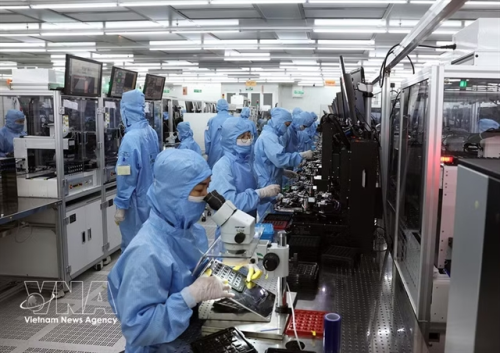
While textiles and footwear once dominated Vietnam’s export structure, electronic products now account for more than one-third of the country’s exports. HSBC said Vietnam has expanded its role in final electronics assembly, particularly in consumer electronics, supported by supply-chain diversification among multinational technology firms such as Samsung.

The bank noted that Vietnam’s share of global consumer electronics exports, including smartphones, printers and computers, has risen from almost zero to between 8% and 15% over the past 15 years, despite mainland China continuing to dominate the sector.

Besides consumer electronics, Vietnam is also seeking to move further up the value chain by targeting the integrated circuits segment. HSBC said Vietnam has gained market share in certain consumer electronics categories in the United States despite tariff risks.

The economists also stressed the importance of expanding into new export markets. Vietnam currently has a broad network of free trade agreements, including the EU-Vietnam Free Trade Agreement.

While many tariff barriers have been removed, HSBC said further progress could be made in addressing non-tariff barriers such as import licensing requirements and lengthy customs procedures.

The bank also noted that Vietnam’s trade exposure to ASEAN markets remains among the lowest in the region. It said reducing non-tariff barriers could help unlock greater intra-regional trade potential.

Beyond ASEAN, HSBC suggested Vietnam could also explore opportunities in markets such as South America and the Middle East, although trade volumes with those regions remain relatively small.

HSBC said tariff uncertainty has prompted many investors to adopt a cautious “wait-and-see” approach in the short term. However, the bank maintained that Vietnam’s long-term advantages remain intact, citing openness to FDI, infrastructure connectivity, labour cost competitiveness, talent development and an established manufacturing ecosystem.

The economists also highlighted the importance of domestic consumption, saying Vietnam’s domestic demand story is often overlooked compared to its export performance. They pointed to long-term trends such as an improving labour market, urbanisation and a growing middle class as key drivers of future consumption.

HSBC added that Vietnam’s fast-growing e-commerce sector and the rise of Generation Z could create additional growth opportunities in the years ahead.

Think tanks said economic challenges remain, but opportunities for Vietnam still exist if the country adopts appropriate policies.


Source: VOV

Photo: Illustrative image
Latest Posts

Construction ministry proposes to abolish, simplify, and decentralize 157 administrative procedures

Construction ministry proposes to abolish, simplify, and decentralize 157 administrative procedures

The move is followed a comprehensive review of all 454 administrative procedures under its jurisdiction by the ministry in April.

The Ministry of Construction (MoC) has proposed to abolish, simplify, and decentralize 157 procedures, accounting for nearly 35% of the total.

The move is followed a comprehensive review of all 454 administrative procedures under its jurisdiction by the ministry in April.

According to the Chief of the MoC Office, Mr. Lam Van Hoang, the ministry also recommended cutting 19 investment and business sectors (a 30% reduction) and 102 out of 249 business conditions, achieving a reduction rate of nearly 41%.

In May, the ministry will continue to focus on substantive reductions in administrative procedures, business conditions, compliance costs, and processing times. Furthermore, it aims to accelerate decentralization and the delegation of power, coupled with enhanced inspection and supervision to improve the effectiveness and efficiency of state management.

Notably, Mr. Hoang stated that several procedures related to the opening and closing of airports, as well as the issuance of airport registration certificates, have been proposed for abolition in a new draft decree recently submitted to the Government.

Specifically, under the draft Decree on Airports and Landing Strips, the MoC is implementing decentralization based on the principle of cutting and simplifying administrative procedures related to production and business activities. The goal is to avoid deep interference in corporate operations, creating a fair, transparent, safe, and efficient investment environment in line with the Party and Government’s policy on streamlining the state apparatus.

The draft also aims to limit the use of multiple licenses in management, shifting instead toward a "post-audit" (post-inspection) model. This move ensures alignment with international practices and the standards of the International Civil Aviation Organization (ICAO).

The MoC reported that the draft simplifies, cuts, or decentralizes 14 out of 26 administrative procedures in the aviation sector. Ten procedures are slated for abolition, including those for opening airports and airfields, as well as a group of procedures for granting airport registration certificates—such as temporary registration, official registration, and the modification or re-issuance of these certificates.


HCMC sees surge in land-related revenue as property firms pay tens of millions of US dollars

HCMC sees surge in land-related revenue as property firms pay tens of millions of US dollars

Budget revenue from land in Ho Chi Minh City has rebounded sharply as a series of real estate projects overcome legal bottlenecks and developers begin fulfilling financial obligations, according to the city’s Finance Department.

In the first four months of the year, several major property companies paid hundreds of billions to trillions of Vietnamese dong (VND1 trillion = $38 million) into the state budget, contributing significantly to the city’s fiscal revenue growth.

According to the Department of Finance, total state budget revenue in HCMC during the January-April period was estimated at over VND328.11 trillion ($12.46 billion), equivalent to more than 40% of the full-year target and up 18.8% from a year earlier. Domestic revenue reached nearly 252 trillion dong, rising more than 23% year-on-year.

Notably, land-related revenue posted a sharp increase compared with the same period last year. Revenue from land-use fees alone totaled nearly VND14.63 trillion ($555.56 million), up 84.2% from the first four months of 2025.

The finance department said the increase was driven by progress in resolving legal issues at multiple real estate projects, enabling developers to begin paying land-use fees and related financial obligations.

Several property developers recorded substantial budget payments in the early months of the year. Can Gio Tourism Urban JSC paid nearly VND1.89 trillion ($71.64 million), while Lotte Properties HCMC contributed approximately VND1.18 trillion ($44.82 million).

Other notable contributors included Greatree Industrial JSC with around VND870 billion ($33.05 million), Metro Star Investment JSC with VND698 billion, Nguyen Phuong Real Estate Co Ltd with VND446 billion, and Levacom Real Estate JSC with VND362 billion.

The developments suggest that HCMC’s property market is beginning to regain momentum, at least in terms of legal procedures and financial flows. After a prolonged period in which many projects were stalled due to licensing and legal hurdles, the easing of bottlenecks is generating additional revenue for the city budget.

However, land-related revenue remains below the pace targeted for the full year. Revenue from land-use fees has so far fulfilled just over 16% of the year's target, while revenue from land and water surface rental fees has reached around 9%. Registration fee collections have completed about 28% of the year's plan.

The finance department said the shortfall reflected an uneven recovery in the real estate market and the continued slow legal processing of many projects, which directly affects land-related revenue collection.

Beyond land revenue, several key sectors of Ho Chi Minh City’s economy also recorded positive growth.

Revenue from the non-state business sector reached over VND84.88 trillion ($3.22 billion), up 33.8% from a year earlier, while revenue from foreign-invested enterprises rose 21.8% to nearly VND61.78 trillion ($2.35 billion).

Corporate income tax and value-added tax remained the largest contributors to the city budget. Personal income tax revenue reached nearly VND38.9 trillion ($1.48 billion), supported by annual tax finalization activities and an increase in real estate transfer transactions.

On the other hand, the finance department noted that some revenue categories lagged targets due to government support measures for the economy. Environmental protection tax collections reached only nearly 30% of the year's target after continued tax cuts on gasoline and aviation fuel.

Local budget expenditure in the first four months of the year rose nearly 29% year-on-year to around VND53.9 trillion ($2.05 billion). However, public investment disbursement remained slow, reaching only about 15% of the 2026 capital plan.

Authorities attributed the delay to this year being the first year of implementing a new medium-term public investment plan, with many projects still in the preparation phase, including design completion and contractor selection.

Challenges related to land clearance, relocation of technical infrastructure and volatility in construction material prices have also continued to weigh on disbursement progress.

In the second quarter, state budget revenue in HCMC is projected to exceed VND209 trillion ($7.94 billion). If current growth momentum is maintained, cumulative revenue in the first half of the year could surpass VND457 trillion ($17.36 billion), equivalent to nearly 57% of the full-year target.

Vietnam seeks to boost agro-forestry-fishery exports beyond $74.2bln in 2026

Vietnam seeks to boost agro-forestry-fishery exports beyond $74.2bln in 2026

Exports of agricultural, forestry and fishery products recording encouraging growth during the first quarter and April.

Vietnam is stepping up efforts to sustain growth in agro-forestry-fishery exports and achieve a target export turnover of more than $74.2 billion in 2026.

At a conference held in Ho Chi Minh City on May 8, Deputy Prime Minister Ho Quoc Dung and leaders from the Ministry of Agriculture and Environment chaired discussions aimed at addressing challenges facing the sector and identifying solutions to strengthen export momentum.

Speaking at the event, Deputy Minister of Agriculture and Environment Vo Van Hung said exports of agricultural, forestry and fishery products recorded encouraging growth during the first quarter and April of 2026, driven by strong performance in several key product groups.

Fruit and vegetable exports reached nearly $2.06 billion, while seafood exports generated approximately $3.7 billion. Pepper and spice shipments were valued at around $760 million. Several major export items posted gains in both volume and value, reflecting resilient global demand and improving market competitiveness.

Participants highlighted persistent difficulties in production, processing, logistics and export operations, while proposing measures to enhance competitiveness and expand market access. Many called for a review and improvement of support mechanisms for businesses, simplification of administrative procedures, and accelerated digital transformation in agricultural management and trade.

Participants also stressed the importance of trade promotion, maximizing free trade agreements, and strengthening the role of trade and agricultural offices abroad in market intelligence and early risk warning.


See all blog