Lumen Vietnam Fund

Blog

General Secretary and President of Vietnam holds talks with Chinese counterpart

General Secretary and President of Vietnam holds talks with Chinese counterpart

During their talks in Beijing on April 15, the two leaders affirmed that the two Parties and countries should further strengthen solidarity, enhance strategic trust, and promote policy connectivity, trade, infrastructure, and energy.

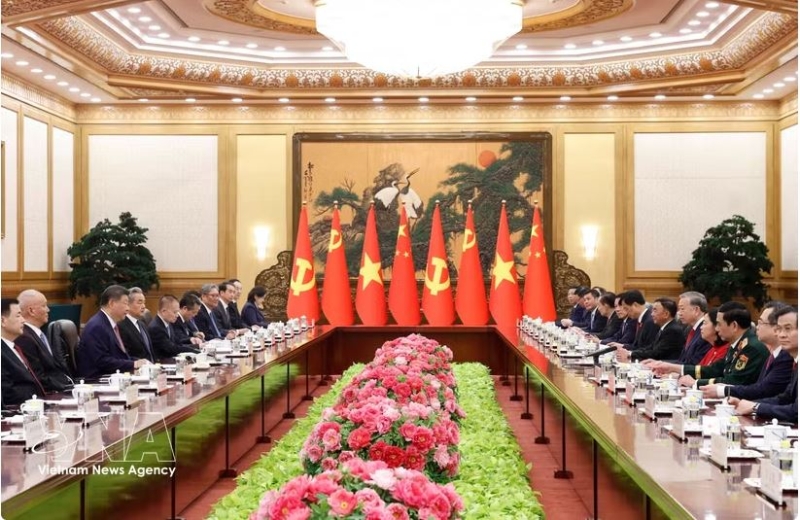
General Secretary of the Communist Party of Vietnam (CPV) Central Committee and President of Vietnam To Lam had talks with General Secretary of the Communist Party of China (CPC) Central Committee and President of China Xi Jinping in Beijing on April 15 morning, according to a report from theVietnam News Agency.

Welcoming the Vietnamese leader and high-ranking delegation,President Xiwarmly congratulatedMr.To Lam on his recent election as President of Vietnam by the 16th National Assembly. He appreciated his guest choosing China to visit first following the resounding success of the 14th National Congress of the CPV and the consolidation of state leadership positions, considering this as a demonstration of the high regard and top priority given by the Vietnamese Party and State in general, and General Secretary and President Lam in particular, to the traditional friendship and comprehensive strategic cooperation between China and Vietnam, as well as the strategic nature and high level of bilateral relations.

The Vietnamese leader sincerely thanked General Secretary and President Xi for the warm and thoughtful welcome, and for the strong support shown in various forms for the 14th National Congress of the CPV.

Announcing the new theoretical and practical highlights of the 14th National CPV Congress, General Secretary and President Lam emphasized that the new leadership of the Vietnamese Party and State wishes to work with their Chinese counterparts to continuously nurture the traditional friendship, promote the Comprehensive Strategic Cooperative Partnership and the Vietnam – China community with a shared future that carries strategic significance.

He congratulated the Chinese Party, State, and people on their epoch-making achievements, and expressed confidence that China will successfully implement its 15th five-year Plan, achieve high-quality development and Chinese-style modernization, successfully realize the "second centenary goal”, and continue to play an increasingly important role in the region and the world.

Vietnam always considers developing relations with China as a consistent policy, a strategic choice, and a top priority in its overall foreign policy of independence, self-reliance, self-strengthening, multilateralization and diversification of external relations, he stated, affirming that Vietnam supports China's global initiatives on development, security, civilization, and governance, and consistently implements the "one China" policy.

Once again congratulating the CPV on its successful 14th National Congress, General Secretary and President Xi highly valued and congratulated Vietnam’s outstanding achievements in socialism building and the Doi Moi (Renewal) process, which have opened up a new era of development for the country.

He emphasized that China supports Vietnam in steadfastly upholding the Party's leadership and promoting the building of socialism, affirming Vietnam is a priority direction in China's neighborhood diplomacy.

The Chinese leader said he believes that under the leadership of the new CPV Central Committee, headed by General Secretary and President To Lam, Vietnam will successfully achieve the goals and tasks set forth by the 14th National Congress, and soon realize the two centenary goals, transforming Vietnam into a high-income and developed socialist-oriented nation.

The top leaders held in-depth and comprehensive discussions on their respective national situations, bilateral relations, and regional and international issues of mutual concern.

They expressed their satisfaction with the positive developments in bilateral ties in recent years. Notably, high-level strategic exchanges have become increasingly frequent; cooperation mechanisms have been more comprehensive, diverse, and trustworthy; and defense and security cooperation has evolved from exchanges to more substantive activities. Economic, trade, and investment ties, along with transport connectivity, have seen new breakthroughs, while local-level cooperation and people-to-people exchanges have remained vibrant. Coordination in multilateral frameworks has also grown closer.

Amid complex global developments, the two leaders affirmed that the two Parties and countries should further strengthen solidarity, enhance strategic trust, and promote policy connectivity, trade, infrastructure, and energy. They agreed to continue deepening and elevating Vietnam–China relations in the new phase, practically contributing to peace, cooperation, and development in the region and the world.

Regarding future directions, they agreed to continue directing relevant agencies to adhere to the overarching “six major orientations”, maintain regular high-level exchanges, and promote the guiding role of Party-to-Party channels. They emphasized the need to expand substantive cooperation across sectors, reinforce the social foundation of bilateral ties, enhance close coordination at multilateral mechanisms, and better manage and resolve differences.

At the talks, the two leaders officially announced the launch of the “Vietnam–China Tourism Cooperation Year 2026–2027,” agreeing to step up joint promotion activities, improve tourism infrastructure and services, and maintain each country’s position as a leading source of tourists for the other.

General Secretary and President Lam also proposed both sides consider visa exemptions for group tourists at designated destinations on a reciprocal basis.

He proposed that the two sides strengthen political trust and strategic coordination at a new level, step up high-level exchanges, and continue to promote the role and effectiveness of comprehensive cooperation across Party, Government, National Assembly/National People’s Congress, and Vietnam Fatherland Front/Chinese People’s Political Consultative Conference channels.

The Party and State leader of Vietnam called for enhanced theory exchanges and cadre training, stronger substantive cooperation between key agencies, particularly in diplomacy, national defense, and public security, and the effective implementation of the ministerial-level “3+3” strategic dialogue mechanism. He also proposed increasing cooperation in security, defense industry, and military trade, along with support each other in successfully hosting APEC Year 2026 and 2027 in each country.

He further suggested elevating economic, trade, investment, and tourism ties to a new height to contribute to the realization of each country’s development goals. Priority should be given to upgrading strategic infrastructure connectivity, especially railway, shifting from simple trade to deeper economic linkages, and associating bilateral trade with infrastructure, logistics, and market connectivity.

General Secretary and President Lam proposed that China open its market as wide as possible to Vietnamese goods and work toward balanced and heathy trade. He also called for stronger investment, technology transfer, development of supporting industries, and the establishment of complete production and supply chains in Vietnam, as well as coordination in building mechanisms to ensure strategic energy supply.

In addition, he emphasized expanding cooperation in education and training, science and technology, culture, people-to-people exchanges, and local-level cooperation, including providing more scholarships for Vietnamese students and boosting collaboration between leading universities of the two countries.

Agreeing with and highly valuing the proposals, General Secretary and President Xi suggested that the two sides further intensify political trust and strategic exchanges, maintain the tradition of high-level contacts, and bring into play the special role of Party-to-Party relations. He asked for in-depth exchanges of experience in the Party building and state governance, and for maximizing the role of the ministerial-level “3+3” strategic dialogue on foreign affairs, national defense, and public security between Vietnam and China to firmly advance the socialist cause in both countries.

The host recommended the two sides effectively align the Belt and Road Initiative with the “Two Corridors, One Belt” framework, accelerate strategic infrastructure connectivity, and actively implement the three standard-gauge railway projects linking the two countries.

He welcomed the increasing export of high-quality Vietnamese goods to the Chinese market, and called for deeper cooperation in key sectors, stronger production and supply chain collaboration, and encouragement for Chinese enterprises to invest more in Vietnam.

The two countries should enhance policy coordination in science and technology, promote diverse people-to-people exchanges, actively implement global initiatives on development, security, civilization, and governance, and jointly contribute to a stable, open and cooperative international environment while together promoting the socialist cause around the word as well as safeguarding peace, stability, and prosperity in the region and beyond, the Chinese leader added.

At the talks, the two sides agreed to properly resolve differences and promote cooperation in line with the new level of Vietnam – China relations on the basis of international law, seriously comply with the consensus between the Association of Southeast Asian Nations (ASEAN) and China on the implementation of the Declaration on the Conduct of Parties in the East Sea (DOC), and accelerate negotiations to soon finalize an effective and substantive Code of Conduct (COC) in accordance with international law, particularly the 1982 United Nations Convention on the Law of the Sea (UNCLOS).

The top leader of Vietnam asked both sides to truly respect each other’s rights and legitimate interests and resolve differences through peaceful means in line with international law, especially the 1982 UNCLOS.

Following the talks, the two leaders witnessed the signing of cooperation documents across Party, public security, judicial, economic, science and technology, production and supply chain, social welfare, media, and local collaboration, reflecting the comprehensive outcomes of the visit.


Source: en.vneconomy.vn

Photo: VNA
Latest Posts

Vietnam tested by rising global energy risks

Vietnam tested by rising global energy risks

Events in the Middle East are sure to test Vietnam’s long-term energy security strategy.

The global energy system is facing a severe shock following Operation Epic Fury in the Middle East and the blockade of the Strait of Hormuz. The crisis is also emerging as a “stress test” and an opportunity for Vietnam to accelerate a comprehensive, long-term transformation to safeguard energy security.

The concept of energy security in the 21st century has undergone a profound structural shift, moving beyond traditional definitions centered solely on fossil fuel supply. It now encompasses a broader framework built on four core pillars - the “4As”: Availability, Accessibility, Affordability, and Acceptability.

After four decades of transformation from an agricultural economy into a dynamic industrial manufacturing hub and major destination for FDI in Asia, energy security has become the absolute foundation of Vietnam’s growth, directly shaping macro-economic stability and national security.

Energy demand under growth pressure

Achieving the double-digit GDP growth target for 2026-2030 will require vast energy resources, with electricity demand projected to rise by 12-14 per cent annually. Industrialization, digital infrastructure, logistics, and urbanization all depend on stable and affordable energy supplies. Rapid economic expansion has pushed Vietnam’s energy system to a turning point. The country has shifted from being a net exporter of traditional energy to a rapidly-growing net importer.

Macro-economic data shows that Vietnam’s total primary energy consumption reached approximately 1,457.179 terawatt-hours (TWh) in 2024, equivalent to around 126 million tonnes of oil equivalent (Mtoe), with an average annual growth rate of 9 per cent during 2022-2024.

A key structural concern is the overwhelming dominance of fossil fuels, accounting for 78.46 per cent of total consumption. Coal leads with 693.435 TWh (47.58 per cent), followed by oil at 388.967 TWh (26.69 per cent) and natural gas at 60.987 TWh (4.18 per cent). This leaves the economy exposed to significant external risks, particularly as domestic production of coal, oil, and gas has reached technical limits and entered irreversible decline.

Domestic coal output by the Vietnam Coal and Minerals Industrial Group (Vinacomin) has plateaued at around 43-44 million tonnes annually as open-pit mines in Quang Ninh province near depletion. As a result, Vietnam imported more than 11.15 million tonnes of coal in 2024, worth over $1.2 billion, making it one of the world’s Top 5 coal importers.

Oil production peaked in 2004 and has been declining since, creating a structural paradox. Vietnam exports high-value light sweet crude (priced at $561.54 per tonne) but must import more than 2.16 million tonnes of specialized crude (at $501.48 per tonne) for the Dung Quat and Nghi Son refineries. At the same time, it imports over 2.17 million tonnes of refined petroleum products at significantly higher prices of up to $663.65 per tonne.

Cost modeling highlights the disparity: producing 1 TWh of primary energy costs approximately $18.64 million from imported coal, $44.28 million from LNG, and $55.95 million from oil.

Vietnam’s total primary energy bill in 2024 is estimated at $53.65 billion, equivalent to roughly 11.26 per cent of GDP. Of this, $37.39 billion was spent on fossil fuel imports, placing significant pressure on the balance of payments and eroding the country’s trade surplus.

Energy costs also play a central role in inflation transmission. Linear regression models indicate that a 1 per cent increase in total energy costs raises the CPI by approximately 0.2 percentage points. The impact spreads quickly through direct channels such as transport and electricity prices, as well as indirect channels including agricultural inputs and construction materials.

Global shocks and immediate impacts

These structural vulnerabilities became starkly evident from late February to early March, when the global energy system was jolted by Operation Epic Fury in the Middle East. Airstrikes on Iran’s nuclear facilities and subsequent missile retaliation prompted Tehran to declare a blockade of the Strait of Hormuz - a critical maritime chokepoint handling about one-fifth of global oil and LNG flows. Vessel traffic plunged from 153 ships per day to just 13 by March 2, and was nearly halted on March 8-9, sending Brent crude prices soaring from $60-70 per barrel to a peak of $126.

Vietnam, deeply integrated into Asian maritime logistics, felt the macro-economic ripple effects almost immediately. In the first two and a half months of 2026 alone, fuel imports surged to approximately $5.27 billion.

Logistics and rail companies immediately raised fees by 10-15 per cent and shortened quotation validity to 24 hours. International air travel was disrupted, affecting more than 4,400 passengers.

The crisis also undermined the positioning of LNG as a “perfect transition fuel,” exposing the fragility of maritime supply chains under geopolitical shocks. Vietnam Electricity (EVN), already burdened with accumulated losses of VND44.792 trillion ($1.72 billion) as of end-2024, faced acute liquidity pressure as LNG-based power generation costs were projected to exceed VND3,327 ($0.13) per kWh, threatening affordability across the economy.

Short-term response, long-term strategy

Recognizing the inflationary risks and impact on purchasing power and export competitiveness, the government implemented a series of urgent policy measures while accelerating structural energy reforms.

Prime Minister Pham Minh Chinh ordered that energy shortages must not occur under any circumstances and activated emergency fiscal tools through Decree No. 72/2026/ND-CP, effective from March 9 to April 30, 2026.

In a classic macro-economic trade-off, Vietnam temporarily sacrificed fiscal revenue by reducing Most-Favored-Nation (MFN) import tariffs to 0 per cent on key fuels, including gasoline (previously 10 per cent), diesel and aviation fuel (previously 7 per cent), and petrochemical inputs. This enabled importers to source fuel globally without origin constraints.

Price management was also liberalized under Resolution No. 36/NQ-CP, allowing immediate retail price adjustments if base prices fluctuate by 7 per cent or more in a single day, instead of following a fixed weekly cycle.

On the supply side, Vietnam secured approximately 4 million barrels of oil through high-level diplomacy with Kuwait, Qatar, and the UAE. Domestic refineries were pushed to maximum output, with Dung Quat operating at about 118 per cent of capacity. The Law on Petroleum 2022 was also activated to prioritize domestic retention of crude oil and condensate.

While these measures stabilized the market in the short term, the March 2026 crisis demonstrated that fiscal and monetary policy space is finite. The only sustainable solution lies in a comprehensive system transformation outlined in Politburo Resolution No. 70-NQ/TW and the revised National Power Development Plan VIII (PDP8).

Politburo Resolution No. 70 elevates energy security to a pillar of national security, targeting strategic reserves equivalent to 75-80 days of net imports by 2030, rising to 90 days thereafter, requiring tens of billions of dollars in storage and logistics infrastructure.

The transition centers on accelerating renewable and low-emission energy to reduce dependence on external fossil fuel supply chains and avoid carbon-related trade barriers such as the EU’s Carbon Border Adjustment Mechanism (CBAM).

The revised PDP8 targets total installed capacity of 89,655-99,934 MW by 2030, with renewables (excluding large hydropower) accounting for 28-36 per cent, rising to 70 per cent by 2050. The economics are increasingly favorable: Global Levelized Costs of Energy (LCOE) have fallen to around $34 million per TWh for onshore wind and $43 million per TWh for solar; far below imported fossil fuels.

To address intermittency and grid congestion, Vietnam is investing in a large-scale high-voltage direct current (HVDC) transmission network with a capacity of 40,000-60,000 MW, alongside battery energy storage systems (BESS) of 10,000-16,300 MW by 2030.

In a major policy shift, nuclear power is being reintroduced, with Ninh Thuan 1 and 2 expected to provide 4,000-6,400 MW of stable, zero-emission baseload capacity between 2030 and 2035.

Market reforms are also advancing. The Direct Power Purchase Agreement (DPPA) mechanism breaks the single-buyer model, unlocking private green investment, while cross-border grid integration under the ASEAN Power Grid, with projected regional investment of $764 billion, aims to enhance system resilience.

Only through a coordinated strategy, expanding domestic renewables, modernizing grid infrastructure, diversifying legal frameworks, and strengthening system affordability, can Vietnam build a robust macro-economic shield against global geopolitical shocks and secure sustainable prosperity in the 21st century.


Việt Nam’s medical tourism services eye nearly $4bln in revenue by 2033

Việt Nam’s medical tourism services eye nearly $4bln in revenue by 2033

Việt Nam’s medical tourism market, valued at about US$700 million in 2024, is projected to reach nearly $4 billion by 2033, growing around 18 per cent annually, highlighting its strong potential.

HÀ NỘI The Ministry of Health is seeking public feedback on a draft project to develop high-quality medical services and promote medical tourism, attracting both domestic and international patients.

Under the project, by 2030, five key localities, namely Hà Nội, HCM City, Đà Nẵng, Quảng Ninh and Khánh Hòa, will pilot integrated medical tourism models combining hospitals, hotels, resorts and travel services.

According to the ministry, Việt Nam’s medical tourism market was valued at approximately US$700 million in 2024 and is projected to expand to nearly $4 billion by 2033, representing an average annual growth rate of around 18 per cent. The figures underscore the sector’s considerable potential.

Việt Nam benefits from several competitive advantages, including relatively low costs, a highly skilled medical workforce, and the capability to perform complex procedures in fields such as cardiology, organ transplantation, in vitro fertilisation (IVF), and dentistry. These strengths position the country to compete with established regional medical hubs.

To capitalise on this potential, the ministry is formulating a development strategy for high-quality healthcare services for the 2025–2030 period. The initiative aims to attract high-spending patients while also reducing the number of Vietnamese citizens seeking treatment abroad.

The plan further envisages establishing at least 15 internationally accredited hospitals by 2030, including five public institutions. In parallel, service packages will be diversified to include advanced medical treatment, traditional medicine combined with wellness retreats, and comprehensive healthcare packages.

Towards an integrated healthcare–wellness ecosystem

In 2026, healthcare in the capital – one of the five target localities of the draft project – is set to prioritise infrastructure upgrades, modern equipment, workforce training, and the application of artificial intelligence in early diagnosis. Major projects, including the expansion of the local oncology, cardiology and paediatric hospitals, are expected to be rolled out alongside modern rehabilitation and therapeutic care complexes.

From a business perspective, integrated treatment-and-leisure models are also beginning to take shape. Notably, Vinmec Ocean Park 2 International Hospital has introduced a model in which patients receive treatment within private villa-style settings, combining round-the-clock medical care with a high-end resort environment.

Commenting on development, Đỗ Tân Khoa, director of the Traditional Medicine Hospital of HCM City, emphasised that traditional medicine is being identified as a key pillar of the healthcare sector, particularly in attracting international visitors. Beyond treatment, it offers services focused on wellness, rehabilitation, and quality-of-life enhancement – areas of growing interest among foreign patients.

Meanwhile, Trần Quang Huy, director of the Chim Cánh Cụt Travel Service JSC, noted that regional administrative restructuring has enabled travel firms to diversify their products. Previously centred on HCM City with basic services such as dental care, tour packages can now incorporate a broader range of options from specialised dental treatment to cosmetic procedures and wellness retreats.

According to Bùi Thị Ngọc Hiếu, deputy director of HCM City’s Department of Tourism, between 30 - 40 per cent of patients seeking medical treatment in the city come from other provinces or overseas. While most international patients originate from neighbouring countries such as Cambodia and Laos, there has also been a notable growth in other markets, including the US, Australia, Canada and Japan, as well as overseas Vietnamese communities.

Deputy Minister of Health Trần Văn Thuấn affirmed that Việt Nam’s competitive costs, improving medical expertise, and rich tradition of traditional medicine not only enhance domestic healthcare services but also open a promising new avenue for the country’s tourism and healthcare industries.


Swiss–Vietnam dialogue advances cooperation in AI, fintech

Swiss–Vietnam dialogue advances cooperation in AI, fintech

A Switzerland – Vietnam dialogue on artificial intelligence (AI) and financial technology (fintech) built on trusted digital infrastructure has been held in Zurich, bringing together representatives from governments, financial institutions, technology firms and innovation ecosystems of both countries.

Co-organised by the Swiss–Viet Economic Forum (SVEF) and Rikkeisoft, a leading Vietnamese IT company providing software development, digital transformation, and AI solutions worldwide, the event focused on how to harness AI’s transformative potential in finance while ensuring trust, regulatory compliance and secure cross-border digital infrastructure.

Opening the dialogue, Ivo Sieber, Vice President of SVEF and former Swiss Ambassador to Vietnam, highlighted the urgency of addressing integration, compliance and data governance challenges as AI reshapes financial services. He stressed that trusted digital infrastructure is now a strategic necessity and reaffirmed SVEF’s role in fostering practical bilateral partnerships.

Ambassador Mai Phan Dung, head of Vietnam’s Permanent Mission to the United Nations, the World Trade Organisation and other international organisations in Geneva, underscored AI’s growing impact on global trade and economic growth. He noted that AI-related goods are becoming a key driver of global trade expansion and that digital transformation is also evident at the societal level, with a high AI adoption rate in Vietnam.

He added that AI governance has moved to the forefront of the global multilateral agenda, evolving from ethical principles to concrete regulatory frameworks and enforcement mechanisms. Recent international developments reflect a broad consensus on the need for a human-centred, inclusive and trustworthy digital future.

Chu Thu Hang, Chargé d’Affaires of the Vietnamese Embassy in Switzerland, highlighted the rapid growth of Vietnam’s fintech and digital economy. She noted that most financial institutions in Vietnam have adopted AI, with investment accelerating amid strong demand for digital banking and high smartphone penetration. She also stressed the need to further strengthen legal frameworks, infrastructure and cybersecurity to aid sustainable growth.

Providing industry insights, Son Bui, a representative of Rikkeisoft, shared practical experience in deploying AI in highly regulated financial environments, noting that the key challenge lies not in whether to adopt AI, but in how to implement it in line with regulatory expectations and stakeholder trust.

A panel discussion moderated by Samantha Wai Sze Wong, founder and CEO of WSB International brought together experts from finance, legal and technology sectors, with participants agreeing that trust remains the decisive factor for successful AI adoption in financial services.

The dialogue concluded with a shared view that the future of financial services will depend on building trusted digital infrastructure that supports both innovation and legal integrity. It also reaffirmed strong potential for Switzerland and Vietnam to deepen cooperation by leveraging complementary strengths in finance, governance, technology and innovation.

The event forms part of a series leading up to the Swiss–Viet Economic Forum 2026, scheduled for June 10 at the University of Zurich. The forum is expected to convene senior representatives from government, industry and academia to further advance discussions on finance, technology, sustainable development and cross-border partnerships.


See all blog