Early achievement of a development goal
The World Bank has officially reclassified Vietnam as an upper-middle-income country, four years earlier than anticipated.
For the World Bank’s fiscal year from July 1, 2026, to June 30, 2027, Vietnam has officially been reclassified as an upper-middle-income economy, confirming that it has achieved one of its key development goals four years ahead of the timeline set out in the Resolutions from the 13th and 14th National Congresses of the Communist Party of Vietnam.
Looking ahead, Vietnam’s ambition is to attain high-income status by the end of 2045. According to research by the Institute of Economics and Finance at the Academy of Finance, achieving that objective would require average annual GDP growth, measured at constant prices, of at least 5 per cent between 2026 and 2044. Should average GDP growth reach 6 per cent, 7 per cent, or 8 per cent annually over the period, Vietnam could achieve high-income status by the end of 2044, 2039, or 2037, respectively.
Understanding the classification
The World Bank classifies the world’s economies into four income groups: low-income, lower-middle-income, upper-middle-income, and high-income. The classification is updated annually on July 1, based on each country’s Gross National Income (GNI) per capita, measured in current US dollars using the World Bank’s Atlas method.
The thresholds are calculated using GNI per capita from two calendar years prior to the relevant World Bank fiscal year. In other words, for FY2027, the classification is based on 2025 GNI per capita data and remains in effect from July 1, 2026, through June 30, 2027.
These income groups serve as a standard reference across numerous international datasets, including the World Bank’s World Development Indicators, which cover subjects ranging from energy access and education to trade and economic development. The classifications also play a crucial role in determining countries’ eligibility for concessional financing and development assistance. Beyond lending decisions, they provide governments, researchers, international organizations, and the media with a consistent framework for understanding where economies stand and the direction in which they are developing.
According to the World Bank’s latest classification, released on July 1, 2026, the income thresholds for FY2027 are as follows - Low-income: GNI per capita of $1,175 or less; Lower-middle-income: $1,176-$4,635; Upper-middle-income: $4,636-$14,375; and High-income: above $14,375. Compared with FY2026, the thresholds increased notably, largely reflecting adjustments for global inflation, as measured by the International Monetary Fund’s Special Drawing Rights (SDR) deflator.
Moving up
Under the updated classification, no economy was downgraded during the FY2027 review. Five countries moved from the lower-middle-income group to the upper-middle-income category: Vietnam, the Philippines, Sri Lanka, the Federated States of Micronesia, and Jordan. Meanwhile, Togo advanced from the low-income to the lower-middle-income group.
Vietnam remained one of the fastest-growing economies in East Asia and the Pacific, supported by its export-led growth model. After exports contracted by 3 per cent in 2023, GDP growth slowed from 8.5 per cent to 5 per cent. As exports rebounded by 15.7 per cent in 2024 and 16.3 per cent in 2025, GDP growth accelerated to 7 per cent and 8 per cent, respectively.
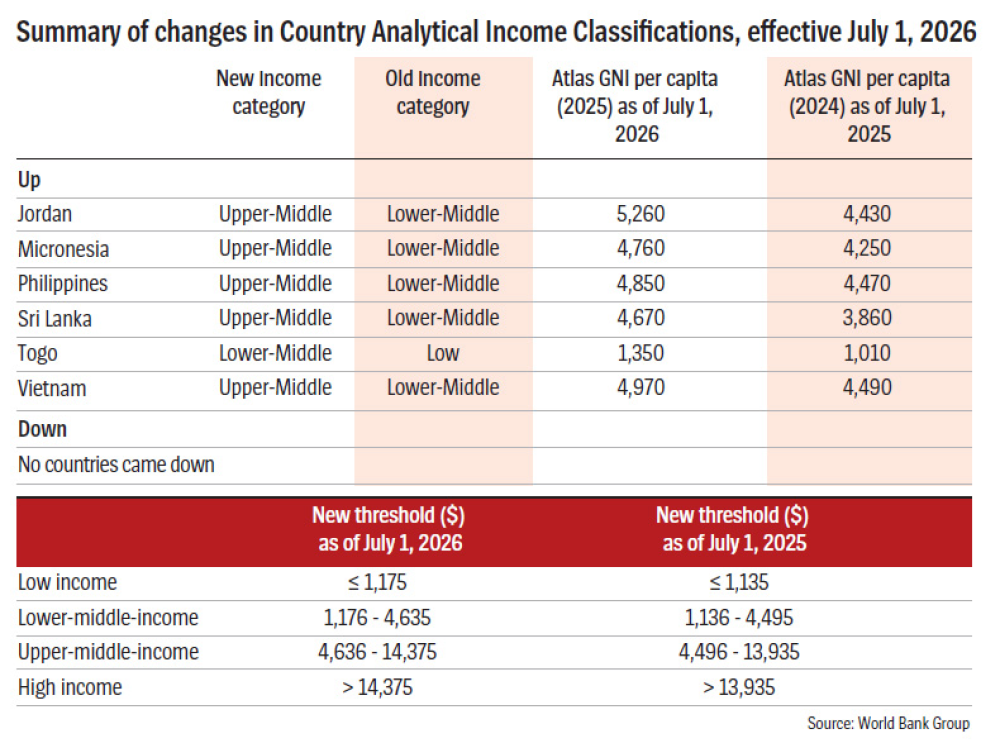
Overall, Vietnam’s post-pandemic recovery has been among the strongest in the region, lifting GNI per capita to $4,970 in 2025; above the World Bank’s FY2027 upper-middle-income threshold of $4,636.
The Philippines achieved its new classification through broad-based economic expansion. Its economy grew by an average of 5.8 per cent annually between 2021 and 2025, reflecting sustained growth across all major industries, though growth moderated to 4.4 per cent in 2025. During the same period, net primary income rose by an average of 39 per cent annually, resulting in average GNI growth of 10.9 per cent per year.
Sri Lanka continued its recovery from the 2022 economic crisis. Real GDP grew by 5 per cent in 2025, supported by a broad-based rebound in industry and steady expansion in the services sector, particularly financial and tourism-related services. GDP at current prices increased by 8.8 per cent, while GNI rose 9.7 per cent despite a 22.4 per cent decline in net primary income.
The Federated States of Micronesia sustained a modest post-pandemic recovery, with real GDP expanding by 1.1 per cent in 2025. Growth was driven primarily by construction, which surged 81.7 per cent, and agriculture, which expanded 12.7 per cent. However, these gains were partly offset by a 10.4 per cent decline in net primary income.
Togo advanced to the lower-middle-income group largely due to revisions to its population data, which reduced the estimated population by 11.7 per cent for 2024, and a 4 per cent depreciation of the Central African franc (CFA franc) against the US dollar. GDP growth moderated slightly, to 5.9 per cent in 2025 following a strong post-pandemic rebound. Agriculture, industry, and services all recorded solid growth, supported by favorable weather conditions, stronger mining output, improved electricity reliability, and resilient domestic demand.
Vietnam’s elevation
Vietnam’s increase to upper-middle-income status represents more than a statistical milestone; it fulfills a major national development objective well ahead of schedule. The Resolution from the 13th National Congress of the Communist Party of Vietnam set the goal of becoming “a developing country with modern industry and upper-middle-incomes” by 2030; the centennial of the Party’s founding. The Resolution from the 14th National Congress, meanwhile, reaffirmed this objective, underscoring the country’s commitment to reaching upper-middle-income status by the end of the decade.
According to World Bank data, Vietnam’s GNI per capita reached $4,970 in 2025, an increase of $480, or 10.69 per cent, from the previous year. Among the economies newly classified as upper-middle-income, Vietnam’s GNI per capita exceeded that of the Philippines ($4,850) and remained well above neighboring lower-middle-income economies, including India ($2,760), Cambodia ($2,750), Laos ($2,150), and Myanmar ($1,320).
However, Vietnam continues to trail several regional peers. Indonesia recorded GNI per capita of $5,120 in 2025, while Thailand reached $7,690. The gap is even more pronounced compared with Malaysia ($12,380), China ($14,230), Brunei ($34,790), and Singapore ($81,760). Vietnam’s GNI per capita also amounted to just 34.89 per cent of the global average of $14,244.
Under the World Bank’s FY2027 classification, which took effect on July 1, 2026, Vietnam officially moved from the lower-middle-income group to the upper-middle-income category. Within Southeast Asia, it joins Malaysia, Thailand, Indonesia, and the Philippines in the group. Singapore and Brunei remain the region’s only high-income economies, while Cambodia, Laos, and Myanmar continue to be classified as lower-middle-income economies.
The Resolution from the 13th National Congress of the Communist Party of Vietnam also set a clear goal for 2045: “By 2045, the centennial of the founding of the Democratic Republic of Vietnam, now the Socialist Republic of Vietnam, Vietnam will become a developed, high-income country.” The Resolution from the 14th National Congress reaffirmed this objective, calling for the realization of the vision of becoming a developed, high-income nation by 2045. To achieve high-income status, Vietnam’s GNI per capita in 2044 must at least meet the high-income threshold set by the World Bank for FY2046.
According to calculations by the research team from the Institute of Economics and Finance, if the global and domestic economic and political environment remains broadly stable during 2026-2044, similar to the conditions seen over 2015-2025, Vietnam will become a high-income country by the end of 2045 if it maintains average annual GDP growth of 5 per cent over the 2026-2044 period. The more the average GDP growth exceeds 5 per cent, the earlier Vietnam will reach high-income status before 2045.
Specifically, using a 19-year moving average (MA19) based on growth data from 2008-2025 and projecting it for the 2026-2044 period, the researchers estimated that if Vietnam records average annual GDP growth of 6 per cent, 7 per cent, or 8 per cent, it would attain high-income status by the end of 2044, 2039, and 2037, respectively.
These projections suggest that the 2045 development targets set out in the Resolutions from the 13th and 14th National Congresses of the Communist Party of Vietnam are entirely achievable. They also reinforce confidence in Vietnam’s economic outlook, allowing the country to pursue development policies that are aligned with its potential, promote sustainable growth, and preserve macro-economic stability while achieving the Party’s two centennial goals: becoming an upper-middle-income country by 2030, the 100th anniversary of the Party’s founding, and a high-income country by 2045, the centennial of the nation’s founding.
At the same time, the findings suggest that policymakers should avoid becoming overly impatient in pursuit of these goals. Mobilizing excessive resources to drive growth or implementing overly aggressive economic interventions could result in inefficient resource allocation and unnecessary macro-economic instability.
In recent years, some views in Vietnam have reflected misunderstandings about the World Bank’s income classification system. The most common misconception is equating growth in GNI per capita, which the World Bank measures in current prices, with GDP growth, which is measured at constant prices.
Based on this misunderstanding, some have argued that Vietnam faces a serious risk of falling into the “middle-income trap” and have recommended that the country achieve annual GDP growth of 8-10 per cent throughout 2025-2045.
However, such a target would require the economy to grow at an unsustainably rapid pace, likely forcing the government to significantly increase public investment, widen the budget deficit, and accept lower investment efficiency, reflected in a higher Incremental Capital-Output Ratio (ICOR). This could lead to wasted resources, rising inflationary pressures, and greater macro-economic instability. For that reason, Vietnam should carefully consider the risks before pursuing an overly aggressive growth strategy.
Source: Mr. Pham Minh Thuy is from the Institute of Economics and Finance at the Academy of Finance.