Continued confidence from foreign investors
Impressive FDI figures for the opening quarter of 2026 confirm the belief investors hold in Vietnam’s future.
Vietnam kicked off 2026 on a high note in terms of FDI, posting robust growth in the opening months of the year. Data released by the National Statistics Office (NSO) at the Ministry of Finance put total registered FDI at $15.2 billion in the first quarter, for a significant 42.9 per cent increase year-on-year.
The surge reflected foreign investors’ confidence in Vietnam despite geopolitical tensions, trade uncertainties, and economic slowdowns in some major markets. “The increase in registered FDI is not purely a short-term spike, but reflects sustained investor confidence in Vietnam as a regional production and operational base,” Mr. Matthew Lourey, Chairman of Alitium, told Vietnam Economic Times / VnEconomy. “Vietnam remains one of the most logical beneficiaries of this shift, given its manufacturing ecosystem, workforce profile, and trade connectivity.”
Key standout projects
FDI inflows were geographically concentrated in key economic zones. According to the NSO, Ho Chi Minh City saw a dramatic surge in capital, attracting nearly $2.9 billion in the first quarter, an increase of over 200 per cent against the same period last year and driven by projects in technology, media, and manufacturing.
For example, the TikTok Shop Vietnam Company Limited was licensed to implement a new project with capital of $125 million in the information and communication industry. This was one of the most prominent investments in the period, reflecting growing interest in digital platforms and e-commerce infrastructure. The Netherlands’ MSD Animal Health Vietnam, meanwhile, added capital of $80 million in professional, scientific, and technological activities.
Other notable expansions in Ho Chi Minh City included the SP Vietnam Ho Chi Minh JSC adding capital of $67 million to investments in the communications industry, and the Momogi Group Vietnam registering a capital contribution of over $64.3 million in Bibica.
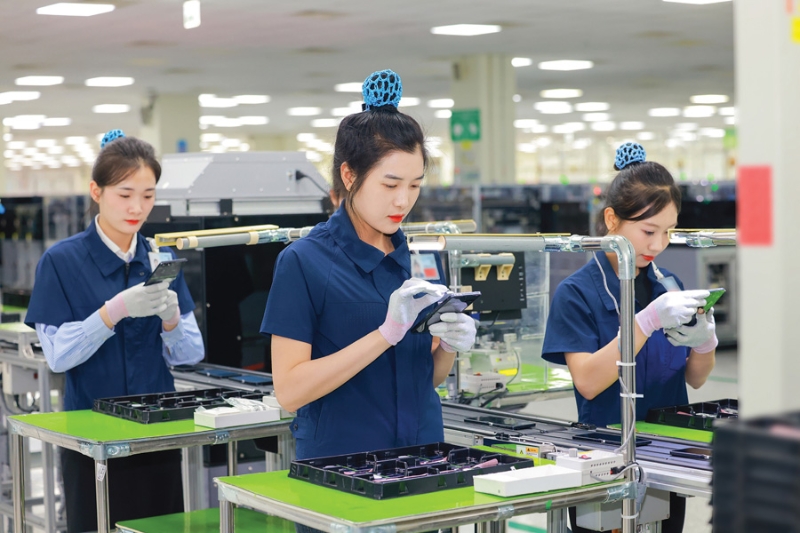
Meanwhile, northern provinces like Bac Ninh and Thai Nguyen remained magnets for heavy manufacturing, especially electronics and components, with contributions from South Korea, Singapore, and elsewhere.
Bac Ninh licensed 138 new projects and approved capital increases to 89 existing projects during the first quarter of the year, with total registered and additional investment capital standing at some $5.2 billion. Notable projects included Foxconn from Taiwan (China) adding $287.1 million to investment in its Bac Ninh facility to expand production capacity in electronic assembly, and Cooler Master Vietnam, a Taiwan (China)-based computer hardware manufacturer, investing $100 million in a facility at Bac Ninh’s Gia Binh Industrial Park.
In terms of investment destinations, Thai Nguyen led the country in attracting new FDI, with total newly-registered capital exceeding $5.4 billion in the first quarter, and it continues to be a key hub for Samsung-related and high-tech manufacturing.
Overall, the first quarter of 2026 demonstrated Vietnam’s continued attractiveness for quality FDI with a mix of new projects and expansions that boosted employment, technology transfer, and export capacity. As Vietnam navigates a complex global landscape, this strong start to the year positions Vietnam as a bright spot in regional investment flows.
Sustaining momentum
According to the NSO, disbursed FDI reached an estimated $5.41 billion in the first quarter, up 9.1 per cent year-on-year and marking the highest first-quarter disbursement for the past five years, since 2022. The manufacturing and processing industry attracted the largest share, with $7.07 billion in newly-registered capital, accounting for 69 per cent of the total for new projects. The sector continued to benefit from global supply chain diversification as companies sought resilient alternatives for electronics, semiconductors, and consumer goods assembly.
There is also growing momentum in higher-value electronics, support industries, and industrial infrastructure. In parallel, logistics, data infrastructure, and business services are seeing increased investment, reflecting Vietnam’s transition from a purely production-focused market to a more integrated regional hub.
In terms of investor profiles, there is continued strength from North Asian investors, alongside sustained interest from Singapore-based holding structures representing global investors operating through a Singapore-based regional hub. “There is also a notable increase in activity from mid-market European investors, particularly in advanced manufacturing and industrial services,” Mr. Lourey said.
However, it’s not a shift away from traditional manufacturing but an expansion alongside it. Vietnam continues to benefit from its role in global supply chain diversification, so electronics assembly, textiles, and general manufacturing remain the backbone of FDI inflows. Simultaneously, investors are increasingly allocating capital into future-oriented sectors such as AI, data infrastructure, and green technologies. “These are not always immediate return plays,” said Mr. Leif D. Schneider, Attorney & Country Head of law firm Luther in Vietnam. “They are strategic positioning investments linked to Vietnam’s long-term role in global value chains.”
He added that sustaining the required momentum to achieve the figurative “giant leap forward” requires addressing two structural constraints. The first is supply chain depth. Vietnam has made significant progress but is still largely an assembly hub in many sectors. The second constraint is talent. There is no shortage of workers but there is a clear gap when it comes to highly-specialized skills such as semiconductor engineering, advanced manufacturing, and energy systems. “Bridging that gap will be decisive,” he believes. “In the next phase, competitiveness will be defined less by cost advantage and more by capability. That is the transition Vietnam is currently navigating.”
According to Mr. Lourey, the disbursement figure of $5.41 billion in the first quarter is particularly encouraging, as it reflects not just commitments but actual execution. Several factors have contributed to improved implementation. Firstly, there is greater familiarity among repeat investors, who are able to navigate licensing, land access, and operational setup more efficiently. Secondly, regulatory processes, while still complex, are becoming more predictable in key localities with strong FDI track records. Thirdly, industrial infrastructure, including ready-built factories and industrial parks, has improved significantly, allowing for faster project mobilization.
Entering a new phase
Vietnam has already positioned itself very well from a strategic standpoint. The directions set at the 14th National Party Congress represent a renewed and fortified commitment to this course. “For 2026 and 2027, the key differentiator will not be new or different investment incentives,” Mr. Schneider said. “The measure of success in this regard is speed and predictability of implementation.”
In practical terms, bolstering Vietnam’s new wave of development requires faster licensing cycles, more efficient land allocation, and reliable power and digital infrastructure. High-value sectors such as semiconductors, AI, and data centers are not tolerant of uncertainty in electricity supply or connectivity. “If Vietnam can deliver consistency on those fronts, disbursement will accelerate naturally,” he explained.
At the same time, Vietnam is moving toward a more ecosystem-driven development model. Investors are no longer looking at standalone projects. They want integrated industrial clusters where suppliers, logistics, and talent are advantageously co-located. “If Vietnam succeeds in building those ecosystems it will significantly compress the time between commitment and actual capital deployment,” he continued. “Ultimately, the question investors are asking today is no longer ‘Why Vietnam?’ That case has already been made. The real question is how fast operations can be scaled.”
Vietnam’s FDI performance in the first quarter of 2026 reflects both cyclical recovery and deeper structural strength in the market. While the headline figures are impressive, they are underpinned by a combination of global supply chain realignment, domestic policy continuity, and investor familiarity with operating in Vietnam. However, we should be cognizant of the likely domestic and global economic impacts during 2026 due to the ongoing issues in the Middle East.
Looking ahead, Vietnam remains very well positioned to maintain strong FDI inflows through the remainder of 2026. “The underlying fundamentals - demographics, cost competitiveness, and strategic location - remain intact, and the government continues to demonstrate a clear commitment to attracting and facilitating foreign investment,” Mr. Lourey said.
For foreign investors, he went on, the key message is that Vietnam is a high-opportunity market but not a passive one. Success requires upfront structuring, careful planning, and a strong understanding of both regulatory requirements and practical implementation. Investors should focus on getting the fundamentals right from the outset, particularly around investment structuring, capital flows, and compliance frameworks.
Analyst view Vietnam’s first-quarter FDI figures as a positive sign for the year as a whole. To capitalize, continued reforms and infrastructure upgrades could enhance the business climate and reinforce Vietnam’s role as a dynamic emerging economy as well as underscore its enduring appeal as a manufacturing and supply chain hub in Southeast Asia.
Source: Linh San