Lumen Vietnam Fund

Blog

Capital-market channels widened after FTSE upgrade: expert

Capital-market channels widened after FTSE upgrade: expert

Việt Nam is broadening its capital-market channels as the FTSE upgrade opens access to more global investors while new bond mechanisms seek to mobilise longer-term funding for infrastructure.

HÀ NỘI — Việt Nam is widening its capital-raising options as its stock market enters FTSE Russell’s Secondary Emerging Market category and new rules give HCM City greater authority to develop municipal and project bonds.

The two developments could expand access to both international equity investors and longer-term debt capital, but market depth, liquidity, transparency and risk management will be key to turning the new access into sustained investment, according to EBC Financial Group.

Việt Nam officially entered FTSE Russell’s Secondary Emerging Market category on September 21 after reforms to trading, settlement and foreign-investor access. The reclassification gives Vietnamese equities access to a much larger pool of international capital, but also puts them in direct competition with other emerging markets.

Foreign flows have yet to translate into sustained buying. Reuters data cited by EBC showed foreign investors recorded net purchases of about VNĐ2.7 trillion (US$103 million) in the week before the upgrade, but remained net sellers of about VNĐ91 trillion year-to-date.

FTSE Russell has estimated that the reclassification could redirect as much as $6 billion into Việt Nam in the future. But benchmark-driven passive flows are only part of the picture, as active investors will also assess valuations, earnings, liquidity, currency movements and macroeconomic risks before allocating capital.

“The upgrade gives Việt Nam access to a much larger pool of international capital, but it also places the market in a more demanding competition,” said Sana Ur Rehman, senior market analyst at EBC Financial Group.

He said passive flows would follow the index timetable, while active investors would assess whether Việt Nam could generate sufficiently attractive returns to increase their allocations relative to other emerging markets.

Việt Nam’s relatively attractive valuation could help draw active investors. VinaCapital estimated the market’s 2026 forward price-to-earnings ratio at about 12.7 times, below 14.3 times for Thailand and 14.9 times for Malaysia. It also forecast earnings per share growth of 42.3 per cent in 2026 and 13.4 per cent in 2027.

EBC said a sustained re-rating would depend on earnings growth broadening beyond a small group of large-cap companies. Growth across banks, manufacturing, consumer businesses, technology, logistics and infrastructure could help narrow Việt Nam’s valuation discount against regional peers.

“A low valuation creates an attractive entry point, but it is not enough to drive a sustained re-rating,” Rehman said, adding that active investors would look for durable earnings and cash flow across a broader range of sectors.

Foreign inflows are likely to remain selective in the coming months rather than turn into sustained buying. EBC expects investors to focus on companies with strong earnings prospects, while broader inflows will depend on market liquidity and the global interest-rate and currency environment.

The next major milestone will come in March 2027, when FTSE Russell is scheduled to add a further 20 per cent of the eligible weight, taking the cumulative inclusion factor to 30 per cent.

A wider funding base

While the FTSE upgrade expands access to equity capital, Việt Nam is also developing instruments to meet the longer-term funding needs of infrastructure projects.

The Urban Development Law took effect on October 1, giving the HCM City People’s Council authority to decide on municipal and project bond issuance through the Việt Nam International Financial Centre in HCM City (VIFC-HCMC).

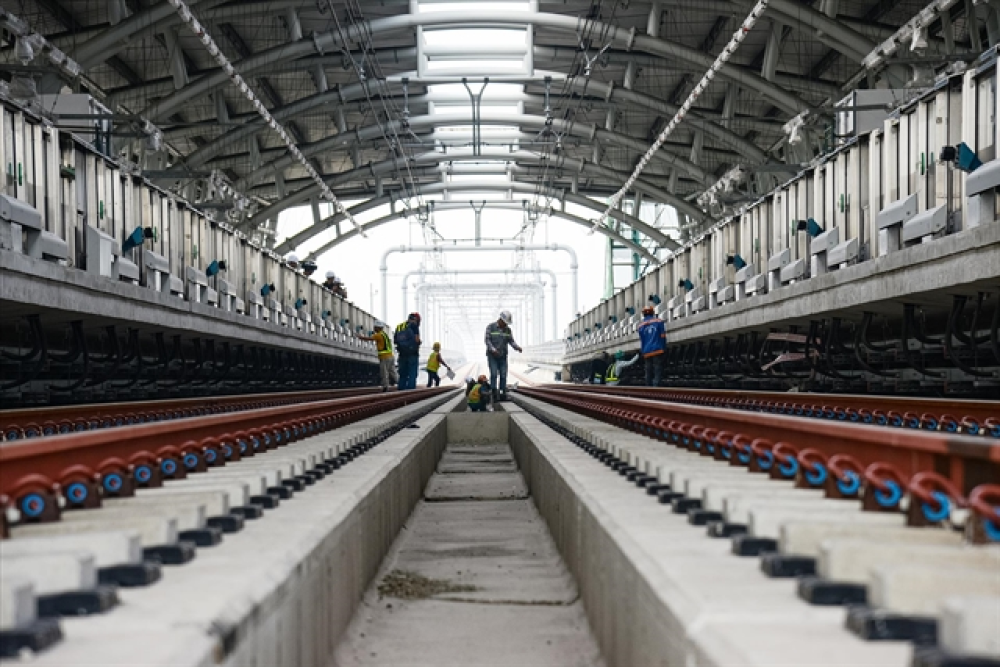
VIFC-HCMC has identified municipal and project bonds as foundational financial products, with potential applications including metro systems, ports, logistics infrastructure and energy projects. The issuance framework was still under consultation in September, and the first actual issuance has not yet been verified.

The rationale is partly about matching the maturity of funding with the life of an asset. Railways, ports, logistics networks and energy projects can take years to build before generating stable cash flows. Long-term bonds could therefore complement bank credit by connecting these projects with institutional investors able to hold assets over longer periods.
“The opportunity here is to create a broader financing system in which banks and capital markets can play complementary roles,” Rehman said.

"Long-term infrastructure benefits from long-term funding, and a deeper bond market can help connect projects with investors that are prepared to hold duration over many years."

But issuing bonds is not the same as building a functioning bond market. EBC identified pricing, liquidity, transparency and investor diversity as key requirements. Investors need sufficient information to assess issuers and projects, while secondary-market liquidity is needed to allow them to adjust their exposure.

International capital could further broaden the funding base, but would introduce additional currency risks.

For equity investors, the relatively high level of US Treasury yields creates an alternative source of returns against which emerging-market assets are assessed. For project bonds, meanwhile, borrowing in a foreign currency while generating most project revenues in đồng can expose issuers to exchange-rate movements.

The developments point to a broader capital-market structure in Việt Nam, with the FTSE upgrade widening access to international investors and municipal and project bonds opening new channels for long-term capital. The key test will be whether these channels can build sufficient liquidity, transparency and investor diversity to support sustained capital flows.

Source: BIZHUB/VNS

Latest Posts

Bank credit surge supports high GDP growth target: SBV

Bank credit surge supports high GDP growth target: SBV

As of the end of August 2026, credit proportion to agriculture, forestry, and fisheries accounted for 6.08 per cent; industry and construction accounted for 23.1 per cent; and trade and services accounted for 70.11 per cent.

HÀ NỘI — Total outstanding loans across the banking system hit nearly VNĐ20.75 quadrillion (US$786 billion) as of September 30 this year significantly supporting Việt Nam’s high GDP growth target, Deputy Governor of the State Bank of Vietnam (SBV) Phạm Thanh Hà said at a press conference on Thursday.

Speaking at the event to reveal the banking sector's performance in the first nine months of 2026 and outline steps for the remaining months of the year, Hà said that the credit increased by 11.59 per cent compared to the end of 2025 and 16.69 per cent year-on-year.

The results, he said, were due to effective measures taken by the SBV and commercial banks amid the difficulties in the global market.

“The SBV has implemented appropriate measures to help control inflation, stabilise the macro-economy, and support economic growth," Hà said.

"Notably, it has promptly directed credit institutions to implement credit solutions for specific sectors and industries, thereby facilitating access to credit for businesses and the public, especially large-scale and key projects.”

Nguyễn Xuân Bắc, deputy director of the SBV’s Credit Department, reported that bank credit structure in the first three quarters aligned with the economic sector structure.

“Credit capital continued to be channeled into production, business, and priority sectors," Bắc said.

"As of the end of August 2026, credit proportion to agriculture, forestry, and fisheries accounted for 6.08 per cent; industry and construction accounted for 23.1 per cent; and trade and services accounted for 70.11 per cent.”

“Priority sectors designated by the Government and the Prime Minister accounted for a significant share, such as agriculture and rural development at approximately 22 per cent; or sectors that gained high growth rates, such as exports with 33.32 per cent and high-tech enterprises with 39.62 per cent,” Bắc added.

Regarding interest rates, Hà said that the SBV continued to maintain benchmark interest rates, creating favourable conditions for credit institutions to access capital from the SBV at low costs, enabling them to support the economy.

The average interest rate for new deposits as of September 20 this year stood at 6.38 per cent per annum, an increase of 1.15 percentage points compared to the end of 2025.

Despite the rise, Hà noted that, the rising pace is slowing, and interest rate levels are essentially stabilising around a new baseline.

According to Phạm Chí Quang, director of the SBV’s Monetary Department, although the exchange rate and foreign exchange market have been under pressure from recent unpredictable global developments, the SBV managed the exchange rate flexibly, helping to absorb external shocks.

Effective coordination between monetary policy tools helped stabilise the foreign exchange market, contributing to macro-economic stability and inflation control. As a result, the foreign exchange market is operating smoothly, the legitimate foreign currency needs of the economy are being fully and promptly met, and the USD-VNĐ exchange rate is fluctuating flexibly, in accordance with market conditions, Quang said.

In the remaining months of the year, Hà said that the SBV will continue to flexibly manage monetary policy, closely coordinating with fiscal policy and other macro-economic measures to control inflation, contribute to macro-economic stability and support sustainable economic growth.

Interest rates will be managed in line with market developments, macro-economic conditions, inflation and monetary policy objectives. The central bank will also continue to closely monitor developments in deposit and lending interest rates for the market and for each credit institution.

"The SBV will continue to closely monitor international and domestic market developments," Hà added.

"It will manage exchange rates flexibly, in accordance with market conditions, and coordinate with other monetary policy tools to stabilise the foreign exchange market, contributing to macro-economic stability, controlling inflation and supporting economic growth."


Vietnam's securities accounts surpass 14.1 million

Vietnam's securities accounts surpass 14.1 million

Domestic individual investors overwhelming the market with around 14 million accounts.

The total number of securities trading accounts in Vietnam reached over 14.13 million as of September 30, 2026, an increase of 1.76% from the end of August, according to market data.

Domestic individual investors accounted for 244,505 of the new accounts, representing almost the entire monthly increase. By comparison, the number of domestic institutional accounts rose by just 180.

The figures show that the continued expansion of Vietnam’s investor base is being driven overwhelmingly by domestic retail investors rather than institutions. Nearly 245,000 accounts were added in September, with domestic accounts accounting for more than 99.8% of the increase.

By the end of September, domestic individual investors held around 14 million accounts, accounting for approximately 99.48% of all domestic investor accounts and continuing to represent the overwhelming majority of market participants, in terms of account numbers.

Foreign investors recorded a much smaller increase. Their total number of securities accounts rose by only 264 during September to 52,897.


​

German investment in Vietnam hits $3.7 bln as firms expand beyond manufacturing

German investment in Vietnam hits $3.7 bln as firms expand beyond manufacturing

German companies have invested an estimated $3.7 billion in Vietnam through 620 projects, creating at least 55,000 direct jobs, as businesses increasingly use the country for services, engineering and sourcing, as well as manufacturing, according to the latest report by the Delegation of German Industry and Commerce in Vietnam (AHK Vietnam).

The investments were made through subsidiaries in third countries and other international corporate structures where the ultimate owner is German, the Current Status of German Investments in Vietnam 2026/27 report said.

Manufacturing investment shifts toward faster market entry

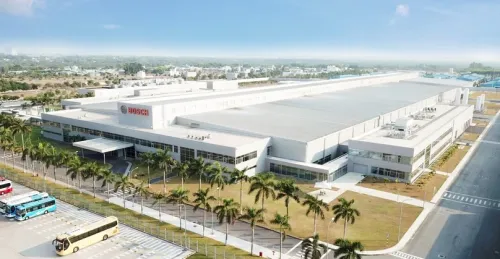
Manufacturing remains the largest segment in terms of capital intensity. The roughly 120 German manufacturers in Vietnam operate across industries including apparel, chemicals, machinery, automotive components, electronics, medical technology, and consumer goods.

The AHK assessment also points to changes in how German manufacturers establish operations. About 71% of reviewed manufacturers operate company-owned facilities in industrial parks, while around 27% use ready-built factories. Built-to-suit facilities remain relatively uncommon.

The growing use of ready-built factories reflects companies' preference for faster market entry and lower initial capital requirements.

Southern Vietnam accounts for about 58% of identified German manufacturing investments. Northern Vietnam represents around 25%, while central Vietnam accounts for about 16%.

Though manufacturing remains the most capital-intensive segment, sales and service operations account for the largest share of identified German business functions, with over 250 German companies.

German firms have also expanded their programming, technical consulting, engineering, and outsourcing operations. Software development, industrial engineering, automation, and digital services teams are active in HCMC, Hanoi, and Danang.

The shift suggests Vietnam is increasingly being viewed not only as a manufacturing base but also as a regional platform for customer support, engineering, and business services.

Southern Vietnam remains the main investment hub

The Greater Ho Chi Minh City region remains the leading destination for German companies, accounting for about 70% of the German business presence in Vietnam, the report shows.

The region contributes about 40% of Vietnam's national GDP and provides access to a population of around 21 million people. German companies are particularly concentrated within roughly 40 km of central Ho Chi Minh City. Established supplier networks, logistics infrastructure, industrial parks, and access to customers have helped maintain the region's appeal.

The Hanoi-Hai Phong corridor in the north is the second major destination for German investors. Its proximity to China, access to Hai Phong city's deep-sea port, and growing industrial infrastructure have supported investment in northern Vietnam.

Central Vietnam, particularly Danang city, is also attracting interest as companies look for lower-cost locations and new growth opportunities.

Supply chain diversification supports future investment

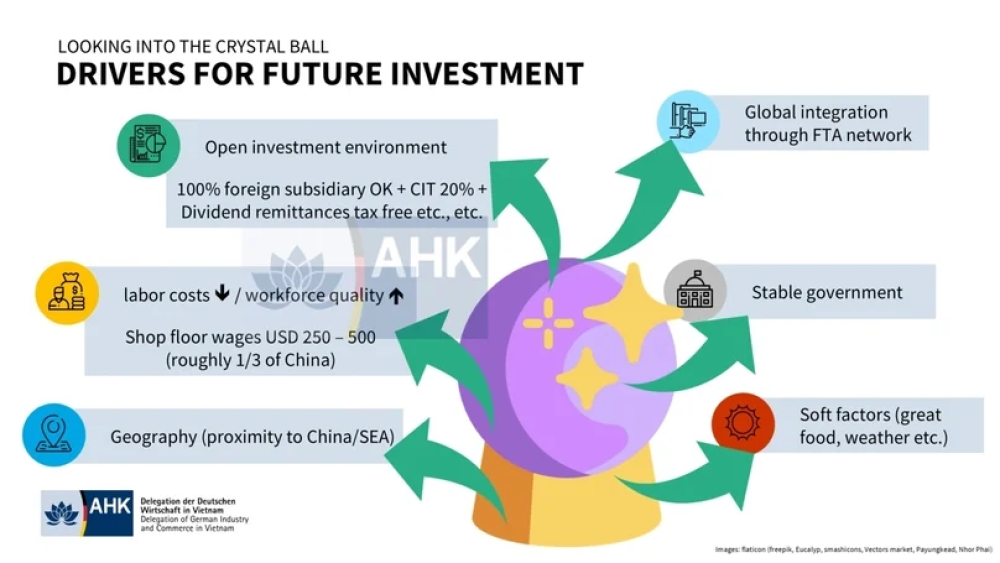
Several factors are expected to continue supporting German investment in Vietnam, including political stability, competitive labor costs, improving workforce quality, access to regional supply chains, and a more open investment framework, according to the report.

Supply chain diversification is another key driver, as many German companies are positioning Vietnam as an additional manufacturing and sourcing base rather than replacing operations in other markets. The country's network of free trade agreements and ongoing infrastructure development further support its role in regional supply chains.

The growing availability of engineering and technology talent could also encourage German companies to expand digital, technical, and outsourcing operations in Vietnam.

As a result, future German investment is likely to extend beyond traditional factories, with greater emphasis on engineering, technology, customer services, and regional business functions, the report noted.

See all blog