Benefits from e-commerce for furniture and fashion exporters
E-commerce has proven to be a boon for MSMEs in Vietnam’s furniture and fashion exports and the room for continued growth is substantial.
Vietnam’s rise as a global export powerhouse has been built on decades of manufacturing strength, deepening trade integration, and competitive production costs. From wooden furniture to apparel and footwear, the country has firmly established itself among the world’s leading exporters in key consumer goods sectors. But a new phase is now taking shape, one driven not by factories alone but by digital storefronts.
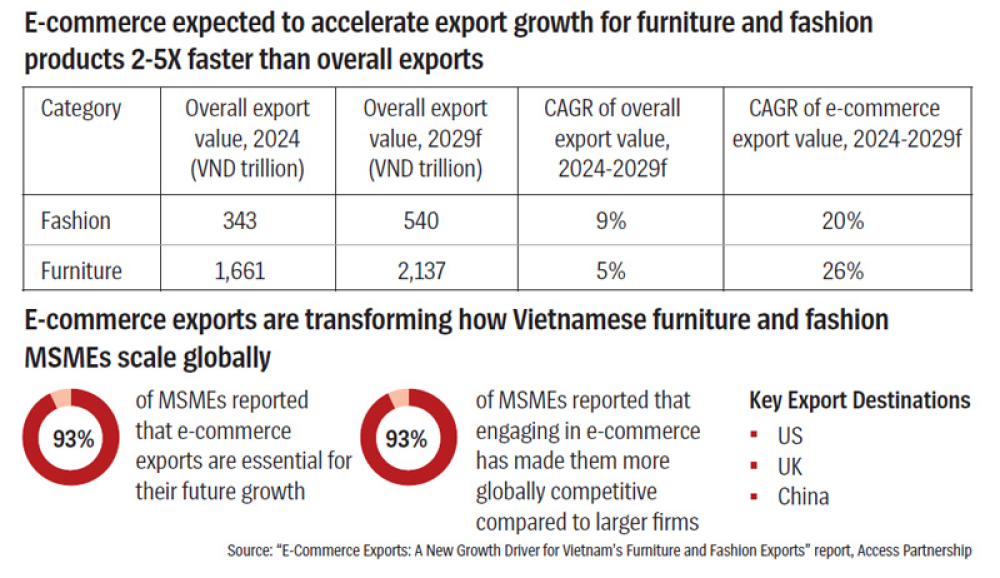
A recent report from Access Partnership, entitled “E-Commerce Exports: A New Growth Driver for Vietnam’s Furniture and Fashion Exports,” argues that e-commerce is rapidly emerging as a critical engine of export growth for Vietnam, particularly for micro, small, and medium-sized enterprises (MSMEs) in the furniture and fashion industries. The report stated that nearly all surveyed MSMEs, or around 97 per cent, view e-commerce exports as essential to their future growth.
MSMEs movement
The most striking finding in the report is the widening gap between traditional export growth and e-commerce-driven expansion. In furniture, overall exports are projected to grow at around 9 per cent annually between 2024 and 2029, while business-to-consumer (B2C) e-commerce exports are expected to grow at approximately 20 per cent a year. The divergence is even sharper in fashion, where overall exports are forecast to grow at about 5 per cent annually, while e-commerce exports could expand by roughly 26 per cent over the same period. In other words, e-commerce exports are growing two to five-times faster than traditional channels.
This shift reflects more than just changing consumer behavior. As the report noted, digital platforms enable exporters to reach global consumers directly, test new products with lower risk, and adapt quickly to shifting demand. For MSMEs in particular, these advantages are significant.
Historically, entering international markets required navigating complex distribution networks, securing overseas partners, and absorbing high upfront costs. E-commerce reduces many of these barriers, allowing companies to access foreign markets with far fewer intermediaries. The result is a structural change in how exports are generated; one that is especially beneficial to smaller firms.
MSMEs form the backbone of Vietnam’s economy, accounting for 97 per cent of all enterprises, more than 60 per cent of jobs, and roughly a quarter of total export value. In sectors such as furniture and fashion, they are deeply embedded in production networks and supply chains. E-commerce is now enabling these firms to move beyond their traditional roles.
According to the survey, 96 per cent of MSMEs reported that engaging in e-commerce has increased their global competitiveness relative to larger firms, while 98 per cent said their online presence has also driven offline sales. The findings suggest that digital channels are not only generating revenue directly but also strengthening brand visibility and customer loyalty across markets.
One of the most important shifts is the move from business-to-business (B2B) manufacturing toward direct-to-consumer (D2C) models. Instead of producing goods for foreign brands, Vietnamese firms are increasingly selling under their own names to overseas customers.
This transition allows MSMEs to capture more value, build brand identity, and respond more directly to consumer preferences. It also reduces reliance on intermediaries, giving firms greater control over pricing, product development, and market strategy.
The report highlighted that expanding overseas outreach is the primary motivation for adopting e-commerce. More than half of respondents cited the ability to engage directly with foreign customers in a wider range of destinations as key drivers.
In effect, e-commerce is leveling the playing field, enabling smaller Vietnamese firms to compete in global markets that were once dominated by larger, better-resourced players.
Aligning with global demand
The rapid growth of e-commerce exports is also being supported by shifts in global consumer demand, many of which align closely with Vietnam’s production capabilities. In furniture, demand is increasingly driven by sustainability and functionality. The report found that 57 per cent of surveyed MSMEs identified growing demand for eco-friendly products as a key driver of export growth, while 51 per cent pointed to rising interest in multi-functional and space-saving designs.
These trends play to Vietnam’s strengths. The country has developed expertise in modular, flat-pack furniture designs that are efficient to ship and adaptable to different markets. The adoption of certified timber and sustainable sourcing practices is also helping exporters meet stricter environmental standards abroad.
In fashion, similar dynamics are at play. Sustainability again emerges as the leading driver, cited by 55 per cent of firms, alongside growing interest in cultural and heritage-inspired designs. Vietnamese producers are responding by incorporating locally-sourced materials such as bamboo and organic cotton, as well as traditional weaving patterns from regions such as Sapa and Hue.
These trends are being amplified by e-commerce platforms, which allow firms to target niche consumer segments more effectively. Products that emphasize sustainability, craftsmanship, and cultural identity can be marketed directly to global audiences seeking differentiated offerings.
Geographically, Vietnamese MSMEs are focusing on large, mature markets with strong purchasing power and established e-commerce ecosystems. The US ranks as the top destination, followed by China, the UK, and Japan. These markets offer robust demand for consumer goods, reliable logistics infrastructure, and widespread adoption of digital payments.
Trade agreements, including the Regional Comprehensive Economic Partnership (RCEP) and Vietnam’s bilateral agreements with key partners, are also supporting this expansion by reducing tariffs and streamlining customs procedures.
Barriers a threat
Despite the strong growth outlook, the report emphasized that significant barriers continue to constrain MSMEs’ ability to scale e-commerce exports. The most pressing challenge is cost, particularly cross-border logistics. According to the survey, high logistics costs were cited by 94 per cent of furniture MSMEs and 86 per cent of fashion MSMEs as a major obstacle.
For furniture exporters, the issue is compounded by the bulky and fragile nature of their products, which drives up warehousing, storage, and packaging costs in overseas markets. For fashion firms, high shipping costs and the expense of handling returns - common in online apparel sales - are key concerns.
Regulatory complexity presents another major hurdle. More than 90 per cent of furniture MSMEs and 86 per cent of fashion MSMEs reported difficulties navigating complex and frequently-changing regulations in export destinations. These include product compliance standards, labeling requirements, and sustainability regulations, particularly in markets such as the EU and the US.
Knowledge gaps further compound these challenges. Many companies lack a clear understanding of consumer preferences in foreign markets, as well as the strategies needed to succeed in e-commerce environments. At the same time, rapid developments in digital marketing, analytics, and platform tools are widening the gap between more advanced and less experienced exporters.
Finally, capability constraints, such as shortages of skilled workers in logistics, digital operations, and regulatory compliance, limit companies’ ability to execute effectively. These gaps are particularly acute for MSMEs with limited resources and technical capacity.
Unlocking the next stage
While e-commerce offers a powerful pathway for expanding Vietnam’s exports, realizing its full potential will require targeted support, the report concluded. Policy measures identified include improving logistics infrastructure, providing training on product compliance and certification, and enhancing access to digital tools and e-commerce resources. Strengthening coordination between government and industry will also be critical in raising awareness about export opportunities and reducing administrative friction.
At a broader level, addressing regulatory complexity, both domestically and in export markets, will be essential to lowering barriers for MSMEs. Simplifying procedures, improving transparency, and supporting firms in navigating international requirements could significantly enhance participation in cross-border e-commerce.
Vietnam’s manufacturing base has already positioned the country as a leading exporter of furniture and fashion. The next phase of growth will depend on how effectively its businesses, especially MSMEs, can connect with global consumers through digital platforms. If the current momentum is sustained and key constraints are addressed, e-commerce could play a defining role in shaping Vietnam’s export trajectory in the years ahead.
Source: Linh Tong