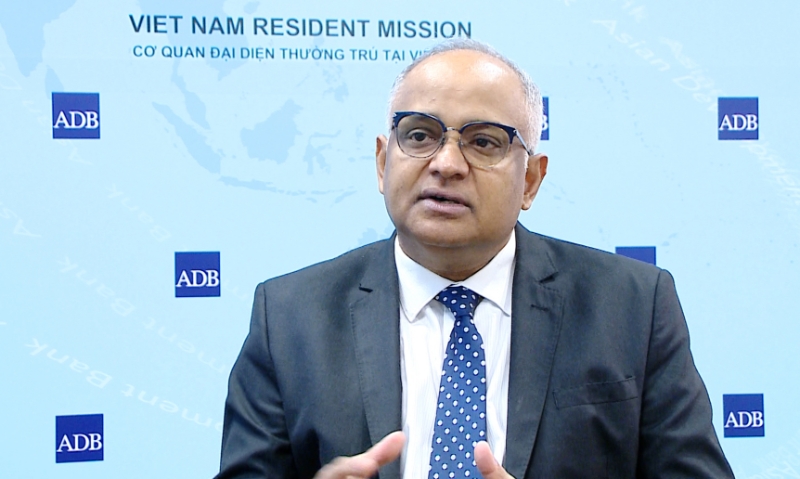
ADB's expert: Reforms on key sectors will help Vietnam sustain strong growth momentum
Mr. Shantanu Chakraborty, ADB Country Director for Vietnam, shared his insights on Vietnam’s growth outlook amid ongoing global economic uncertainties...
How do you assess Vietnam’s economic outlook for 2026 and 2027 compared to other countries in the region? In addition, as the country targets becoming a high-income economy by 2045, what key strengths should it leverage and which priority reforms will be most critical?
According to forecasts by the Asian Development Bank (ADB), Vietnam’s GDP growth is expected to reach around 7.2 per cent in 2026 and approximately 7 per cent in 2027. These are among the highest growth rates in Southeast Asia, clearly pointing to the economy’s resilience despite the overall challenges.
Vietnam’s performance is underpinned by strong economic fundamentals, a significant boost from public investment, and its export-oriented strategy, which continued to drive growth last year.
However, in order to sustain this high and resilient growth, the country needs to focus on raising productivity and improving production efficiency. It is also important to strengthen financial and capital markets to ensure investors have access to long-term capital.
Most importantly, as highlighted by recent crises, Vietnam must prioritize energy security and accelerate the transition toward green and clean, domestically sourced energy to reduce exposure to external shocks. Reforms in these three key areas will be crucial for Vietnam’s growth in the coming times.
How does ADB view Vietnam’s position in global and regional supply chains, and what policy priorities and investments are most important to help Vietnam move up the value chain, strengthen trade resilience, and safeguard macroeconomic stability over the next three to five years?
Vietnam is already well integrated into global value chains. Over the past decades, the country has built a strong manufacturing base, particularly in export-oriented industries, which has been a key factor in attracting foreign direct investment.
However, the level of value addition within Vietnam still needs improvement. The advantage of low labor costs is not a sustainable long-term strategy, as reflected in the relatively low domestic value added. Therefore, Vietnam needs to enhance its role in the supply chain by moving up the value chain and increasing value-added activities.
To achieve this, four key elements are essential.
First,a stronger business environment with greater transparency and ease of doing business is needed to attract high-quality investors.
Second,improved access to long-term capital requires deeper and more developed capital markets, both equity and debt, supported by appropriate regulatory reforms.
Third,the provision of high-quality infrastructure remains a key determinant in attracting continued investment into supply chains, despite significant progress through public investment and private sector participation.
Finally,the availability of skilled labor is critical, especially as Vietnam aims to advance in areas such as AI, fintech, and green growth, which demand advanced skill sets.
Focusing reforms on these four areas will enhance Vietnam’s ability to move up the value chain and strengthen its position in global supply chains.
How do you see Vietnam’s role in advancing green growth and energy transformation in Southeast Asia?
Vietnam plays a very important role in Southeast Asia and has been taking the right steps toward a more sustainable and green growth model. ADB’s Country Partnership Strategy (CPS) with Vietnam, formulated in 2023, also identifies green growth as a key pillar of its support, highlighting the country’s importance in the region’s transition.
Vietnam has set strong ambitions to achieve net-zero emissions by 2050 and has joined the Just Energy Transition Partnership (JETP), which is progressing with early signs of success as more projects become financially viable.
However, more actions need to be done to improve the bankability of these projects. While there is strong interest from private investors, the government, and state-owned enterprises in green investments, financial viability remains the key consideration for both development partners and private financiers.
From ADB’s perspective, we remain deeply committed to supporting Vietnam’s energy transition. We have announced $10 billion in support for the ASEAN Power Grid, a regional initiative aimed at expanding renewable energy and strengthening transmission and distribution networks across ASEAN. As an important member of ASEAN, Vietnam stands to benefit significantly from this initiative.
What are the biggest bottlenecks slowing Vietnam's energy transition amid global fuel supply disruptions and rising geopolitical tensions? And how can policy frameworks both accelerate progress toward net zero while keeping energy costs competitive for households and businesses?
Some of the key constraints Vietnam is facing relate to policy and regulatory uncertainties, as well as infrastructure and financing gaps.
For instance, much of the country’s renewable energy capacity is concentrated in southern Vietnam, which requires a robust transmission and distribution network to transport electricity to major demand centers in the north. This highlights the urgent need for high-quality transmission infrastructure to ensure efficient power flow across regions.
Another challenge is the relatively slow adoption of green technologies. While there was a surge of investment during the National Power Development Plan VII (PDP7), particularly in solar, wind, and floating solar projects, momentum has slowed somewhat in recent years. Revitalizing investment in clean energy generation is therefore essential to sustain the transition.
To accelerate progress toward green growth while maintaining affordability, Vietnam needs stronger planning frameworks and a more predictable regulatory environment. Greater mobilization of private investment will also be critical, given the scale of financing required. This ultimately depends on creating an enabling environment that ensures projects are bankable and attractive to private capital.
In addition, diversifying energy sources and improving efficiency will be key. Expanding into areas such as offshore wind and battery energy storage systems can complement existing renewable capacity and enhance grid reliability.
At the same time, improving energy efficiency across industries, buildings, and households offers a cost-effective pathway toward reducing emissions. In many cases, enhancing efficiency can be a more economical solution than investing in new energy generation capacity.
What institutional or regulatory barriers continue to constrain private sector participation, and which reforms would most effectively crowd in private investment alongside public investment in Vietnam?
Going forward, one of the key priorities is to strengthen project ownership and significantly improve the quality of project preparation. While many projects are being announced and developed, challenges remain in ensuring their bankability and applying best practices in risk sharing and structuring.
To attract more private capital, the focus should be on expediting project preparation and improving project readiness. In recent years, there has been a period where project implementation slowed, but with new leadership and increasingly ambitious growth targets, there is now a strong opportunity to accelerate progress.
In particular, the time lag between project conception and execution needs to be shortened. Ensuring that projects are well-prepared and “shovel-ready” at an earlier stage will be crucial for unlocking financing. The government’s efforts, supported by development partners like ADB, should therefore prioritize faster and higher-quality project preparation to facilitate greater private sector participation.
Looking ahead, what breakthrough reforms in public governance, the business environment, and human capital development are most critical to boosting productivity and improving the quality of growth?
2025 marked a significant shift in Vietnam’s reform agenda, particularly in improving the business enabling environment. Resolution No. 68-NQ/TW placed the private sector at the center of the country’s growth strategy, while Decree No.114/2021/ND-CP helped streamline ODA borrowing procedures.
These reforms have reduced the multiplicity of approvals, simplified previously fragmented processes, and improved the staged approach to project preparation. Besides, there has also been greater decentralization, with more authority delegated to the provincial level. As a result, many projects are now being initiated at the local level, making it essential to ensure that provinces are well equipped to prepare high-quality, bankable projects that can attract international financing.
At the same time, recent administrative restructuring, including the move toward a more streamlined two-tier system, is already having an impact on decision-making processes and could further improve implementation efficiency going forward.
In the coming times, in human resources, strengthening skills development is critical. Vietnam needs to significantly expand its capacity to train workers in high-value sectors such as AI, science and technology, biotechnology, and fintech.
Besides, the establishment of international financial centers is a step in the right direction, as it helps build an ecosystem capable of attracting long-term private capital.
Investors, particularly from the private sector, are more likely to engage where risk allocation is clear and aligned with international best practices. Vietnam can also benefit from learning from regional peers that have been more successful in structuring projects and allocating risks effectively.
Public-private partnerships (PPP) are another area with substantial untapped potential. While PPPs in energy, particularly independent power projects, have seen some success, momentum has slowed in recent years.
Expanding PPP models into other sectors such as ports, metro systems, roads, and airports will be essential to mobilizing private capital at scale. Targeted reforms to address bottlenecks in PPP frameworks, including risk-sharing mechanisms and project structuring, will therefore play a crucial role in supporting Vietnam’s long-term growth trajectory.
Source: Phuong Hoa
Photo: VGP